
Physicochemical Properties of Argan Oil from Planted Trees in Doukkala: Towards Perspectives of Domestication
Abstract
The argan tree (Argania spinosa L. Skeels) is endemic to southwestern Morocco. It holds significant socio-economic benefits through its fruits, particularly argan oil, which is highly sought after in the international market for its cosmetic and culinary properties. Its domestication will promote the sustainability of this species but also stimulate the local economy. Here, for the first time, we investigate the physicochemical properties of argan oil extracted from fruits of argan trees planted in the Doukkala region, which lies outside its endemic geographical range. The results demonstrate the successful domestication of the argan tree in this area, with the physicochemical properties of the oil being comparable to those from endemic trees in Essaouira. Both oils meet the quality standards of extra virgin oil, exhibiting similar values for acidity, peroxide index, and specific extinction. Fatty acid analysis, performed via gas chromatography (GC), revealed comparable profiles, predominantly featuring oleic and linoleic acids. This study highlights the success of the domestication of the argan tree in the Doukkala region, which will result in creating opportunities for economic and sustainable development in these areas.
Keywords:
Argania spinosa, Argan oil, Physicochemical properties, Fatty acid, Gas chromatographyIntroduction
The argan tree (Argania spinosa L. Skeels) is an endemic relic of the Tertiary era in southwestern Morocco, representing the only member of the Sapotaceae family found outside the intertropical zone. It plays a crucial socio-economic and ecological role. Argan oil extracted from its fruit is a vital source of income for local communities, particularly for women organized in cooperatives. Furthermore, the tree helps combat soil erosion, conserve biodiversity, and mitigate desertification.1
Since its designation as a UNESCO Biosphere Reserve in April 1998, the argan tree has gained international recognition for the nutritional, therapeutic, and cosmetic values of its oil.2 The growing demand for this oil has increased pressure on argan forests, as the fruits yield only about one liter of oil per 100 kg of fresh fruits, combined with deforestation, overgrazing, and climate change, has led to a significant reduction in forest area.3
To preserve this species, which is vital for sustainable development, Morocco has integrated “arganiculture” into its agricultural policies. This strategy focuses on rehabilitating and extending argan forests through plantation and conservation projects. Studies have shown that Argania spinosa is suitable for integration into various agroforestry systems, and its domestication serves as a powerful tool for effective socio-economic and environmental management.4 This study aims to evaluate the success of the domestication of the argan tree in the Doukkala region by analyzing and comparing the physicochemical properties of argan oil produced from trees cultivated in this area with those of oil from endemic trees in Essaouira. The parameters studied include density, acidity, peroxide index, and fatty acid profiles.
Experimental
General experimental procedures – All chemicals used in this study were of analytical grade and were purchased from Sigma: Hexane (C6H14, ≥ 99%), Dichloromethane (CH2Cl2, ≥ 99%), Methanol (CH3OH, ≥ 99%), Phenolphthalein, Sodium thiosulfate (Na2S2O3), Potassium iodide (KI, ≥ 99%), Chloroform (CHCl3, ≥ 99%), Ethanol (C2H5OH, ≥ 96%), Sodium hydroxide (NaOH), Phenolphthalein were used in accordance with standard protocols for the determination of acidity and peroxide value. Folin-Ciocalteu reagent was used for the determination of total phenols.
BF3 solution, H2SO4, and NaCl were used for the conversion of fatty acids to methyl esters (FAMEs). The fatty acid composition was determined by a gas chromatographic (GC) microanalytical system equipped with a flame ionization detector (FID) (Agilent 8890; Agilent Technologies, Santa Clara, CA, USA); fatty acid standards (C14:0, C15:0, C16:0, C16:1, C17:0, C18:0, C18:1, C18:2, C18:3, C20:0, C20:1) were employed for identification of lipid compounds.
Plant materials – The argan fruits were harvested in September 2023 from two distinct regions: trees planted since 2006 in Douar Rouahla, Sidi Abed Commune, in the Doukkala region, and endemic trees from the Essaouira region. The location and geographical and climatic characteristics of the two sites studied are shown in the Table 1. After harvesting, the fruits were sun-dried, then depulped and crushed. The kernels were subsequently dried in an oven at 40oC for 24 hours before being ground.

Location and geographical and climatic characteristics of the two sites studied
Extraction of argan oil – Argan oil was extracted using ultrasound. A sample of 10 g of kernel powder was mixed with 160 mL of hexane and subjected to an ultrasonic bath at 40 kHz for 35 minutes at room temperature. After extraction, the mixture was centrifuged at 5000 rpm for 5 minutes. The supernatant was filtered through filter paper and evaporated under vacuum at 45oC using a rotary evaporator. To remove any residual solvent, the sample was dried in an oven at 45oC until its weight stabilized. The recovered argan oil was stored in a tinted glass bottle at −20oC. All analyses were performed in triplicate.
Density – The density of argan oil was determined using the classical method of comparison with water.5 This method involves measuring the mass of a specific volume of oil and comparing it to the mass of the same volume of water. An empty Erlenmeyer flask was weighed, then filled with 1 mL of argan oil and weighed again. After emptying, cleaning, and drying the flask, it was filled with 1 mL of distilled water and weighed a final time.
Acidity – The acidity of argan oil was determined according to ISO 660.6 A sample of 1 g of oil was dissolved in 10 mL of ethanol with a few drops of phenolphthalein. The mixture was titrated with a sodium hydroxide solution (0.1 N) until a persistent pink coloration appeared, lasting at least 10 seconds. A control sample was prepared in parallel.
Peroxide value – The peroxide value of argan oil was measured following ISO 3960.6 A sample of 1 g of oil was dissolved in 12 mL of acetic acid and 8 mL of dichloromethane. After adding 1 mL of a saturated potassium iodide solution, the mixture was stirred and incubated in the dark for 5 minutes. Distilled water and a few drops of starch were added, and the solution was titrated with sodium thiosulfate (0.01 N) until the violet color disappeared.
Specific extinction coefficients (K232, K270, and ΔK) – The specific extinction coefficient of argan oil was measured according to ISO 3656.6 A sample of 0.1 g of oil was dissolved in 10 mL of hexane. After homogenization, the solution was transferred to a quartz cuvette, and absorbance was measured at wavelengths of 232 nm, 266 nm, 270 nm, and 274 nm, using hexane as a reference.
Chlorophyll and carotenoid content – A sample of 1.5 g of argan oil was dissolved in 5 mL of hexane. After homogenization, the absorbance was measured at 670 nm for chlorophylls and 470 nm for carotenoids, using hexane as the dilution solvent. The concentrations of chlorophylls and carotenoids were expressed in mg of pheophytin and mg of lutein per kg of oil, respectively.7
Dosage of phenolic compounds – For the extraction of phenolic compounds from argan oil, 2 g of oil were dissolved in 4 mL of hexane and 2 mL of Methanol (80%). After agitation, the sample was centrifuged at 3000 rpm for 30 minutes, and this process was repeated twice.7 The methalonic extracts were used to determine the total phenolic content, based on the reduction of the Folin-Ciocalteu reagent, which produces a blue color proportional to the amount of phenolic compounds present.8
Fatty acid composition of argan oil – The fatty acid composition was determined by a gas chromatographic (GC) microanalytical system equipped with a flame ionization detector (FID) (Agilent8890; Agilent Technologies, Santa Clara, CA, USA). In a Soviet tube, 10 mg of oil were mixed with 0.2 mL of hexane and 0.5 mL of BF3 solution. The mixture was heated at 70oC for 90 minutes, then cooled and treated with 0.5 mL of saturated NaCl and 0.2 mL of 10% H2SO4. After agitation, the mixture was diluted with 8 mL of hexane. A 0.5 µL sample of the hexane phase was injected into a DB-23 column (60 m × 0.15 mm; Agilent Technologies) for chromatographic analysis. The GC oven temperature was initially set at 50oC for 1 min, then raised to 175oC with an increase of 20oC/min and maintained for 0 min. The heat was raised continuously to 230oC with an increase of 1.3oC/min and maintained for 5 min. A constant helium flow rate was 1 mL/min. The analysis was performed using a 20:1 split ratio. Thirty-seven fatty acid standards with purities higher than 99.5% obtained from Sigma Aldrich were used for qualitative analysis with compared retention times, and the internal standard was used for quantitative analysis according to GB 5009.168-2016. All samples were analyzed in triplicate.9
Statistical analysis – Categorical variables were presented as percentages and mean ± standard deviation (SD). For the comparison of experimental data, the Student’s t-test for independent samples was used. All statistical analyses were performed using SPSS V26 software, with a significance level set at 5%.
Results and Discussion
The oil yield from argan kernels of trees grown in Doukkala was 39.06%, while that from trees in Essaouira was 40.45%. Both yields showed no significant difference and fell within Moroccan standards of 35% to 55%.10 These results are slightly higher than those reported by Dakich.10 In contrast, the yield obtained using the Soxhlet extraction method was higher (49.58%), as indicated by Mechqoq et al.,11 confirming that this technique is more effective than ultrasound extraction. However, while the ultrasound method produced a slightly lower yield, it offers notable advantages: it operates at room temperature and requires a shorter extraction time of just 35 minutes, which helps preserve thermosensitive compounds.12
The physicochemical characterization of argan oil is essential for evaluating its quality, authenticity, and suitability for various applications, including food and cosmetics. This analysis identifies key parameters such as density, acidity, peroxide index, and specific extinction, which provide insight into the oil’s chemical composition, stability, and purity. These characteristics are influenced by several factors, including the extraction method, storage conditions, and the geographic origin of the fruit.13 Quality standards set by organizations like the International Olive Council (IOC) and Moroccan national standards establish thresholds for these parameters to ensure compliance with international requirements (Table 2). These criteria help classify argan oil into quality categories, enhancing the credibility of products that meet the standards in local and international markets.
Quality criteria for virgin argan oil, according to the Moroccan standard 08.5.090 (2003)
For instance, the acidity level for cold-pressed oils must be below 2%, while the peroxide index and specific extinction values are critical indicators for assessing oxidation and freshness.14
The density of argan oil is a critical physical parameter that reflects its chemical composition, including the proportions of fatty acids and volatile compounds. The measured density values were 0.91 ± 0.006 g/mL and 0.94 ± 0.018 g/mL for argan oil from Doukkala (AOD) and Essaouira (AOE), respectively. This difference is not statistically significant. Both values fall within the acceptable density range established by quality standards, which is between 0.910 and 0.930 g/mL at 20oC.16 Thus, the oils from both regions exhibit a chemically comparable composition in terms of density. The free acidity level serves as an indicator of the degradation of triglycerides into free fatty acids, which is typically caused by improper storage or extraction conditions. A low acidity level is essential for ensuring oil quality, with standards requiring an acidity level below 2% for argan oils obtained through cold pressing.15 The values observed in our study—0.71 ± 0.2% for AOD and 0.57 ± 0.4% for AOE—are both below the regulatory threshold, confirming the freshness of both oils and the effectiveness of the extraction process.
The peroxide index measures the concentration of peroxides, which are primary markers of lipid oxidation. A low peroxide index indicates that the oil is stable and less oxidized. The standard requires a peroxide index value below 15 mEq O2/kg for high-quality argan oil.15 Our results indicate that both oils are highly stable and well-preserved, with values well below the maximum allowable limit. Specifically, AOD has a peroxide index of 3 ± 1 mEq O2/kg, while AOE shows a peroxide index of 2.77 ± 1.53 mEq O2/kg. The oxidation of fats leads to the formation of hydroperoxides, which absorb light near 232 nm. If oxidation continues, secondary oxidation products, particularly diketones and unsaturated ketones, are generated and absorb light around 270 nm. Absorbance measurements at 266 nm and 274 nm can indicate oils that have undergone a refining process, allowing for the determination of the variation in specific extinction (ΔK).16 The results of this analysis demonstrate that both oils comply with the established standards, showing no significant difference (Table 3). This suggests a similar purity level and a low degree of oxidative degradation. The values for density, acidity, and peroxide index indicate chemical stability and proper preservation, while the specific extinction values confirm the absence of alteration in unsaturated fatty acids. Therefore, both argan oils from both regions are classified in the extra virgin oil category according to the Moroccan standard (N.M. 08.5.090, 2003).17
Physicochemical properties of argan oil from Doukkala (AOD) and Essaouira (AOE)
The analysis in Fig. 1, revealed that the argan oil from Doukkala has a significantly lower chlorophyll content (0.53 ± 0.07 mg of pheophytin/kg) compared to that from Essaouira (0.95 ± 0.12 mg/kg). In contrast, while no significant difference in β-carotenoid content was observed the oil from Essaouira (0.51 ± 0.07 mg of lutein/kg) showed a slightly higher concentration than that from Doukkala (0.3 ± 0.08 mg/kg). This variation can be attributed to several agro-climatic and environmental factors. Sunlight exposure, soil composition, climate conditions specific to each region, and local agricultural practices all influence the synthesis of these pigments in the argan fruits. For instance, greater sunlight exposure or soils richer in key nutrients may promote the production of chlorophylls and carotenoids.18 Total polyphenol content (TPC) is an essential parameter for assessing the antioxidant properties and overall quality of argan oil. In fact, polyphenols contribute directly to the oil’s oxidative stability by delaying the formation of oxidation products, thus extending its shelf life. In addition, they confer antioxidant properties on the oil, which are beneficial to human health, notably by reducing oxidative stress and its effects on chronic diseases. The TPC in the argan oil from Doukkala (50 ± 0.003 mg GAE/kg) is significantly higher than that of the oil from Essaouira (20 ± 0.0004 mg GAE/kg) (Fig. 2). These values fall below those reported in the literature (100 mg GAE/kg),7 which may be attributed to geographical differences and the extraction methods. The observed differences in TPC highlight the specificity of each oil in terms of phenolic composition and antioxidant potential.
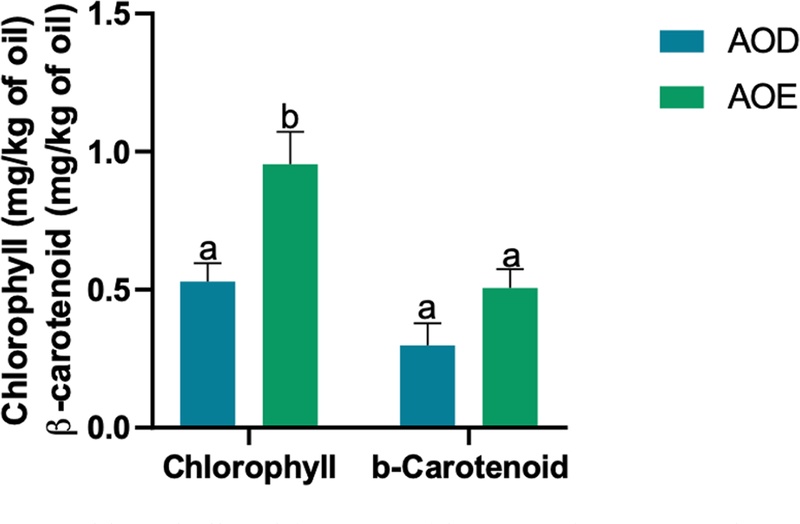
Chlorophyll and β-carotenoid content for AOD and AOE.Lettering (a,b) indicated the significant difference in the means (p < 0.05) using a one-way analysis of variance (ANOVA) and Student’s t-test.
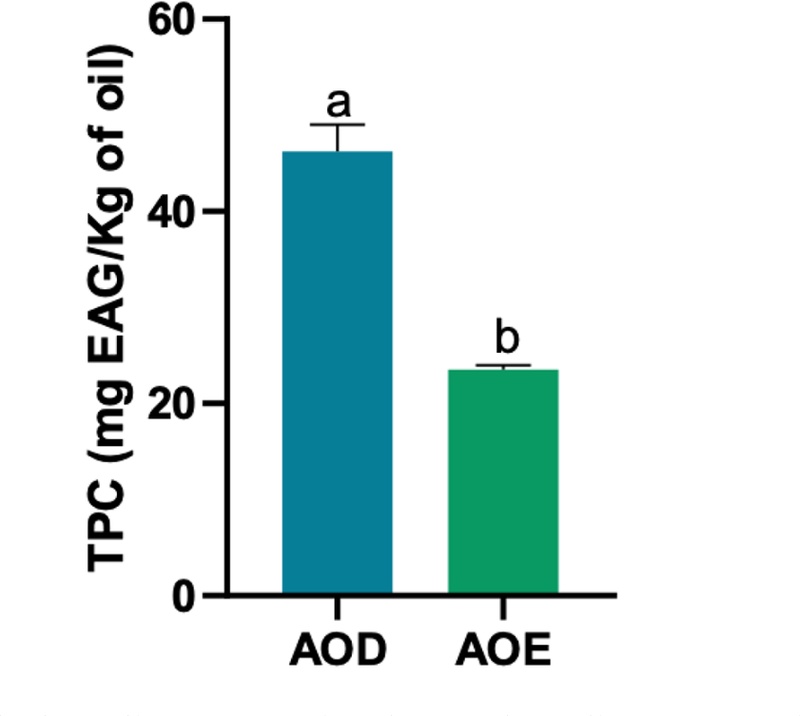
Total phenolic content for the methanolic extract of AOD and AOE.Lettering (a, b) indicated the significant difference in the means (p < 0.05) using a one-way analysis of variance (ANOVA) and Student’s t-test.
Factors such as the genetic traits of the trees, geographical location, and climatic and edaphic conditions can explain the variation between oils from the two regions.18 Despite the overall similarity in climatic conditions of the two regions, this difference may primarily be due to genetic diversity and soil composition. Genetic variations among the argan trees could influence their ability to synthesize and accumulate phenolic compounds. Additionally, differing soil composition in Doukkala and Essaouira may impact the availability of essential nutrients required for phenolic biosynthesis, warranting a comparative study of the mineral composition of soils from both regions for further confirmation.
The results of the fatty acid profile analysis of the two types of oil are shown in the Table 4. The argan oils from Doukkala and Essaouira exhibit similar major fatty acid profiles that conform to the Moroccan standard (N.M. 08.5.090)18 (Fig. 3 and 4). Oleic acid (C18:1) is the predominant fatty acid in both oils, making up approximately 46%, comparable to olive oil (43–49%), which is beneficial for cardiovascular health. Linoleic acid (C18:2), a polyunsaturated fatty acid, is also present in significant amounts, with values of 36.62% for AOD and 34.22% for AOE, slightly exceeding the typical range found in olive oil (29.3–36%) and offering anti-inflammatory benefits. Regarding saturated fatty acids, palmitic acid (C16:0) is the most prevalent comprising 12.33% for AOD and 13.03% for AOE, which falls within the normal olive oil range (11.5–15%). Stearic acid (C18:0) is present in moderate amounts, around 5% for both oils, which also align within the expected range for olive oil (4.3–7.2%) (Table 4). Compared to olive oil, argan oils share similar fatty acid profiles, characterized by high levels of monounsaturated (oleic acid C18:1) and polyunsaturated fatty acids (linoleic acid C18:2), with argan oil being slightly richer in linoleic acid. These characteristics underscore argan oil’s high nutritional quality, and health benefits. Our findings, in accordance with Moroccan standards,19 indicate that argan oil is richer in linoleic acid and lower in oleic acid compared to olive oil, highlighting its specific nutritional advantages. Notably, the argan oil from Doukkala demonstrates a higher oleic acid content (46.33%) compared to that of argan trees planted in the Casablanca region (42.66%).20
Comparison of fatty acid concentration (%) of argan oil from argan trees planted on Doukkala (AOD), Essaouira’s endemic trees (AOE) and olive oil
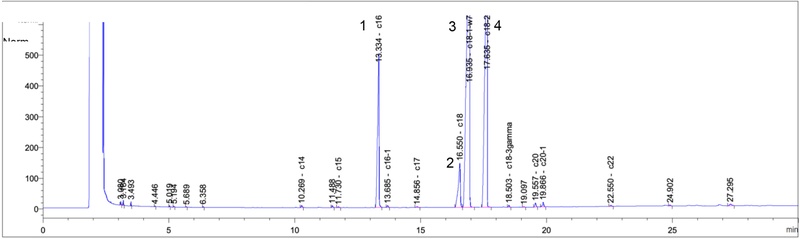
Chromatogram of fatty acids from Doukkala argan oil. 1: palmitic acid C16:0; 2: stearic acid C18:0; 3: oleic acid 18:1; 4: linoleic acid C18:2
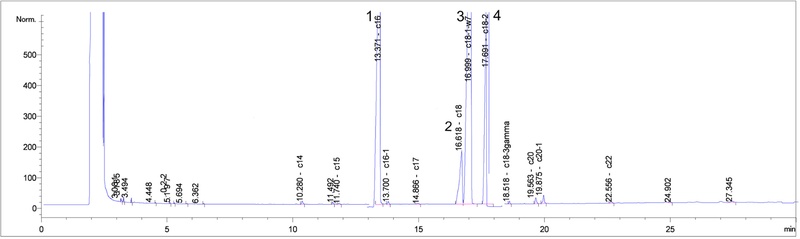
Chromatogram of fatty acids from Essaouira argan oil. 1: palmitic acid C16:0; 2: stearic acid C18:0; 3: oleic acid 18:1; 4: DElinoleic acid C18:2
In conclusion, this study demonstrates that argan oil produced from fruits of argan trees cultivated in the Doukkala region exhibits similar physicochemical characteristics to that derived from endemic trees in Essaouira. This confirms that the argan tree can be successfully grown outside its original geographic area. While the yields and fatty acid composition are comparable, variations in chlorophyll, polyphenol, and carotenoid levels highlight the influence of local environmental conditions. This study paves the way for the expansion of argan tree cultivation into new regions, facilitating production diversification to meet growing demand while offering ecological and socio-economic benefits. Such expansion could contribute to the preservation and valorization of the argan tree, which is vital for sustainable development. Looking ahead, further studies are needed to assess the impact of argan tree cultivation on local ecosystems and the long-term effects on oil quality based on agricultural practices and environmental conditions. Additionally, research on argan tree varieties adapted to other regions of Morocco and beyond would be valuable in maximizing the economic and ecological benefits of this iconic crop of the country.
Acknowledgments
We would like to thank Pr Ahmed. NAFIS for having contributed to the realization of the analysis of fatty acids at the laboratory of chemistry of natural molecules, of the university of liege in belgium.
Conflict of Interest
The authors declare that there is no conflict of interest.
References
-
Adlouni, A. Phytothrapie 2010, 8, 89–97.
[https://doi.org/10.1007/s10298-010-0538-9]

-
Alaoui, K. Phytothrapie 2009, 7, 150–156.
[https://doi.org/10.1007/s10298-009-0382-y]
- Charrouf, Z.; Guillaume, D. Eur. J. Lipid. Sci. Technol. 2009, 111, 631–636.
-
Chakhchar, A.; Ben Salah, I.; El Kharrassi, Y.; Filali-Maltouf, Y.; El Modafar, C.; Lamaoui, M. Front. Plant Sci. 2021, 12, 789615.
[https://doi.org/10.3389/fpls.2021.783615]
-
Diakit, K.; Diagouraga, S.; Diawara, M.; Fane, M. Int. J. Biol. Chem. Sci. 2022, 16, 1320–1330.
[https://doi.org/10.4314/ijbcs.v16i3.33]
-
Asbbane A.; Bousaid Z.; Guillaume D.; El Harkaoui S.; Matthäus B.; Charrouf Z.; Goh K. W.; Srasom N.; Bouayahya A.; Gharby S. Sci. Rep. 2024, 14, 23045.
[https://doi.org/10.1038/s41598-024-74466-6]
- Kechebar, M. S. A.; Karoune, S.; Falleh, H.; Belhamra, M.; Rahmoune, C.; Ksouri, R. Nutr. Santé 2017, 6, 82–96.
-
Oubannin, S.; Asbbane, A.; Hallouch, O.; Giuffrè, A. M.; Sakar, E. H.; Gharby, S. Future Foods 2024, 10, 100430.
[https://doi.org/10.1016/j.fufo.2024.100430]
-
Chávarri, F.; Virto, M.; Martin, C.; Nájera, A. I.; Santisteban, A.; Barrón, L. J. R.; de Renobales, M. J. Dairy Res. 1997, 64, 445–452.
[https://doi.org/10.1017/S0022029997002197]
-
Charrouf, Z.; Guillaume, D. Sustainability 2009, 1, 1012–1022.
[https://doi.org/10.3390/su1041012]
-
Mechqoq, H.; El Yaagoubi, M.; Momchilov, S.; Msanda, F.; El Aouad, N. Grain Oil Sci. Technol. 2021, 4, 125–130.
[https://doi.org/10.1016/j.gaost.2021.08.002]
-
Chemat, F.; Huma, Z.; Kamran Khan, M. Ultrason. Sonochem. 2011, 18, 813–835.
[https://doi.org/10.1016/j.ultsonch.2010.11.023]
-
Hilali, M.; Charrouf, Z.; Soulhi, A. E. A.; Hachimi, L.; Guillaume, D. J. Agric. Food Chem. 2005, 53, 2081–2087.
[https://doi.org/10.1021/jf040290t]
-
Boulfane, S.; Maata, N.; Anouar, A.; Hilali, S. J. App. Biosci. 2015, 87, 8022–8029.
[https://doi.org/10.4314/jab.v87i1.5]
- Gharby, S.; Harhar, H.; Kartah, B.; Guillaume, D.; Chafchaouni-Moussaoui, I.; Bouzoubaa, Z.; Charrouf, Z. J. Cosmet. Sci. 2014, 65, 81–87.
-
Manai-Djebali, H.; Trabelsi, N.; Medfai, W.; Hessini, K.; Mohamed S. N.; Madrigal-Martinez, M.; Canas, M. A. M.; Sanchez-Casas, J.; Youssef, N. B.; Oueslati I. J. Pol. J. Food Nutr. Sci. 2023, 73, 354–366.
[https://doi.org/10.31883/pjfns/174488]
-
Demnati, D.; Pacheco, R.; Martínez, L.; Sánchez, S. J. Food. Sci. Technol. 2020, 57, 840–847.
[https://doi.org/10.1007/s13197-019-04115-8]
-
Hilali, M.; Charrouf, Z.; Soulhi, A. E. A.; Hachimi, L.; Guillaume, D. J. Agric. Food Chem. 2005, 53, 2081–2087.
[https://doi.org/10.1021/jf040290t]
- Rahmani, M. Cah. Agric. 2005, 14, 461–465.
-
Sabri, C.; Tazi, B.; Maata, N.; Rahim, S.; Taki, H.; Bennamara, A.; Saad, L.; Derouich, A. Forests 2023, 14, 180.
[https://doi.org/10.3390/f14020180]