
Simultaneous Determination of Seven Compounds Isolated from Euonymus alatus by HPLC-DAD
Abstract
Euonymus alatus has traditionally been utilized for its wide-ranging medicinal benefits, such as supporting cardiovascular health by preventing atherosclerosis, relieving menstrual pain, promoting blood circulation, easing pain, and dissipating blood stasis. In this research, a high-performance liquid chromatography (HPLC) technique was established to simultaneously quantify seven bioactive constituents, moretenone, moretenol, friedelanol, lupenone, β-sitosterol, betulin, and glycerol 1-tetracosanoate, isolated from E. alatus. The method underwent comprehensive validation, demonstrating strong linearity, precision, and accuracy. All analytes showed excellent linear correlation, with R² values exceeding 0.9990. The method also showed high repeatability and reproducibility, with intra-day and inter-day relative standard deviations (RSDs) ranging from 0.12% to 0.99% and 0.12% to 1.00%, respectively. Recovery tests confirmed the method's accuracy, yielding recoveries between 97.24% and 109.55%. These findings suggest that the developed HPLC method is robust and dependable, making it a valuable tool for the quality control and standardization of E. alatus preparations containing these key compounds.
Keywords:
Euonymus alatus, HPLC, Validation, Quality controlIntroduction
Euonymus alatus (Thunb.) Siebold (E. alatus), commonly known as winged euonymus, has long been employed in traditional Korean medicine for its broad spectrum of pharmacological activities. Traditionally, it has been prescribed to prevent the development and progression of atherosclerosis, a benefit that is likely attributed to its reported effects on lipid metabolism and vascular function.1 In addition, E. alatus has been investigated for its potential application in cancer therapy, as emerging evidence suggests that its extracts may exert antiproliferative and pro-apoptotic effects across a range of cancer cell lines.2 In traditional gynecological practice, E. alatus has been utilized to relieve dysmenorrhea by regulating uterine activity and alleviating pelvic congestion. Its reputed effects on promoting blood circulation and reducing pain are likely associated with its anti-inflammatory and vasodilatory mechanisms.3 It has traditionally been employed to resolve blood stasis, a principle in East Asian medicine associated with disrupted blood flow or coagulation, which in turn is believed to enhance tissue perfusion and support recovery.4 E. alatus harbors a diverse array of pharmacologically active constituents, notably flavonoids and alkaloids. Key flavonoid components such as quercetin, kaempferol, and rutin have been identified, all of which exhibit strong antioxidant, anti-inflammatory, and cardioprotective properties.5,6 Additionally, various alkaloids including alatamine, eunymine, and evorine have been isolated from the plant and are believed to underlie several of its bioactivities, particularly those related to anticancer and analgesic effects. These phytochemicals are considered to be central to the medicinal properties ascribed to E. alatus in traditional therapeutic practices.7,8 In recent years, the use of herbal products as both food and medicine has significantly increased. Many natural compounds exhibit enhanced therapeutic efficacy through synergistic interactions. However, the presence of multiple active constituents in herbal formulations poses challenges for consistent quality control. Moreover, the concentration of bioactive compounds in medicinal plants can vary depending on geographical origin, climate, cultivation conditions, and other environmental factors. Therefore, establishing robust and standardized methods for the quantitative analysis of these compounds is essential for ensuring the safety, efficacy, and reproducibility of herbal products. In response to this need, numerous researchers have focused on developing reliable quality control strategies. Among these, high-performance liquid chromatography (HPLC) has emerged as a widely used, simple, and accurate method for the quantitative analysis of a broad range of medicinal herbs.9–11
In our previous study, we demonstrated that the 80% methanol (MeOH) extract of E. alatus exhibited significant neuroprotective effects against glutamate-induced cytotoxicity in HT-22 mouse hippocampal neuronal cells. We have isolated and identified seven compounds from E. alatus extract. Furthermore, betulin, one of the major bioactive constituents isolated from E. alatus, also showed pronounced neuroprotective activity in the same glutamate-induced neurotoxicity model. These findings suggest that both the crude extract and its active compound, betulin, may contribute to the neuroprotective potential of E. alatus through mechanisms that mitigate glutamate-mediated excitotoxicity.12,13
In the present study, we developed and validated a simultaneous analytical method for the qualitative and quantitative determination of seven bioactive compounds isolated from E. alatus. These compounds include moretenone, moretenol, friedelanol, lupeone, β-sitosterol, betulin, and glycerol 1-tetracosanoate. The established method enables efficient and reliable analysis of these constituents, providing a valuable tool for the standardization and quality control of E. alatus extracts.
Experimental
Plant materials and analysis reagents – The dried herbs of E. alatus were purchased from the Kyungdong Traditional Herbal Market in Seoul, Korea. A voucher specimen (No. CJ090M) has been authenticated and deposited in the Natural Product Laboratory of Kangwon National University, located in Chuncheon, Korea. HPLC-grade solvents, including methanol and water, were obtained from J.T. Baker (USA). Trifluoroacetic acid (TFA) was purchased from DAE JUNG Chemicals (Korea).
HPLC analysis – Seven compounds were analyzed using a HPLC system (Dionex UltiMate 3000, Thermo Fisher Scientific, Germany). The system was equipped with a quaternary pump (LPG-3X00), an autosampler (ACC-3000), a column compartment (TCC-3000SD), and a diode array UV/VIS detector (DAD-3000(RS)). Chromatographic separation was carried out on a SHISEIDO C18 column (S-5 μm, 4.6 mm I.D. × 250 mm), with the column temperature maintained at ambient room temperature. The mobile phase consisted of water (solvent A) and methanol (solvent B), delivered at a flow rate of 1.0 mL/min. The injection volume was 50 μL. The gradient elution program was as follows: 0–5 min, 20% B; 5–20 min, linear gradient from 20% to 100% B; 20–45 min, 100% B; and 45–50 min, re-equilibration at 20% B. The diode array detector was set to monitor at multiple wavelengths: 205, 254, 280, and 330 nm, to ensure optimal detection of the target compounds.
Preparation of standard and sample solutions – Each compound was dissolved in methanol to prepare individual stock solutions at a concentration of 800 μg/mL, including moretenone (1), moretenol (2), epifriedelanol (3), lupenone (4), β-sitosterol (5), betulin (6), and glycerol 1-tetracosanoate (7) (Fig. 1). The stock solutions were appropriately diluted with methanol to obtain working standard solutions, which were used for the construction of calibration curves and method validation. Both stock and working solutions were stored at 4℃ prior to HPLC analysis. Dried E. alatus samples were extracted using ultrasonic-assisted extraction with 80% methanol. The resulting extracts were concentrated under reduced pressure at 40°C using a rotary vacuum evaporator, and the concentrated residues were subsequently freeze-dried. Prior to HPLC analysis, all solutions were filtered through a 0.45 μm membrane filter to remove particulates.
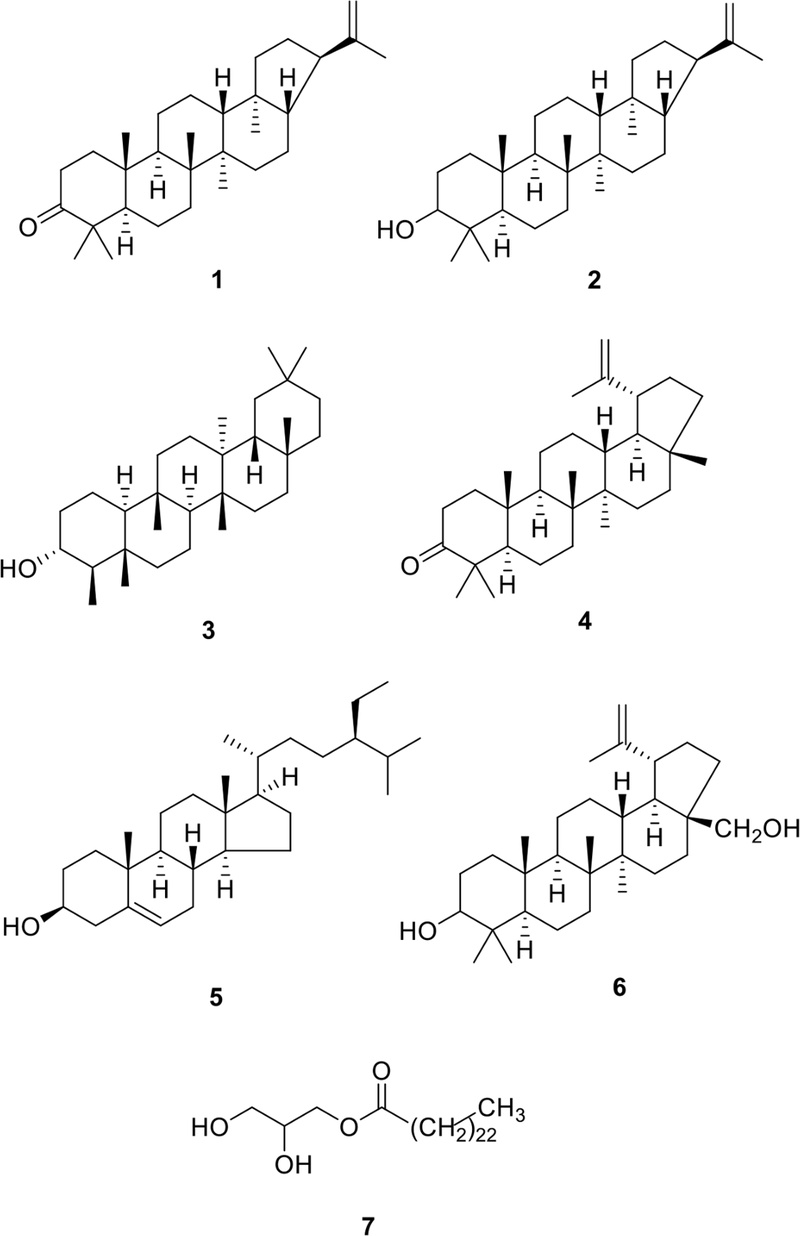
Chemical structures of compounds 1–7 isolated from E. alatus.
Validation of the HPLC method – The reproducibility and analytical reliability of the developed HPLC method were rigorously validated according to the International Council for Harmonisation (ICH) guidelines for analytical procedures. The validation process included the assessment of linearity, limit of detection (LOD), limit of quantitation (LOQ), precision (intra- and inter-day), and accuracy. To evaluate linearity, calibration curves were constructed by serial dilution of the stock solutions of each standard compound in chloroform to yield at least five concentration levels spanning the expected working range. Each concentration level was analyzed in triplicate. The peak area versus concentration data were subjected to linear regression analysis, and the correlation coefficient (R²) was calculated to assess the goodness-of-fit. An R² value of ≥ 0.999 was considered indicative of excellent linearity. The limit of detection (LOD) and limit of quantitation (LOQ) were determined based on signal-to-noise (S/N) ratios, with LOD defined as the concentration producing an S/N ratio of approximately 3.3 and LOQ as the concentration corresponding to an S/N ratio of approximately 10. These values were obtained by analyzing serially diluted standard solutions and measuring the response at the lowest detectable concentration. Precision of the method was assessed through both intra-day (repeatability) and inter-day (intermediate precision) tests. Intra-day precision was evaluated by analyzing replicate (n = 3 or more) injections of quality control samples at three concentration levels within a single day, whereas inter-day precision involved repeating the analysis on three separate days. Results were expressed as relative standard deviation (RSD, %) of the measured concentrations. An RSD value less than 2% was considered acceptable, demonstrating good precision. Accuracy of the method was determined through recovery studies by performing spike recovery experiments. Known amounts of each target analyte were added (spiked) into the sample matrix at low, medium, and high concentration levels, and the resulting mixtures were analyzed using the established HPLC method. The percent recovery was calculated using the following formula: Spike Recovery (%) = [(Detected amount – Original amount) / Spiked amount] × 100. Recoveries within the range of 95–105% with RSD less than 2% were considered indicative of acceptable accuracy and absence of significant matrix effects. Collectively, the results of these validation parameters confirm that the developed HPLC method is robust, precise, accurate, and suitable for the simultaneous quantitative analysis of the selected marker compounds in E. alatus extracts.
Sample analysis using established method – To verify the applicability of the optimized simultaneous quantification method, a full analysis of the E. alatus extract was conducted. Quantitative evaluation was performed using the standard calibration curves for the seven marker compounds. All target analytes were clearly identified in the chromatographic profile, with each peak showing sufficient resolution and no interference from adjacent compounds. This confirmed the method’s capability to distinctly separate and quantify all components within the complex plant matrix.
Statistical analysis – All experiments were performed in triplicate, and results were expressed as mean ± standard deviation (S.D.). Statistical significance was evaluated using one-way ANOVA followed by Tukey’s post hoc test, with significance set at p < 0.05, p < 0.01, and p < 0.001. For cell-based assays, data were normalized to the control group, which was defined as 100%, to allow for relative comparison.
Results and Discussion
To optimize the analytical conditions, various wave-lengths and mobile phase compositions were systematically tested. The mobile phase consisted of water (A) and methanol (B) in different ratios. A gradient elution program was optimized to achieve efficient separation of the target compounds. The mobile phase consisted of water (A) and methanol (B), delivered at a constant flow rate of 1.0 mL/min. The injection volume for each sample was set at 50 μL. The gradient elution program was as follows: 0–5 minutes, 20% B; 5–20 minutes, linear gradient from 20% to 100% B; 20–45 minutes, maintained at 100% B; and 45–50 minutes, returned to 20% B for re-equilibration. Under these conditions, seven analytes were successfully resolved within a total run time of 50 minutes. The maximum absorption wavelengths were set at 205 nm for six compounds and 254 nm for one compound, based on their individual UV absorbance profiles. Peak identification was performed by comparing the retention times and UV spectra of each analyte with those of the corresponding reference standards in the HPLC chromatograms (Fig. 2).
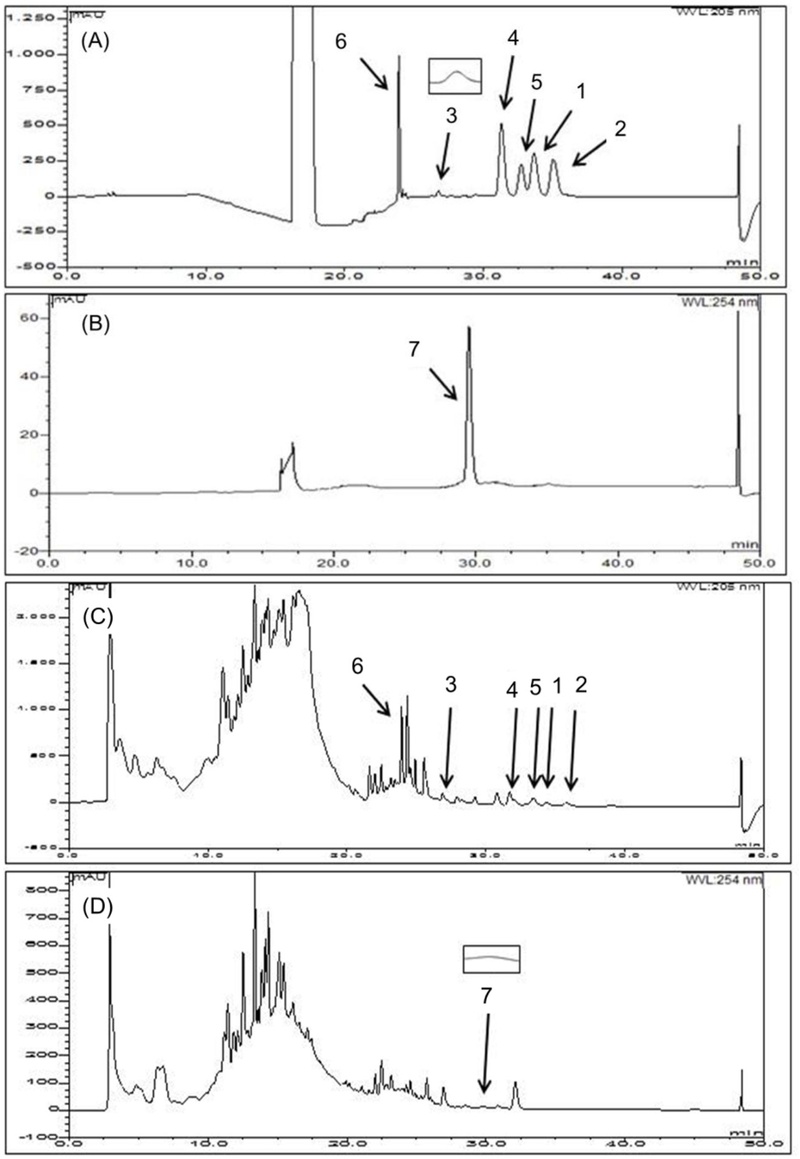
The HPLC chromatogram of standard mixture at the 205 nm of UV wavelength (A), standard mixture at the 254 nm of UV wavelength (B), extract of E. alatus at the 205 nm (C) and extract of E. alatus at the 254 nm (D). Standard mixtures were composed of moretenone (1), moretenol (2), friedelanol (3), lupenone (4), β-sitosterol (5), betulin (6) and glycerol 1-tetracosanoate (7), respectively.
Calibration curves for each of the seven compounds were generated by plotting the peak area (Y) against the corresponding concentrations (X, µg/mL). The resulting curves exhibited excellent linearity, with correlation coefficients (R²) exceeding 0.9990 across the tested concentration ranges. The limits of detection (LOD) and limits of quantitation (LOQ) for the analytes were determined to be as low as 0.1 µg/mL and up to 2.56 µg/mL, respectively (Table 1). These findings demonstrate the high sensitivity and reliability of the developed HPLC-DAD method for the simultaneous quantification of multiple components in E. alatus extract.

The regression data, LOD and LOQs four isolated compounds analyzed by HPLC-DAD
The precision of the developed HPLC analytical method was assessed through both intra-day and inter-day variability tests. Precision was evaluated by calculating the relative standard deviation (RSD, %) of replicate measurements. The intra-day RSD values ranged from 0.12% to 0.99%, while inter-day RSD values ranged from 0.12% to 1.00%, indicating excellent repeatability and intermediate precision (Table 2).
Intra- and inter-day precision data of seven compounds
Accuracy of the analysis method was also determined by analyzing spiked samples over multiple days. The intra-day accuracy ranged from 97.29% to 103.37%, and the inter-day accuracy ranged from 94.76% to 104.37%, demonstrating that the method provides reliable and consistent results over time. Additionally, a recovery test was performed to further validate the accuracy of the method. The percent recovery of the target compounds ranged from 97.24% to 109.55%, confirming the method’s suitability for quantitative analysis in complex sample matrices (Table 3). The validation outcomes clearly demonstrate that the analytical method delivers robust reproducibility and dependable precision. Recovery values for all tested compounds fell within the acceptable analytical range, and the consistently low RSD values further support the method’s reliability. Taken together, these findings validate the method’s accuracy and confirm its applicability for the precise quantification of constituents in E. alatus extracts.
Recovery of the seven compounds from E. alatus
Quantitative analysis of the E. alatus extract was performed using the validated HPLC method, applying calibration curves established for each of the seven marker compounds. As presented in Table 4, all target compounds were clearly detected and quantified, with notable variations in their concentrations. Moretenone (1), moretenol (2), epifriedelanol (3), lupenone (4), β-sitosterol (5), betulin (6), and glycerol 1-tetracosanoate (7) were measured in amounts of 1.46 mg/mg, 1.94 mg/mg, 23.43 mg/mg, 2.21 mg/mg, 5.79 mg/mg, 15.40 mg/mg and 0.26 mg/mg, respectively. The analytical procedure enabled complete resolution of all compounds within a 50-minute runtime, without any signs of peak overlap or matrix interference. These findings further support the robustness and applicability of the developed HPLC-DAD method for accurate and selective quantification of bioactive constituents in E. alatus extracts.
Contents of seven compounds in E. alatus
In conclusion, this study presents the development of a HPLC method designed for the simultaneous quantification of seven bioactive compounds such as moretenone, moretenol, friedelanol, lupenone, β-sitosterol, betulin, and glycerol 1-tetracosanoate, isolated from E. alatus. The method was thoroughly validated, demonstrating robust linearity, high precision, and reliable recovery rates across all analytes. Furthermore, the approach proved to be both sensitive and reproducible, making it a suitable tool for the concurrent determination of these compounds in the E. alatus extract. Ultimately, the findings of this study highlight the potential of this HPLC method as a valuable technique for the quality control and pharmacological evaluation of E. alatus as a medicinal plant.
Acknowledgments
This research was supported by Korea Basice Science Institute (National research Facilities and Equipment Center) grant funded by the Ministry of Education (grant No. 2022R1A6C101A739).
Conflicts of Interest
The authors have declared that there are no conflicts of interest.
References
-
Zhai, X.; Lenon, G. B.; Xue, C. C.; Li, C.-G. Evid. Based Complement. Alternat. Med. 2016, 2016, 9425714.
[https://doi.org/10.1155/2016/9425714]

-
Lee, T.-K.; Kim, D.-I.; Han, J.-Y.; Kim, C.-H. Immunopharmacol. Immunotoxicol. 2004, 26, 315–327.
[https://doi.org/10.1081/IPH-200026840]
-
Cha, B.-Y.; Park, C.-J.; Lee, D.-G.; Lee, Y.-C.; Kim, D.-W.; Kim, J.-D.; Seo, W.-G.; Kim, C.-H. J. Ethnopharmacol. 2003, 85, 163–167.
[https://doi.org/10.1016/S0378-8741(02)00373-2]
-
Lee, H.; Kim, H. K.; Ha, T. Y. Korean J. Immunol. 1993, 15, 243–253.
[https://doi.org/10.3802/kjgoc.1993.4.3.15]
-
Fan, L.; Zhang, C.; Ai, L.; Wang, L.; Li, L.; Fan, W.; Li, R.; He, L.; Wu, C.; Huang, Y. J. Ethnopharmacol. 2020, 259, 112942.
[https://doi.org/10.1016/j.jep.2020.112942]
-
Middleton, E. Jr.; Kandaswami, C. Biochem. Pharmacol. 1992, 43, 1167–1179.
[https://doi.org/10.1016/0006-2952(92)90489-6]
-
Kitanaka, S.; Takido, M.; Mizoue, K.; Nakaike, S. Chem. Pharm. Bull. 1996, 44, 615–617.
[https://doi.org/10.1248/cpb.44.615]
- Kim, C. H. Korean J. Orin. Gynecol. 2003, 8, 28–36.
-
Wei, H.; Sun, L.; Tai, Z.; Gao, S.; Xu, W.; Chen, W. Anal. Chim. Acta 2010, 662, 97–104.
[https://doi.org/10.1016/j.aca.2009.12.039]
-
Olszewska, M. J. Pharm. Biomed. Anal. 2008, 48, 629–635.
[https://doi.org/10.1016/j.jpba.2008.06.004]
-
Molnár-Perl, I.; Füzfai, Zs. J. Chromatogr. A 2005, 1073, 201–227.
[https://doi.org/10.1016/j.chroma.2004.10.068]
-
Jung, Y. S.; Ma, C. J. Nat. Prod. Sci. 2025, 31, 49–54.
[https://doi.org/10.20307/nps.2025.31.1.49]
-
Jung, Y. S.; Lee, H. W.; Ma, C. J. Pharmacog. Mag. 2020, 16, S308–S314.
[https://doi.org/10.4103/pm.pm_450_19]