
Photochemical Transformation of Emodin in Alcohols: Access to Physcion and (–)-Biemodin and their Bioactivity Profiles
Abstract
Emodin, a natural anthraquinone possessing anticancer, anti-inflammatory, antioxidant, and antiviral activities, has recently garnered interest as a photosensitizer for photodynamic therapy (PDT). In this study, we investigated its solvent-dependent photochemical reactivity under UV–visible irradiation (320–800 nm) to access structurally diverse derivatives. Photoirradiation in methanol afforded physcion (1), a C-6 methoxylated analogue formed via phenoxyl radical-mediated O-methylation, whereas prolonged irradiation in ethanol yielded (–)-biemodin (2), a symmetric C-7–linked dimer. Structures were elucidated by 1H-NMR, HR-ESI-MS, and electronic circular dichroism (ECD) spectroscopy analysis. Biological activities were assessed in three assays including cytotoxicity, DPPH radical scavenging, and indoleamine 2,3-dioxygenase (IDO) inhibition. Notably, only emodin itself showed moderate cytotoxicity at 50 μM; neither physcion (1) nor (–)-biemodin (2) displayed significant activity in any assay. These findings illustrate that photochemical modification of emodin enhances structural diversity but does not necessarily improve biological efficacy. Moreover, the pronounced photoreactivity of emodin highlights the importance of light-protected storage to prevent unintended degradation or structural alteration.
Keywords:
Emodin, Photochemical reactions, Physcion, (–)-Biemodin, CytotoxicityIntroduction
Photochemical reactions have emerged as a powerful and sustainable strategy in modern synthetic chemistry. By harnessing light, an abundant and renewable energy source, they enable transformations under mild conditions, avoiding the need for harsh reagents or high temperatures. As a result, they offer significant advantages in energy efficiency and reducing environmental impact. Their operational simplicity, compatibility with gentle conditions, and selective activation of specific bonds make them an attractive tool for accessing structurally diverse and complex molecules, often beyond the reach of conventional methods. As such, photochemical transformations align closely with the principles of green chemistry and are increasingly employed in natural product modification and drug discovery.1–4
Emodin (6-methyl-1,3,8-trihydroxyanthraquinone) is a naturally occurring anthraquinone derivative found in medicinal plants such as Rheum palmatum, Reynoutria japonica, and Aloe vera.5–7 It has been widely studied for its broad pharmacological profile, including anticancer, anti-inflammatory, antibacterial, antiviral, and antioxidant activities.5–9 Mechanistically, emodin suppresses proinflammatory cytokines such as TNF-α and IL-6 and modulates oxidative stress through the NF-κB and MAPK signaling pathways.10–13 Beyond its conventional bioactivities, emodin has also been identified as a promising photosensitizer for photodynamic therapy (PDT). Its light-induced photoreactivity, the generation of reactive oxygen species (ROS), and selective cytotoxicity against cancerous or microbial cells support its use in light-activated therapeutic strategies.10 Moreover, its natural origin and low systemic toxicity enhance its appeal as a sustainable therapeutic candidate.13
Recent studies in natural-product photochemistry have shown that the photochemical transformation of chromones, bis-chromones, and anthraquinone derivatives garners considerable interest because they can form diverse heterocyclic photoproducts via light-induced intramolecular hydrogen-abstraction reactions.14–16 These transformations enable the construction of structurally complex and biologically relevant frameworks under mild, catalyst-free conditions. For example, chromone-2-carboxylic acid esters undergo [2+2] photocycloaddition upon UV irradiation— either in solution or in the solid state—to afford stereochemically defined C₂-symmetric chiral dimers (anti-head-to-head and anti-head-to-tail).14 The stereoselectivity of these products, confirmed by single-crystal X-ray diffraction, underscores the precise molecular control achievable through photochemical activation.15,16 Collectively, these findings highlight the synthetic potential of light-driven hydrogen-abstraction strategies for accessing novel heterocyclic architectures from natural-product scaffolds.
In this study, we examined the solvent-dependent photo-chemical reactivity of emodin under UV–visible irradiation. In methanol, emodin underwent radical-mediated O-methylation at C-6 to yield physcion, whereas irradiation in ethanol induced radical–radical coupling at C-7, producing a symmetric dimer. The photoproducts were isolated and characterized by ¹H NMR, HR-ESI-MS, electronic circular dichroism (ECD) calculations, and specific optical-rotation measurements. These results demonstrate the efficient, mild, and sustainable photochemistry of emodin and underscore its potential as a scaffold for generating structurally diverse and potentially bioactive natural-product derivatives.16,17
Experimental
General experimental procedures – Optical rotation was measured using a JASCO P-2000 polarimeter (JASCO, Easton, MD, USA). Ultraviolet (UV) spectra were measured using an Agilent 8453 UV spectrophotometer (Agilent Technologies, Santa Clara, CA, USA). Electron circular dichroism (ECD) spectra in the 200–550 nm wavelength range were calculated using a JASCO J-1500 spectropolarimeter (JASCO). Nuclear magnetic resonance (NMR) spectra were obtained using a Bruker AVANCE III HD 850 NMR spectrometer equipped with a 5 mm TCI cryoprobe operating at 850 MHz (1H) and chemical shifts for 1H-NMR analysis were reported in ppm (δ). All high-resolution electrospray ionization mass (HR-ESI-MS) spectra were acquired on an Agilent 6545 quadrupole time-of-flight (QTOF) LC/MS spectrometer (Agilent Technologies) using an EclipsePlus C18 95 Å column (50 × 2.1 mm, 1.8 μm; flow rate: 0.3 mL/min; Phenomenex). LC/MS analysis was performed using an analytical Kinetex C18 100 Å column (100 × 2.1 mm, 5 μm; flow rate: 0.3 mL/min; Phenomenex) on an Agilent 1200 Series HPLC system equipped with a diode array detector and a 6130 Series ESI mass spectrometer. Reversed-phase HPLC was performed using a Phenomenex Luna C18 column (250 × 10 mm, 10 μm, flow rate: 2 mL/min, Phenomenex, Torrance, CA, USA) and Fortis H2O C18 column (250 × 4.6 mm, 5 μm, flow rate: 1 mL/min, Fortis Technologies Ltd., Ellesmere Port, Cheshire, UK) with a Waters 2695 binary HPLC pump equipped with a Waters 2998 photodiode array detector for the Alliance HPLC system. Thin-layer chromatography (TLC) was performed using pre-coated silica gel F254 plates and RP-C18 F254s plates (Merck), and spots were detected by irradiation with ultraviolet light or heating after spraying with anisaldehyde-sulfuric acid. Photochemical reactions of materials were performed using a Caron 7545 photostability chamber (Caron Scientific, Marietta, OH, USA).
Photochemical Reaction – Photochemical reactions were carried out in a Caron 7545 photostability chamber (Caron Scientific) compliant with ICH Q1B photostability‐testing guidelines. The chamber delivers uniform, controlled irradiation by combining ultraviolet (UV, 320–400 nm) and visible (400–800 nm) light sources, thus precisely simulating photochemical stress conditions. Following the ICH Q1B light‐dose criteria, reactions were performed at the chamber’s maximum irradiation setting to achieve rapid accumulation of the required exposure. Samples were irradiated for a total of 42 h, receiving at least 1.2 million lx·h of visible light and 200 Wh/m² of UV radiation, thereby satisfying the minimum photostability requirements of ICH Q1B.18
Emodin (standard compound) was obtained from Aladdin Industrial Corporation (Shanghai, China). For the methanol experiments, 20 mg of emodin was dissolved in 15 mL of methanol. The solution was placed in a transparent glass vessel and exposed to light for 42 h over three consecutive days under ICH Q1B conditions. After irradiation, the mixture was filtered and concentrated under reduced pressure to yield the photoreacted emodin as a solid. LC/MS analysis confirmed the formation of a novel emodin-derived photoproduct absent in the original material. Thin-layer chromatography (TLC) further corroborated this finding: new bands appeared under UV illumination (254 nm and 365 nm) and, upon spraying with anisaldehyde-sulfuric acid reagent, developed a dark yellow color, indicating new photoproduct formation.19
For the ethanol experiments, 20 mg of emodin was dissolved in 15 mL of ethanol. Under identical ICH Q1B conditions, the solution was irradiated continuously for 9 days. Upon completion, the reaction mixture was filtered and evaporated to dryness under reduced pressure, affording the photoreacted emodin product as a solid. LC/MS analysis again confirmed the generation of a new photoproduct not present in the starting material. TLC revealed distinct new bands under UV (254 nm and 365 nm), which turned green after anisaldehyde–sulfuric acid staining, suggesting further structural modification following prolonged irradiation.
Isolation of Photoproducts – The sample following the photochemical reaction in methanol was subjected to semi-preparative reversed-phase HPLC with an isocratic solvent system of MeOH/H2O (85:15; Fortis H2O C18 column) to isolate photoproduct 1 (1.2 mg, tR = 26.4 min) as a powder after filtration, solvent removal, and concentration under reduced pressure. The sample following the photochemical reaction in ethanol was subjected to semipreparative reversed-phase HPLC with an isocratic solvent system of MeCN/H2O (70:30; Phenomenex Luna C18 column) to isolate photoproduct 2 (0.8 mg, tR = 22.8 min) as a powder after filtration, solvent removal, and concentration under reduced pressure.
Physcion (1) – Yellow amorphous powder; UV (MeOH) λmax (log ε) 201 (3.3), 224 (2.3), 257 (1.4), 268 (1.5), 288 (1.7) nm; HR-ESI-MS m/z 285.0753 [M+H]⁺ (calcd. for C16H13O5 at m/z 285.0757); 1H-NMR (850 MHz, CDCl₃): δ 12.33 (1H, s, 1-OH), 12.13 (1H, s, 8-OH), 7.64 (1H, s, H-4), 7.41 (1H, d, J = 2.0 Hz, H-5), 7.09 (1H, s, H-2), 6.70 (1H, d, J = 2.0 Hz, H-7), 3.94 (3H, s, 6-OCH3), 2.46 (3H, s, H-11).
(–)-Biemodin (2) – Reddish amorphous powder; −309.5 (c 0.04, CHCl₃); UV (MeOH) λmax 201 (3.5), 224 (0.6), 251 (0.6), 289 (1.1) nm; ECD (CHCl₃) λmax (Δε) 263 (−0.74), 291 (−1.63), 316 (−1.61), 374 (−0.96), 470 (−0.23), 507 (−0.57) nm; HR-ESI-MS m/z 537.0826 [M−H]− (calcd. for C30H18O10 at m/z 537.0827); 1H-NMR (850 MHz, CD3OD): δ 7.61 (2H, br s, H-4 and H-4′), 7.55 (2H, br s, H-5 and H-5′), 7.14 (2H, br s, H-2 and H-2′), 2.27 (6H, s, H-11 and H-11′).
Electronic circular dichroism (ECD) calculations – Initial conformational searches were performed in the MMFF94 force field using the MacroModel (version 2021-4, Schrödinger LLC) program with a mixed torsional/low-mode sampling method, in which a gas phase with a 20 kJ/mol energy window and 10,000 maximum iterations was employed. The Polak-Ribiere conjugate gradient algorithm was established with 10,000 maximum iterations and a 0.001 kJ (mol Å)-1 convergence threshold on the root-mean-square gradient to minimize conformers. The conformers proposed in this study (found within 20 kJ/mol in the MMFF force field) were selected for geometry optimization using TmoleX 4.3.2 with the density functional theory settings of B3-LYP/6-31G+(d,p).20 ECD calculations were conducted for each conformer of (aS)-2 (3 conformers) and (aR)-2 (3 conformers) at the same level of theory and basis set. The calculated ECD spectra were simulated by superimposing each transition, where σ is the bandwidth at height of 1/e, and ΔEi and Ri are the excitation energy and rotatory strength for transition i, respectively. In this study, the value of σ was 0.2 eV. The excitation energies and rotatory strengths of the ECD spectra were calculated based on the Boltzmann populations of the conformers, and ECD visualization was performed using SigmaPlot 14.0.
Reagents – Doxorubicin, L-ascorbic acid, L-tryptophan, methylene blue, dimethyl sulfoxide (DMSO), catalase from Corynebacterium glutamicum, and p-dimethylamino-benzaldehyde were obtained from Sigma-Aldrich (St. Louis, MO, USA). 2,2-Diphenyl-1-picrylhydrazyl (DPPH) was purchased from Thermo Fisher Scientific (Waltham, MA, USA). Epacadostat was acquired from Selleck Chemicals (Houston, TX, USA). Potassium phosphate monobasic and dibasic were obtained from Junsei Chemical Co., Ltd. (Tokyo, Japan). The Cyto X cell viability assay kit was obtained from LPS Solution (Daejeon, Republic of Korea).
Cell culture – The HeLa human cervical cancer cell line was purchased from the American Type Culture Collection (ATCC, CCL-2; Manassas, VA, USA). Cells were cultured in Dulbecco’s Modified Eagle’s Medium (DMEM) supplemented with 10% fetal bovine serum (FBS), 100 U/mL penicillin (Welgene, Gyeongsan, Republic of Korea), and 100 μg/mL streptomycin from (Gibco, Grand Island, NY, USA), and maintained at 37 °C in a humidified incubator with 5% CO₂.
Cell viability assay – HeLa cells were maintained in Dulbecco’s modified Eagle’s medium (DMEM) supplemented with 10% fetal bovine serum (FBS), 100 U/mL penicillin, and 100 μg/mL streptomycin at 37 °C in a humidified atmosphere containing 5% CO₂. Cell viability was assessed using the Cyto X cell-viability assay kit (WST method). Briefly, HeLa cells were seeded in 96-well plates at 7 × 10³ cells/well and allowed to adhere for 24 h. Cells were then treated with emodin, physcion (1), or (–)-biemodin (2) at final concentrations of 10, 20, or 50 μM. After 24 h, 10 μL of WST reagent was added to each well, and the plates were incubated for an additional 1.5 h. Absorbance was measured at 450 nm using a SpectraMax 190 microplate reader (Molecular Devices, San Jose, CA, USA). Cell viability was normalized to the DMSO control, and the IC₅₀ for emodin was determined by fitting the dose–response data to a trend-line equation.
DPPH assay – The free‐radical scavenging activity of the compounds was evaluated using the 2,2-diphenyl-1-picrylhydrazyl (DPPH) assay. For the assay, 1 μL of each stock solution was added to individual wells of a 96-well microplate, followed by the addition of 99 μL of 0.1 mM DPPH solution prepared in 70% ethanol, resulting in a final volume of 100 μL per well and final compound concentrations of 10, 20, and 50 μM. The reaction mixtures were incubated at room temperature in the dark for 10 min. Ascorbic acid (1 mM) was used as a positive control (mean ± SD, n = 3). Absorbance was measured at 520 nm using a microplate reader. The DPPH radical scavenging activity (% inhibition) was calculated as:
Where A0 represents the absorbance of the control sample (DMSO) and A1 corresponds to the absorbance of the samples.
IDO assay – IDO enzymatic activity was determined by quantifying kynurenine formation. Each 200 μL reaction (in a 96-well plate) contained 50 mM potassium phosphate buffer (pH 6.5), 20 mM ascorbic acid, 10 mM catalase (from Corynebacterium glutamicum), 10 μM methylene blue, 200 μM l-tryptophan, 50 μg/mL recombinant human IDO1–His, and emodin, physcion (1), or (–)-biemodin (2) at final concentrations of 10, 20, or 50 μM. Reactions were incubated at 37 °C for 1 h and terminated by adding trichloroacetic acid to 10% (v/v), then centrifuged at 4,000 rpm for 15 min. A 125 μL aliquot of each supernatant was mixed 1:1 with freshly prepared Ehrlich’s reagent (2% p-dimethylaminobenzaldehyde in acetic acid) in a new 96-well plate. Epacadostat (10 μM) served as a positive control (mean ± SD, n = 3). Absorbance was read at 480 nm, and IDO activity was expressed relative to the DMSO control.
Statistical analysis – All statistical analyses of biological activity experiments were performed using R (version 4.5.1). The significance of the difference between the control (DMSO) and treatment groups was determined by a two-tailed Student’s t-test.
Results and Discussion
LC/MS analysis of the methanol‐ and ethanol-irradiated emodin samples confirmed the formation of emodin-derived photoproducts by their m/z values, and TLC analysis corroborated these findings. Guided by LC/MS data, the photoproducts were isolated via semi‐preparative HPLC. The isolated compounds 1 and 2 were identified as physcion (1)21 and biemodin (2)22 by comparison of their NMR spectra and HR‐ESI‐MS data with literature values (Fig. 1). Compound 2 features a bi‐anthraquinone homodimer linked at C-7/C-7′. Steric hindrance from hydroxyl groups at C-6, C-8, C-6′, and C-8′ imposes a high rotational barrier, giving rise to atropisomerism. To assign the axial chirality of 2, we performed quantum-chemical ECD simulations for both (aS)-2 and (aR)-2 and compared them to the experimental ECD spectrum (Fig. 2). The experimental ECD showed a positive Cotton effect at shorter wavelengths and a negative effect at longer wavelengths, matching the calculated spectrum of (aS)-2 (P-form), and the compound showed a negative specific rotation value. Notably, although prior literature correctly depicted the biemodin structure, it misassigned the axial configuration as M-form rather than P-form.22 We thus unambiguously determine the absolute configuration and axial chirality of 2 as (aS) and designate it as (–)-biemodin (Fig. 1).
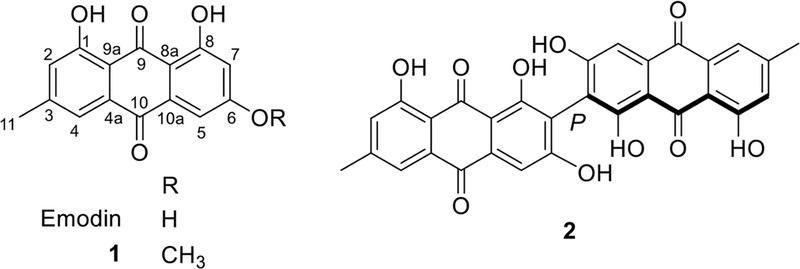
Chemical structures of emodin, physcion (1), and (–)-biemodin (2).
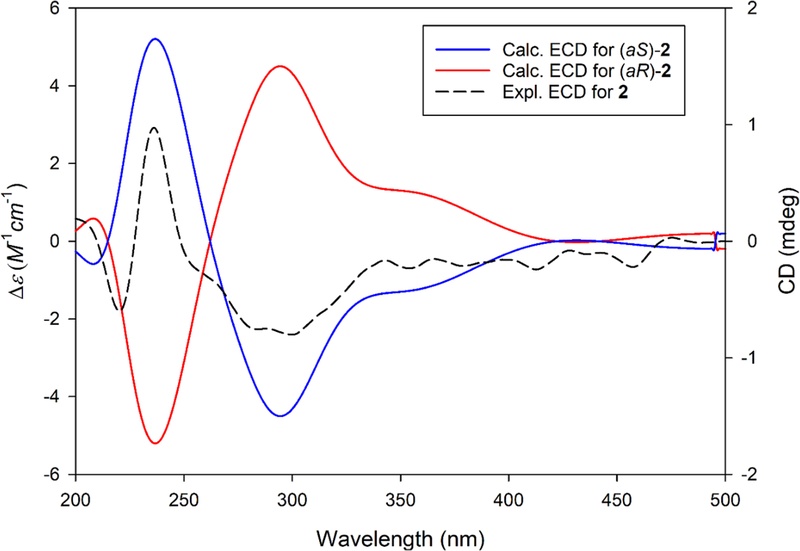
Experimental ECD spectrum for compound 2 and calculated ECD spectra for (aS)-2 and (aR)-2.
In this study, we propose plausible products arising from light-induced radical reactions of emodin in different solvents (methanol and ethanol). Upon irradiation, light energy transiently activates emodin, rendering it chemically reactive. In the excited state, methanol reacts with the activated molecule, substituting a hydroxyl group with a methoxy group to yield physcion (1) (Fig. 3).23 Under ethanol conditions, photodimerization occurs at activated aromatic positions, producing a covalently linked biaryl dimer of two emodin units. Consistent with this, (–)-biemodin (2) was isolated as the major product, confirming a C₂-symmetric dimerization via C–C bond formation (Fig. 4).16,24,25

Proposed photochemical pathway for the conversion of emodin to physcion via methanol-mediated O-methylation under UV-Vis irradiation.

Plausible mechanism for the photodimerization of emodin via radical coupling under UV-Vis irradiation.
We evaluated the biological activities of emodin, physcion (1), and (–)-biemodin (2) using cytotoxicity, DPPH radical scavenging, and IDO-inhibition assays. Emodin showed moderate cytotoxicity at 50 μM, whereas physcion (1) and (–)-biemodin (2) exhibited no detectable cytotoxic effects (Fig. 5). All three compounds displayed minimal antioxidant activity in the DPPH assay, with no clear dose dependence (Fig. 6). In the IDO-inhibition assay, none inhibited IDO-mediated tryptophan metabolism at the tested concentrations (Fig. 7).
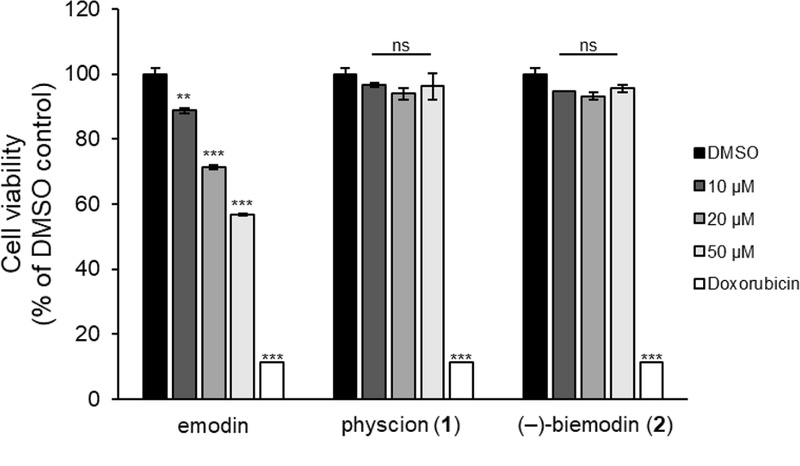
Cell viability of HeLa cells following 24 h incubation with emodin, physcion (1), and (–)-biemodin (2) at the indicated concentrations, assessed by Cyto X cell-viability assay kit. Not significant (ns) (p ≥ 0.01), **p < 0.01, ***p < 0.001 vs. control.
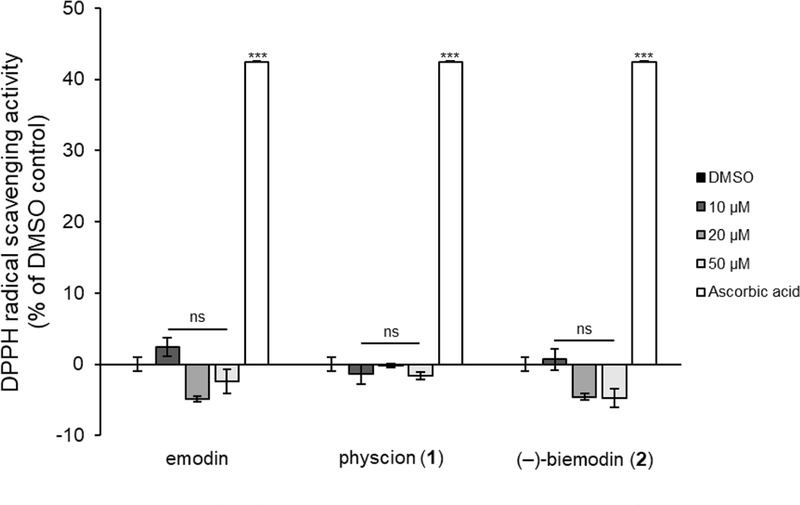
DPPH radical scavenging activities of emodin, physcion (1), and (–)-biemodin (2). Not significant (ns) (p ≥ 0.01), ***p < 0.001 vs. control.
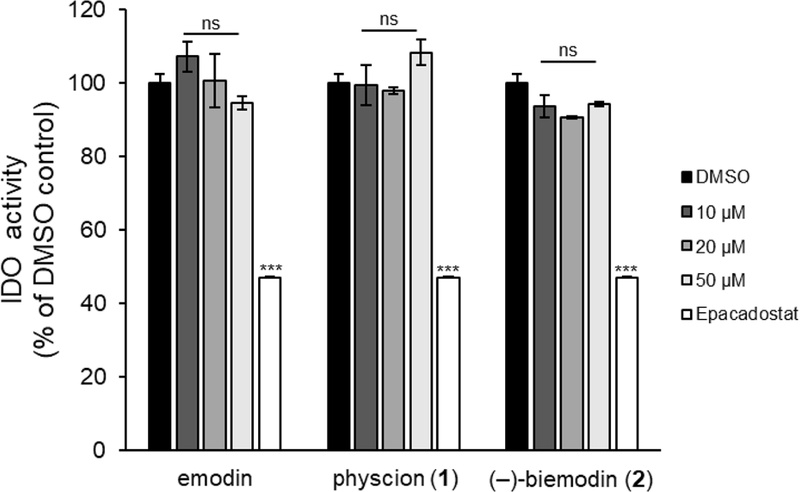
The inhibitory effect of emodin, physcion (1), and (–)-biemodin (2) on IDO enzymatic activity is shown. Not significant (ns) (p ≥ 0.01), ***p < 0.001 vs. control.
In this study, we investigated the photochemical transformation of emodin, a natural anthraquinone with diverse biological activities, under UV–visible irradiation (320–800 nm) in methanol and ethanol. This approach expanded the structural diversity of emodin, yielding modified photoderivatives. Solvent-dependent photoreactions led to two distinct products: physcion (1), an O-methoxylated derivative of emodin, and (–)-biemodin (2), a unique C–C–bonded dimer formed via radical-mediated coupling. Comprehensive spectroscopic analyses including ¹H-NMR, HR-ESI-MS, and ECD calculations enabled full structural elucidation of both compounds and determination of their absolute configurations. Notably, these transformations occurred under mild, catalyst-free conditions, underscoring the inherent photoreactivity of the emodin scaffold and its capacity for light-induced modification.
Biologically, emodin exhibited moderate cytotoxicity at a concentration of 50 μM, whereas its photoderivatives showed no detectable cytotoxic effects (Fig. 5). At the tested concentrations of up to 50 μM, where cell viability remained above 50%, no significant (ns) antioxidant activity was observed for emodin or its photoproducts (Fig. 6). This finding is consistent with previous reports showing that emodin displays antioxidant activity only at millimolar concentrations.9,26 This discrepancy likely reflects the concentration-dependent nature of emodin’s radical scavenging activity. The use of micromolar concentrations was intended to approximate physiologically relevant levels, minimize nonspecific effects caused by cytotoxicity, and enable the observation of selective biological responses. Moreover, none of the compounds demonstrated significant antioxidant or IDO-inhibitory activity in these assays (Fig. 7).
The DPPH radical scavenging assay and the IDO inhibition assay were employed in this study as standard approaches to evaluate antioxidant and potential immuno-modulatory activities, respectively (Figs. 6 and 7). Although all tested compounds exhibited essentially no activity in these assays, previous studies have reported that physcion and (–)-biemodin may possess biological functions, such as antioxidant or immunomodulatory effects. Therefore, the lack of activity observed under our experimental conditions does not necessarily preclude their biological relevance, and further investigations are warranted to explore other potential activities.
Taken together, these results indicate that, although photochemical modification efficiently generates structurally diverse analogues, it does not necessarily enhance cytotoxic, radical-scavenging, or IDO-inhibitory activities under the tested conditions. Nonetheless, a wide array of derivatives can be produced from emodin under various photochemical conditions, suggesting that this strategy may ultimately yield compounds with improved or novel bioactivities. Therefore, further studies are needed to explore other potential activities of these photochemically modified derivatives. On the other hand, given that emodin readily undergoes such changes upon exposure to UV-visible light, it is crucial to protect this compound from light during storage and handling to prevent unintended photoproduct formation or degradation.
Acknowledgments
This work was supported by National Research Foundation of Korea (NRF) grants funded by the Korean government (MSIT; grant numbers RS-2019-NR040057 and RS-2021-NR059240), the Korea Research Institute of Bioscience and Biotechnology (KRIBB) Research Initiative Program (KGM1272511), the National Research Council of Science & Technology grant (CAP23011-300) of the Ministry of Education of the Republic of Korea, and National Research Foundation of Korea (NRF) grant funded by the Korea government (MSIT) (RS-2024-00440614).
Conflicts of Interest
The authors declare that they have no conflicts of interest.
References
-
Ahmad, S.; Jaiswal, R.; Yadav, R.; Verma, S. Sustain. Chem. One World 2024, 4, 100029.
[https://doi.org/10.1016/j.scowo.2024.100029]

-
Cambie, D.; Bottecchia, C.; Straathof, N. J. W.; Hessel, V.; Noël, T. Chem. Rev. 2016, 116, 10276–10341.
[https://doi.org/10.1021/acs.chemrev.5b00707]
-
Costa, P.; Vega-Peñaloza, A.; Cognigni, L.; Bonchio, M. ACS Sustain. Chem. Eng. 2021, 9, 15694–15721.
[https://doi.org/10.1021/acssuschemeng.1c04787]
-
Cheng, Y.-Z.; Feng, Z.; Zhang, X.; You, S.-L. Chem. Soc. Rev. 2022, 51, 2145–2170.
[https://doi.org/10.1039/C9CS00311H]
-
Thakral, F.; Prasad, B.; Sehgal, R.; Gupta, S.; Sharma, U.; Singh, B. J.; Sharma, B.; Tuli, H. S.; Haque, S.; Ahmad, F. Discov. Oncol. 2025, 16, 468.
[https://doi.org/10.1007/s12672-025-02240-9]
-
Han, S.-Q.; Fu, X.-K.; Ha, W.; Shi, Y.-P. Anal. Sci. 2024, 40, 2063–2073.
[https://doi.org/10.1007/s44211-024-00644-1]
-
Li, L.; Song, X.; Yin, Z.; Jia, R.; Li, Z.; Zhou, X.; Zou, Y.; Li, L.; Yin, L.; Yue, G. Microbiol. Res. 2016, 186, 139–145.
[https://doi.org/10.1016/j.micres.2016.03.008]
-
Shao, Q.; Liu, T.; Wang, W.; Liu, T.; Jin, X.; Chen, Z. Front. Pharmacol. 2022, 13, 902626.
[https://doi.org/10.3389/fphar.2022.902626]
-
Vargas, F.; Díaz, Y.; Carbonell, K. Pharma. Biol. 2004, 42, 342–348.
[https://doi.org/10.1080/13880200490519613]
-
Nowak-Perlak, M.; Ziółkowski, P.; Woźniak, M. Phytomedicine 2023, 119, 155035.
[https://doi.org/10.1016/j.phymed.2023.155035]
-
Mantareva, V.; Braikova, D.; Lazarova, I.; Genova, T. Front. Biosci. 2024, 29, 168.
[https://doi.org/10.31083/j.fbl2905168]
-
Nowak-Perlak, M.; Bromke, M. A.; Ziółkowski, P.; Woźniak, M. Int. J. Mol. Sci. 2022, 23, 6276.
[https://doi.org/10.3390/ijms23116276]
-
Hu, Y.; Yang, L.; Lai, Y. Biomed. Pharmacother. 2023, 162, 114585.
[https://doi.org/10.1016/j.biopha.2023.114585]
-
Sakamoto, M.; Yagishita, F.; Kanehiro, M.; Kasashima, Y.; Mino, T.; Fujita, T. Org. Lett. 2010, 12, 4435–4437.
[https://doi.org/10.1021/ol101734k]
-
Siewert, B.; Stuppner, H. Phytomedicine 2019, 60, 152985.
[https://doi.org/10.1016/j.phymed.2019.152985]
-
Yusuf, M.; Solanki, I.; Jain, P.; Kumar, R. Arab. J. Chem. 2019, 12, 1197–1211.
[https://doi.org/10.1016/j.arabjc.2014.11.031]
-
Maharjan, S.; Dakoju, R. K.; Albano, B.; Ondiek, P. A.; O'Shea, J. M.; Cosme‐Hernandez, A. G.; Wink, D.; Pemberton, B. C.; Lopez, S. A.; Ayitou, A. J.-L. Adv. Synth. Catal. 2025, 367, e202400899.
[https://doi.org/10.1002/adsc.202400899]
-
Baertschi, S. W.; Alsante, K. M.; Tønnesen, H. H. J. Pharm. Sci. 2010, 99, 2934–2940.
[https://doi.org/10.1002/jps.22076]
-
Bee, B. S.; Jat, R. K.; Ahmad, S. Int. J. Exp. Res. Rev. 2023, 32, 297–308.
[https://doi.org/10.52756/ijerr.2023.v32.026]
-
Jeong, S. Y.; Alishir, A.; Zhang, S.; Zhang, Y.; Choi, S.; Pang, C.; Bae, H. Y.; Jung, W. H.; Kim, K. H. J. Nat. Prod. 2023, 86, 1891–1900.
[https://doi.org/10.1021/acs.jnatprod.3c00193]
-
Kang, D.-M.; Khalil, A. A. K.; Park, W. S.; Kim, H.-J.; Akter, K.-M.; Bae, J.-Y.; Mehtap Buyuker, S.; Kim, J.-H.; Kang, K. K.; Ahn, M.-J. ACS Omega 2023, 8, 42548–42554.
[https://doi.org/10.1021/acsomega.3c05282]
-
Bara, R.; Aly, A. H.; Pretsch, A.; Wray, V.; Wang, B.; Proksch, P.; Debbab, A. J. Antibiot. 2013, 66, 491–493.
[https://doi.org/10.1038/ja.2013.28]
-
Morawski, O.; Gawryś, P.; Sadło, J.; Sobolewski, A. L. Chemphyschem. 2022, 23, e202200077.
[https://doi.org/10.1002/cphc.202200077]
-
Staveness, D.; Bosque, I.; Stephenson, C. R. J. Acc. Chem. Res. 2016, 49, 2295–2306.
[https://doi.org/10.1021/acs.accounts.6b00270]
-
Phan, H.; Lekin, K.; Winter, S. M.; Oakley, R. T.; Shatruk, M. J. Am. Chem. Soc. 2013, 135, 15674–15677.
[https://doi.org/10.1021/ja4055806]
-
Mellado, M.; Madrid, A.; Peña-Cortés, H.; López, R.; Jara, C.; Espinoza, L. J. Chil. Chem. Soc. 2013, 58, 1767–1770.
[https://doi.org/10.4067/S0717-97072013000200028]