
Anti-neuroinflammatory Potential of Dendrobium fimbriatum var. oculatum and Phenanthrene Derivatives in BV2 Microglial Cells
Abstract
Neuroinflammation is one of the major pathological features of Alzheimer’s disease (AD). Microglial overactivation leads to excessive production of nitric oxide (NO) and other inflammatory mediators, contributing to neuronal damage. Dendrobium fimbriatum var. oculatum, a traditional medicinal herb, has been used to alleviate inflammatory conditions, yet its anti-neuroinflammatory potential remains underexplored. In this study, 90% ethanol extract of D. fimbriatum and its dichloromethane (DCM) fraction significantly inhibited LPS-induced NO production in a dose-dependent manner in BV2 microglial cells. Based on bioactivity-guided isolation, four phenanthrene derivatives were isolated and identified as flavanthridin (1), denthyrsinin (2), lusianthridin (3), and (1R,2R)-1,7-hydroxy-2,8-methoxy-2,3-dihydrophenanthrene (4) from the DCM fraction. Compounds 1, 3, and 4 showed potent effects on NO inhibition at non-cytotoxic concentrations, with corresponding reductions in iNOS expression. These compounds also significantly and dose-dependently inhibited the production of pro-inflammatory cytokines such as IL-6. These results suggest that phenanthrene derivatives from D. fimbriatum exhibit inhibitory activities on neuroinflammation. These findings support their potential as therapeutic agents for preventing or treating AD.
Keywords:
BV2 microglial cells, Dendrobium fimbriatum var. oculatum, Nitric oxide, Phenanthrenes, NeuroinflammationIntroduction
Dendrobii Caulis refers to the dried stems of several species within the Orchidaceae family, including Dendrobium nobile Lindl., D. loddigesii Rolfe., D. fimbriatum var. oculatum Hook., D. chrysanthum Wall. ex Lindl., and D. candidum Wall. ex Lindl.1–3 Among the listed taxa, stems of D. fimbriatum is most widely used in Korea. These plants are perennial epiphytic herbs that typically inhabit rocks or tree trunks in high-altitude mountainous regions.4 Individuals grow to approximately 30–50 cm tall, and their clustered stems are cylindrical, yellow–green, and 1.0–1.3 cm in diameter with numerous nodes.2,5
Traditionally, Dendrobii Caulis has been employed in medicine to relieve deficiency-heat conditions and to suppress cough.6 Phytochemical studies have identified the presence of various bioactive compounds, including sesquiterpenes, phenanthrenes, and bibenzyl derivatives, which have demonstrated a range of pharmacological activities such as anti-inflammatory, immunomodulatory, and anticancer effects.7,8
Neuroinflammation has been recognized as a critical contributor to the pathogenesis of Alzheimer’s disease (AD),9 a progressive neurodegenerative disorder characterized by cognitive decline and memory loss.10 One of the hallmarks of neuroinflammation in AD is the activation of microglia.11 Aggregated β-amyloid (Aβ) peptides induce sustained activation of microglia, leading to the overproduction of inflammatory mediators such as nitric oxide (NO), tumor necrosis factor-α (TNF-α), interleukin-6 (IL-6), and reactive oxygen species (ROS).12 Among these mediators, excessive NO contributes to oxidative stress and neuronal damage during inflammation.
In this study, the 90% ethanol extract of D. fimbriatum significantly inhibited NO production in lipopolysaccharide (LPS)-stimulated BV2 microglial cells in a concentration-dependent manner. Among the five solvent-partitioned fractions, the dichloromethane (DCM) fraction exhibited the most potent inhibitory effect on NO production. Consequently, bioactivity-guided fractionation of the DCM fraction led to the isolation of four phenanthrene derivatives. The isolated compounds were further evaluated for their ability to suppress the production of NO, the expression of iNOS and COX-2, and pro-inflammatory cytokines in activated microglia.
Experimental
Reagents and Instruments – Dulbecco’s Modified Eagle’s Medium (DMEM) was obtained from Welgene (Daegu, Korea), and fetal bovine serum (FBS) was supplied by Equitech-BIO (Kerrville, TX, USA). Lipopolysaccharide (LPS, derived from Escherichia coli O111:B4) and 3-(4,5-dimethylthiazol-2-yl)-2,5-diphenyl tetrazolium bromide (MTT) were purchased from Sigma-Aldrich (St. Louis, MO, USA). Dimethyl sulfoxide (DMSO) was provided by Wako Pure Chemical Industries (Osaka, Japan), and Griess reagent was obtained from Sigma-Aldrich.
Nuclear magnetic resonance (NMR) spectra were measured using a Avance III 400 MHz spectrometer (Bruker, Germany), whereas mass spectrometry analysis was performed with an LCQ Fleet instrument (Thermo Scientific, USA).
Plant Material and Extraction – Stems of D. fimbriatum (6 kg) were purchased in March 2024 from Incha Korean Herbal Market (Seoul, Korea) and were authenticated by Professor So-Young Park at Dankook University. A voucher specimen (DKU-PG-2024-001) was deposited in the Laboratory of Pharmacognosy at Dankook University. The dried stems were ground into powder and extracted with 90% ethanol at room temperature for three days. The extract was then filtered and concentrated under reduced pressure using a rotary evaporator (EYELA, Tokyo, Japan), and 450 g of ethanol extract was obtained. The extract was stored at 4℃ until further use and was dissolved in DMSO for cell-based experiments.
For solvent partitioning, the ethanol extract was suspended in distilled water containing a small volume of methanol (MeOH) and was sequentially partitioned with equal volumes of n-hexane (Hx), dichloromethane (DCM), ethyl acetate (EA), and n-butanol (BuOH). The DCM fraction, which exhibited the strongest biological activity, yielded 70 g.
Isolation of active compounds – The DCM fraction was subjected to silica gel column chromatography using a gradient elution of DCM:MeOH (90:1 to 40:1), resulting in six subfractions (DMC-1 to DMC-6). DMC-2 (6.7 g) was further purified by silica gel open column chromatography with a gradient of chloroform (CHCl3):EA (10:0 to 10:3), yielding seven subfractions (DMC 2-1 to DMC 2-7). Subfraction DMC 2-7 (253.9 mg) was subsequently separated by silica gel open column chromatography using a gradient of Hx:EA (10:0 to 10:7), affording four subfractions (DMC 2-7-1 to DMC 2-7-4). Compound 1 (11.5 mg), a brown amorphous solid, was isolated from DMC 2-7-2. Fraction DMC 3 (2.7 g) was purified by silica gel open column chromatography with a gradient of Hx:EA (10:0 to 1:1), affording twelve subfractions (DMC 3-1 to DMC 3-12). Subfraction DMC 3-11 (395.1 mg) was further separated by silica gel open column chromatography using a gradient of CHCl3:EA (10:0 to 10:5), yielding five subfractions (DMC 3-11-1 to DMC 3-11-5). Compound 2 (29.9 mg), a brown amorphous solid, was obtained from DMC 3-11-2. DMC-5 (1.5 g) was further purified by silica gel open column chromatography with a gradient of CHCl3:acetone (10:0 to 10:4), producing twelve subfractions (DMC 5-1 to DMC 5-12). From these, brown amorphous solids of compound 3 (65.1 mg) and compound 4 (56.7 mg) were isolated from DMC 5-5 and DMC 5-11, respectively. The structures of the isolated compounds were determined as flavanthridin (1),14 denthyrsinin (2),15 lusianthridin (3),16 and (1R,2R)-1,7-hydroxy-2,8-methoxy-2,3-dihydrophenanthrene (4)17 through comparative analysis of their ¹H- and ¹³C-NMR spectroscopic data with literature values.
Flavanthridin (1) – Brown amorphous solid; 1H-NMR (CD3OD, 400 MHz): δ 8.09 (1H, d, J = 9.0 Hz, H-5), 6.52 (2H, m, H-6 and H-8), 6.31 (1H, s, H-1), 3.73 (3H, s, 2-OCH3), 3.70 (3H, s, 4-OCH3), 2.55 (4H, m, H-9 and H-10); 13C-NMR(CD3OD, 100 MHz): δ 154.0 (C-7), 145.7 (C-2), 144.8 (C-4), 139.7 (C-8a), 137.5 (C-3), 129.5 (C-10a), 128.2 (C-5), 125.4 (C-4b), 120.2 (C-4a), 114.4 (C-6), 113.4 (C-8), 106.9 (C-1), 59.9 (4-OCH3), 56.1 (2-OCH3), 29.8 (C-10).
Denthyrsinin (2) – Brown amorphous solid; 1H-NMR (CD3OD, 400 MHz): δ 9.00 (1H, s, J = 9.6 Hz, H-5), 7.72 (1H, d, J = 9.2 Hz, H-10), 7.08 (1H, d, J = 9.6 Hz, H-6), 7.06 (1H, s, H-1), 7.51(1H, d, J = 9.2 Hz, H-9), 3.90 (3H, s, 2-OCH3), 3.83 (3H, s, 4-OCH3), 3.76 (3H, s, 8-OCH3); 13C-NMR (CD3OD, 100 MHz): δ 149.3 (C-2), 147.6 (C-7), 146.0 (C-4), 142.6 (C-8), 141.4 (C-3), 128.4 (C-10a), 129.0 (C-10), 127.1 (C-8a), 125.2 (C-4b), 124.6 (C-5), 120.4 (C-4a), 118.1 (C-6), 119.0 (C-9), 106.3 (C-1), 61.1 (2-OCH3), 60.0 (4-OCH3), 56.6 (8-OCH3).
Lusianthridin (3) – Brown amorphous solid; 1H-NMR (CD3OD, 400 MHz): δ 8.05 (1H, d, J = 9.2 Hz, H-5), 6.57 (1H, m, H-6), 6.56 (1H, br s, H-8), 6.33 (1H, d, J = 2.6 Hz, H-3), 6.32 (1H, d, J = 2.6 Hz, H-1), 3.62 (3H, s, 2-OCH3), 2.54 (4H, m, H-9 and H-10); 13C-NMR (CD3OD, 100 MHz): δ 156.5 (C-4), 156.1 (C-7), 141.9 (C-10a), 140.4 (C-8a), 130.2 (C-5), 126.6 (C-4b), 116.4 (C-8), 115.1 (C-6), 113.7 (C-4a), 106.1 (C-1), 101.6 (C-3), 55.6 (2-OCH3), 31.3 (C-9), 32.0 (C-10), 15.9 (C-2).
(1R,2R)-1,7-hydroxy-2,8-methoxy-2,3-dihydrophenanthrene (4) – Brown amorphous solid; 1H-NMR (CD3OD, 400 MHz): δ 8.90 (1H, d, J = 9.6 Hz, H-5), 8.22 (1H, d, J = 8.8 Hz, H-9), 7.64 (1H, d, J = 8.8 Hz, H-10), 7.15 (1H, d, J = 9.6 Hz, H-5), 3.70 (1H, m, H-2), 3.81 (3H, s, 8-OCH3), 3.37 (3H, s, 2-OCH3), 3.14 (1H, dd, J = 16.0, 4.0 Hz, H-3α), 2.66 (1H, dd, J = 16.0, 7.0 Hz, H-3β); 13C-NMR (CD3OD, 100 MHz): δ 200.1 (C-4), 147.9 (C-7), 143.9 (C-10a), 141.6 (C-8), 131.0 (C-4b), 128.8 (C-9), 127.5 (C-4a), 127.3 (C-10), 126.9 (C-8a), 124.8 (C-5), 122.6 (C-6), 72.4 (C-1), 82.0 (C-2), 43.7 (C-3α and C-3β), 61.7 (8-OCH3), 57.7 (2-OCH3).
Cell culture – The murine microglial BV2 cell line was used for in vitro studies. Cells were cultured in DMEM supplemented with 10% FBS at 37℃ in a humidified incubator with 5% CO₂ (Sankyo Electric, Japan). Cultures were maintained in 75T flasks (SPL, Korea), and the medium was replaced every 2 days.
Cell viability assay – BV2 cells were plated in 96-well plates at a density of 2 × 10⁴ cells/well in 100 μL of medium and incubated for 24 h. The medium was then replaced with serum-free DMEM. After 1 h, cells were treated with varying concentrations of the D. fimbriatum extract and incubated for an additional 24 h. Subsequently, 10 μL of MTT solution (5 mg/mL) was added to each well and incubated for 3 h. Formazan crystals were solubilized with DMSO, and absorbance at 570 nm was measured using an Emax Precision Microplate Reader (Molecular Devices, San José, CA, USA).
Measurement of NO production – NO production in BV2 cells was evaluated by quantifying nitrite (NO₂⁻) in the culture supernatant using the Griess reagent. BV2 cells were plated in 12-well plates at a density of 1.5 × 10⁵ cells/well in 500 μL of medium and incubated for 24 h. The medium was then replaced with serum-free DMEM. After 1 h, cells were treated with varying concentrations of the D. fimbriatum extract, followed 1 h later by LPS at 1 μg/mL. After a further 24 h of incubation, supernatants were collected and centrifuged. Equal volumes of supernatant and Griess reagent were mixed and incubated at room temperature for 15–20 min. Absorbance was measured at 540 nm using a microplate reader (Molecular Devices).
Western blot analysis – After 24 h of treatment with the compounds and LPS, cells were washed twice with PBS and lysed in 300 μL Laemmli sample buffer using a cell scraper. Lysates were transferred to microcentrifuge tubes, heated at 100℃ for 15 min, and stored at −20℃ until analysis. Proteins were resolved by SDS-PAGE (7.5% or 12% acrylamide gels) and transferred to PVDF membranes. Membranes were blocked with 5% skim milk in PBS for 1 h and washed three times for 15 min each with PBST (PBS containing 0.05% Tween 20). Primary antibodies were added and incubated overnight at 4℃.
The primary antibodies used were iNOS (1:1,000, BD Biosciences, Pharmingen, CA, USA), COX-2 (1:1,000, Santa Cruz Biotechnology, Dallas, TX, USA), and α-tubulin (Sigma Aldrich). After washing, membranes were incubated with appropriate HRP-conjugated secondary antibodies in 5% skim milk for 1 h at room temperature. Signals were detected using ECL spray reagent (Advansta, Menlo Park, CA, USA), and protein bands were imaged with a Bio-Rad ChemiDoc system (Hercules, CA, USA).
Enzyme-linked immunosorbent assay (ELISA) – Cytokine levels in the collected medium samples were determined by ELISA. Briefly, 96-well plates were pre-coated with capture antibodies against IL-6 and TNF-α (BD Biosciences) and incubated overnight at 4℃. After three washes with PBST, wells were blocked with blocking buffer for 1 h at room temperature (20–23°C) and then washed four times with PBST. Standard solutions and samples were added to the wells and incubated overnight at 4℃. The plates were washed four times, and biotinylated detection antibodies for IL-6 and TNF-α (BD Biosciences) were applied. Following a 45 min incubation at room temperature, the wells were washed again and treated with avidin-conjugated alkaline phosphatase for 30 min at room temperature. Substrate solution was added, the reaction was allowed to proceed for 5–30 min, and then stop solution was added. Absorbance was recorded at 405 nm using a microplate reader (Molecular Devices).
Statistical analysis – All data are expressed as mean ± standard deviation (SD), and statistical significance was determined using one- or two-way analysis of variance (ANOVA) followed by Tukey’s post hoc test. Statistical significance for cytotoxicity was assessed by comparing treatment groups with the control group (#p < 0.05), and others were analyzed by comparison to the LPS-treated control group (*p < 0.05).
Results and Discussion
To assess the cytotoxicity of the D. fimbriatum extract on BV2 microglial cells, cells were treated with various concentrations (100, 50, 20, and 10 μg/mL) of the extract for 24 h, followed by MTT assay (Fig. 1A). A dose-dependent decrease in cell viability was observed at concentrations above 50 μg/mL compared to DMSO-treated control group. However, at 20 μg/mL, cell viability remained comparable to that of the DMSO-treated control group, indicating that the extract did not exert significant cytotoxic effects at this concentration.
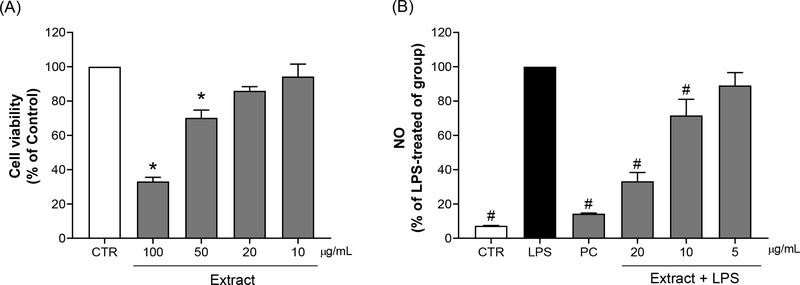
Effects of D. fimbriatum extract on LPS-induced NO production in BV2 cells. (A) Cytotoxic effect of D. fimbriatum extract in BV2 cells assessed by MTT assay. (B) Inhibition of NO production by D. fimbriatum extract measured using the Griess reagent. BV2 cells pretreated with D. fimbriatum extract (5, 10 and 20 μg/mL) for 1 h were treated with LPS (1 μg/mL) for an additional 24 h. The production of NO was determined using Griess reagent. Data are presented as mean ± SD (n = 3). *p < 0.05 vs. control group; #p < 0.05 vs. LPS-treated group.
To evaluate the effect of the D. fimbriatum extract on LPS-induced NO production, BV2 cells were treated with non-cytotoxic concentrations of the extract (20, 10, and 5 μg/mL) in the presence of LPS (1 μg/mL), and NO levels in the culture supernatants were measured using the Griess reagent (Fig. 1B). The results demonstrated that the D. fimbriatum extract significantly inhibited NO production compared to LPS-treated group in a concentration-dependent manner.
To identify the active fraction, the ethanolic extract of D. fimbriatum was partitioned into five solvent fractions based on polarity: Hx, DCM, EA, BuOH, and water. The cytotoxicity of each fraction at 20 μg/mL was evaluated using the MTT assay (Fig. 2A). The Hx and water fractions reduced cell viability to approximately 80%, suggesting potential cytotoxic effects. In contrast, the DCM, EA, and BuOH fractions did not significantly reduce cell viability and were thus selected for further evaluation of NO inhibition.
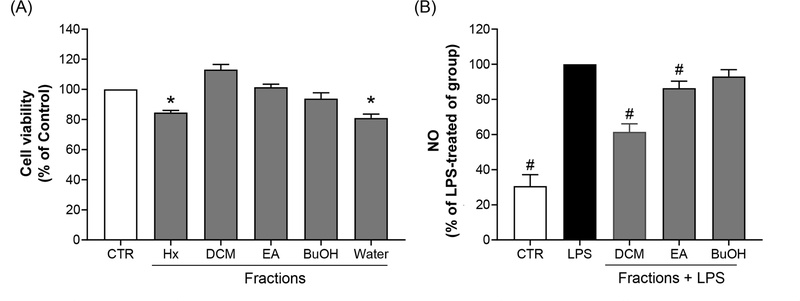
Effects of solvent-partitioned fractions of D. fimbriatum extract on NO production in BV2 cells. (A) Cytotoxicity of solvent-partitioned fractions of D. fimbriatum (20 μg/mL). (B) NO inhibition in LPS-stimulated BV2 cells by non-cytotoxic concentrations of solvent-partitioned fractions (20 μg/mL). DCM fraction showed the strongest inhibitory activity. Data are presented as mean ± SD (n = 3). *p < 0.05 vs. control; #p < 0.05 vs. LPS-treated group.
The effects of the three non-cytotoxic fractions on LPS-induced NO production in BV2 cells were then examined using the Griess reagent (Fig. 2B). Among them, the DCM fraction showed the most potent inhibitory activity, whereas the EA fraction exhibited only a modest effect. Based on these findings, the DCM fraction was selected for further bioactivity-guided isolation of active compounds.
Four phenanthrene derivatives including flavanthridin (1), denthyrsinin (2), lusianthridin (3), and (1R,2R)-1,7-hydroxy-2,8-methoxy-2,3-dihydrophenanthrene (4) were isolated from the DCM fraction of the D. fimbriatum extract through bioactivity-guided isolation (Fig. 3). The cytotoxicity of these compounds on BV2 microglial cells was evaluated using the MTT assay. Compound 2 showed no significant cytotoxicity up to 20 μg/mL, as cell viability remained comparable to the control. In contrast, in case of compounds 1 and 4, they did not show any cytotoxicity at concentrations of 10 μg/mL or lower. Compound 3 decreased cell viability to 63% at 5 μg/mL, but was not cytotoxic at concentrations of 2.5 μg/mL or below (Fig. 4A). Based on these results, the non-cytotoxic concentrations of each compound were used for subsequent experiments.
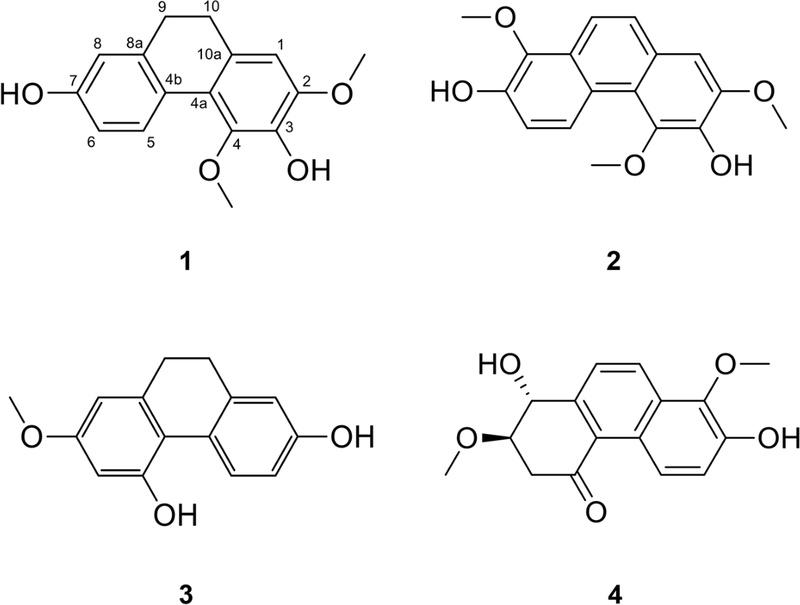
Chemical structures of the four phenanthrene compounds isolated from the DCM fraction of D. fimbriatum including flavanthridin (1), denthyrsinin (2), lusianthridin (3), and (1R,2R)-1,7-hydroxy-2,8-methoxy-2,3-dihydrophenanthrene (4).
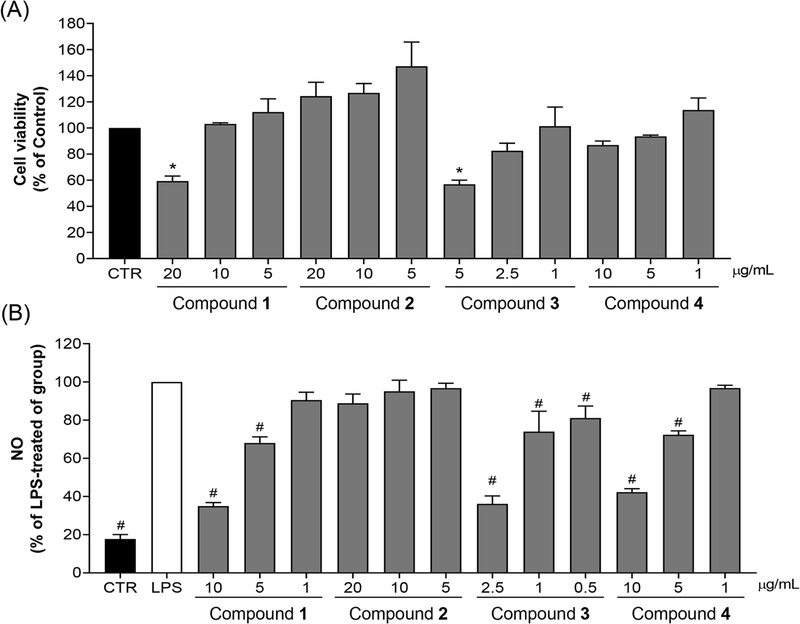
Effects of phenanthrene derivatives on LPS-induced NO production in BV2 cells. (A) Cell viability of BV2 cells treated with isolated phenanthrene derivatives. (B) Inhibitory effects of compounds 1–4 on LPS-induced NO production. Compound 3 showed the most potent activity. Data are presented as mean ± SD (n = 3). *p < 0.05 vs. control; #p < 0.05 vs. LPS-treated group.
To investigate the effects of these compounds on LPS-induced NO production, BV2 cells were treated with non-cytotoxic concentrations of each compound, and NO levels in the supernatant were measured using the Griess reagent (Fig. 4B). Compound 1 exhibited a dose-dependent inhibition of NO production, reducing them by approximately 35% at 10 μg/mL. Compound 2 had no significant effect on NO production at any concentrations tested. Compound 3 significantly reduced NO production even at low concentrations (2.5, 1, and 0.5 μg/mL), while Compound 4 also showed a dose-dependent inhibitory effect. Notably, Compound 4 reduced NO production by nearly 50% at the highest tested concentration of 10 μg/mL compared to the LPS-only group.
To further explore the mechanism of NO inhibition, we examined the effects of compounds 1, 3, and 4 (which showed NO inhibitory activity) on the protein levels of inducible nitric oxide synthase (iNOS) and cyclooxygenase-2 (COX-2) using Western blot analysis (Fig. 5). Compound 1 significantly suppressed iNOS level at 10 and 5 μg/mL, whereas compound 3 significantly reduced the levels of iNOS at 2.5 μg/mL, and compound 4 at 10 μg/mL. Regarding COX-2 protein expression, compound 1 showed a decreasing trend, but the reduction was not statistically significant. Compounds 3 and 4 did not significantly reduce COX-2 levels compared to the LPS-only control.
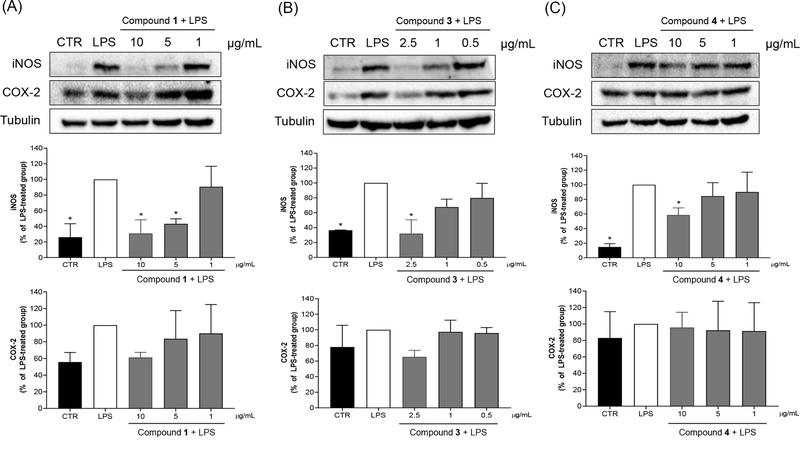
Effects of phenanthrene derivatives on iNOS and COX-2 in LPS-treated BV2 cells. (A) flavanthridin (1), (B) lusianthridin (3), (C) (1R,2R)-1,7-hydroxy-2,8-methoxy-2,3-dihydrophenanthrene (4). Western blot analysis was performed to evaluate iNOS and COX-2 protein expression in BV2 cells treated with compounds 1, 3, and 4. Densitometry results show significant suppression of iNOS by compounds 1, 3 and 4. Data are presented as mean ± SD (n = 3). *p < 0.05 vs. LPS-treated group.
To investigate the effects of three phenanthrene compounds on LPS-induced pro-inflammatory cytokines including IL-6 and TNF-α, BV2 cells were treated with non-cytotoxic concentrations of the compounds in the presence of LPS and cytokine release was measured by ELISA. LPS stimulation markedly increased IL-6 and TNF-α production compared to the control group. Pretreatment with compounds 1, 3, and 4 significantly and dose-dependently reduced IL-6 production, with compound 3 showing the strongest effect among the three (Fig. 6A–C). In contrast, LPS-induced TNF-α production was not significantly altered by these treatment (Fig. 6D–F).
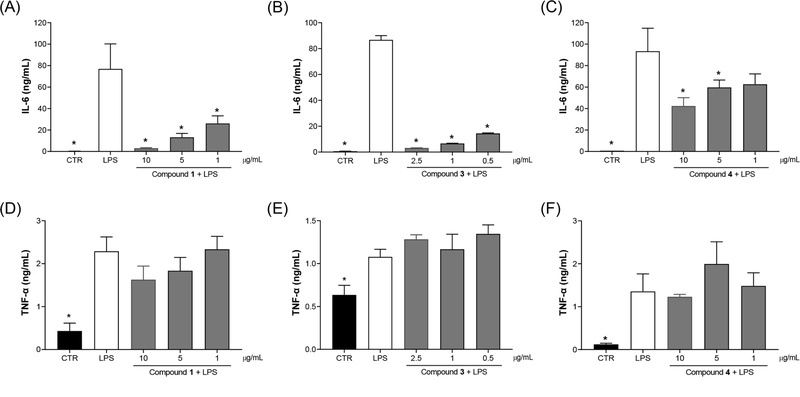
Effects of phenanthrene derivatives on pro-inflammatory cytokine production in LPS-stimulated BV2 cells. (A–C) IL-6; (D–F) TNF-α. BV2 cells were pretreated with the indicated compounds and subsequently stimulated with LPS. Cytokine levels in the culture supernatants were quantified by ELISA. Data are presented as mean ± SD (n = 3). *p < 0.05 vs. LPS-treated group.
In the present study, we investigated the anti-inflammatory effects of the D. fimbriatum extract and its phenanthrene constituents in LPS-stimulated BV2 microglial cells. The ethanol extract of D. fimbriatum significantly suppressed NO production in a dose-dependent manner, without exhibiting cytotoxicity at concentrations up to 20 μg/mL. Among the five fractions obtained based on solvent polarity, the DCM fraction showed the strongest NO inhibitory effect and was selected for further bioactivity-guided isolation. From the DCM fraction, four phenanthrene derivatives were isolated including flavanthridin (1), denthyrsinin (2), lusianthridin (3), and (1R,2R)-1,7-hydroxy-2,8-methoxy-2,3-dihydrophenanthrene (4). Compounds 1, 3, and 4 exhibited potent inhibition of NO production at non-cytotoxic concentrations, while compound 2 showed no significant activity. Notably, compound 3 demonstrated the highest NO inhibitory activity even at low concentrations. Western blot analysis and ELISA assay confirmed that compounds 1, 3, and 4 significantly suppressed the expression of iNOS and the production of IL-6, respectively. These findings suggest that the anti-inflammatory effects of the phenanthrene compounds may be mediated through modulation of key inflammatory enzymes involved in neuroinflammation.
Among the four phenanthrene derivatives identified from D. fimbriatum, compounds 1 and 3 have also been described in other Dendrobium species. Previous studies demonstrated their anti-inflammatory effects, notably through the suppression of LPS-induced nitric oxide production in RAW 264.7 macrophages.18 Such pharmacological activity aligns with our present observations in BV2 microglia, reinforcing their potential role as modulators of neuroinflammatory responses.
IL-6, TNF-α, and IL-1β are principle pro-inflammatory mediators released by microglia during neuroinflammatory responses. Upon LPS stimulation, these cytokines orchestrate the onset and progression of inflammatory signaling in the brain.19 IL-1β was not assessed in this study, as its secretion typically requires co-stimulation with inflamma-some activators such as ATP or nigericin.20 In this study, the three phenanthrene compounds significantly reduced IL-6 production, whereas TNF-α levels were minimally affected. Two explanations may account for this observation. One possibility is that TNF-α is predominantly generated at the early phase of the inflammatory response, making it less susceptible to compounds acting at later stages. 21 Another is that these phenanthrenes did not affect ADAM17, the protease responsible for converting membrane-bound pro-TNF into its soluble form, implying that TNF-α could have persisted in the unprocessed, pro-TNF state rather than being released extracellularly.22
In contrast, limited literature is available regarding (1R,2R)-1,7-hydroxy-2,8-methoxy-2,3-dihydrophenanthrene (4), and its natural origin and biological functions have not been extensively characterized. To our knowledge, this is the first report to demonstrate its significant inhibitory effects on NO production. These novel findings suggest that (1R,2R)-1,7-hydroxy-2,8-methoxy-2,3-dihydrophenanthrene (4) may represent a new phenanthrene scaffold with anti-neuroinflammatory potential.
Overall, these findings provide a pharmacological basis for the traditional use of D. fimbriatum as a neuroprotective agent and suggest that its phenanthrene constituents may be promising candidates for the development of therapeutic agents targeting neuroinflammation in AD. However, this study did not provide the precise mechanisms underlying the anti-neuroinflammatory effects of phenanthrene derivatives from D. fimbriatum. Future studies will investigate whether these effects are mediated through modulation of key signaling pathways, including NF-κB/MAPK and Nrf2, and the efficacy of D. fimbriatum in AD-relevant animal models.
In conclusion, this study demonstrates that the ethanol extract of D. fimbriatum and its phenanthrene derivatives, particularly flavanthridin (1), lusianthridin (3), and (1R,2R)-1,7-hydroxy-2,8-methoxy-2,3-dihydrophenanthrene (4), exert significant inhibitory effects on NO production in LPS-activated BV2 microglial cells. These compounds also modulated the expression of inflammation-related enzymes such as iNOS, and the production of pro-inflammatory cytokines including IL-6. These results suggest that phenanthrene derivatives from D. fimbriatum possess anti-neuroinflammatory properties and may serve as potential lead compounds for the prevention or treatment of AD.
Acknowledgments
This work was supported by the National Research Foundation of Korea (NRF) grant funded by the Korea government (MSIT) (RS-2024-00344498).
Conflicts of Interest
The authors declare that they have no conflicts of interest.
References
-
Cakova, V.; Bonte, F.; Lobstein, A. Aging Dis. 2017, 8, 827–849.
[https://doi.org/10.14336/AD.2017.0214]

-
Ramesh, T.; Koperuncholan, M.; Praveena, R.; Ganeshkumari, K.; Vanithamani, J.; Muruganantham, P.; Renganathan, P. J. Appl. Adv. Res. 2019, 4, 119–128.
[https://doi.org/10.21839/jaar.2019.v4i4.72]
-
Lam, Y.; Ng, T. B.; Yao, R. M.; Shi, J.; Xu, K.; Sze, S. C. W.; Zhang, K. Y. Evid. Based Complement. Altern. Med. 2015, 2015, 841752.
[https://doi.org/10.1155/2015/841752]
-
Hou, B.; Luo, J.; Zhang, Y.; Niu, Z.; Xue, Q.; Ding, X. Sci. Rep. 2017, 7, 43525.
[https://doi.org/10.1038/srep43525]
- De, L. C.; Rao, A. N.; Rajeevan, P. K.; Srivastava, M.; Chhetri, G. J. Glob. Biosci. 2015, 4, 1198–1215.
-
Ye, Z.; Dai, J.-R.; Zhang, C.-G.; Lu, Y.; Wu, L.-L.; Gong, A. G. W.; Xu, H.; Tsim, K. W. K.; Wang, Z.-T. Evid. Based Complement. Altern. Med. 2017, 2017, 8647212.
[https://doi.org/10.1155/2017/8647212]
-
Wang, Y.-H. J. Ethnopharmacol. 2021, 270, 113851.
[https://doi.org/10.1016/j.jep.2021.113851]
-
Ng, T. B.; Liu, J.; Wong, J. H.; Ye, X.; Sze, S. C. W.; Tong, Y.; Zhang, K. Y. Appl. Microbiol. Biotechnol. 2012, 93, 1795–1803.
[https://doi.org/10.1007/s00253-011-3829-7]
-
Streit, W. J. J. Neurosci. Res. 2004, 77, 1–8.
[https://doi.org/10.1002/jnr.20093]
-
Si, Z.-Z.; Zou, C.-J.; Mei, X.; Li, X.-F.; Luo, H.; Shen, Y.; Hu, J.; Li, X.-X. Neural Regen. Res. 2023, 18, 708–715.
[https://doi.org/10.4103/1673-5374.353484]
-
Block, M. L.; Zecca, L.; Hong, J.-S. Nat. Rev. Neurosci. 2007, 8, 57–69.
[https://doi.org/10.1038/nrn2038]
-
Heppner, F. L.; Ransohoff, R. M.; Becher, B. Nat. Rev. Neurosci. 2015, 16, 358–372.
[https://doi.org/10.1038/nrn3880]
-
Hickman, S. E.; Allison, E. K.; El Khoury, J. J. Neurosci. 2008, 28, 8354–8360.
[https://doi.org/10.1523/JNEUROSCI.0616-08.2008]
-
Wu, Y.-P.; Liu, W.-J.; Zhong, W.-J.; Chen, Y.-J.; Chen, D.-N.; He, F.; Jiang, L. Nat. Prod. Res. 2017, 31, 1518–1522.
[https://doi.org/10.1080/14786419.2017.1278599]
-
Radix, S.; Barret, R. Tetrahedron 2007, 63, 12379–12387.
[https://doi.org/10.1016/j.tet.2007.09.052]
-
Guo, X.-Y.; Wang, J.; Wang, N.-L.; Kitanaka, S.; Yao, X.-S. J. Asian Nat. Prod. Res. 2007, 9, 165–174.
[https://doi.org/10.1080/10286020500480522]
-
Nam, B.; Ryu, S. M.; Lee, D.; Jung, C.-H.; Jin, C. H.; Kim, J.-B.; Lee, I.-S.; Han, A.-R. Molecules 2019, 24, 2339.
[https://doi.org/10.3390/molecules24122339]
-
Hwang, J. S.; Lee, S. A.; Hong, S. S.; Han, X. H.; Lee, C.; Kang, S. J.; Lee, D.; Kim, Y.; Hong, J. T.; Lee, M. K.; Hwang, B. Y. J. Bioorg. Med. Chem. Lett. 2010, 20, 3785–3787.
[https://doi.org/10.1016/j.bmcl.2010.04.054]
-
Bockstiegel, J.; Engelhardt, J.; Weindl, G. Cell Commun. Signal. 2023, 21, 335.
[https://doi.org/10.1186/s12964-023-01356-1]
-
Li, C.; Wu, Y.; Huang, M.-Y.; Song, X.-J. Biomedicines 2023, 11, 1121.
[https://doi.org/10.3390/biomedicines11041121]
-
Minogue, A. M.; Barrett, J. P.; Lynch, M. A. J. Neuroinflamm. 2012, 9, 126.
[https://doi.org/10.1186/1742-2094-9-126]
-
Zunke, F.; Rose-John, S. Biochim. Biophys. Acta Mol. Cell Res. 2017, 1864, 2059–2070.
[https://doi.org/10.1016/j.bbamcr.2017.07.001]