
Preparation of Bioactive Iridoid Glycosides from the Stem Bark of Catalpa ovata Using High-Speed Counter-Current Chromatography
Abstract
A preparative high-speed counter-current chromatography (HSCCC) method was developed for the isolation of the major iridoid glycosides from the stem bark of Catalpa ovata (Bignoniaceae). A biphasic solvent system comprising EtOAc/BuOH/water (10:1:10, v/v) was selected as the optimal condition for purification, leading to the isolation of catalposide (1, 3.9 mg, 98.1% purity) and 6-O-trans-feruloyl catalpol (2, 12.2 mg, 99.2% purity) from 100 mg of a 70% EtOH crude extract. The structures of the isolates were identified by the 1H- and 13C-NMR spectroscopy and HR-MS, and their purities were determined by HPLC-ELSD analysis. As 6-O-trans-feruloyl catalpol (2) has recently been proposed as a promising therapeutic agent for liver regeneration, the optimized HSCCC conditions may serve as an efficient preparative strategy for this bioactive compound.
Keywords:
Iridoid glycosides, Catalpa ovata, Bignoniaceae, High-speed counter-current chromatographyIntroduction
Catalpa ovata G. Don (Bignoniaceae) is a deciduous broadleaf tree native to East Asia. The stem bark of C. ovata has traditionally been used for medicinal purposes in the treatment of inflammatory diseases.1 Previous phytochemical studies have shown that it is rich in iridoids such as catalposide and 6-O-trans-feruloyl catalpol. Furthermore, it has been suggested that these compounds are responsible for its anti-inflammatory properties.2–4 Our previous intensive investigation also revealed that 6-O-trans-feruloyl catalpol, which was isolated from the stem bark of C. ovata, promoted liver regeneration by activating redox-sensitive survival pathways, including Akt and MAPKs.5
High-speed counter-current chromatography (HSCCC) is a liquid-liquid chromatographic separation technique that has been widely employed for preparative separation and purification of natural products. The support-free liquid stationary phase of HSCCC enables to prevent irreversible retention of samples by a solid phase. Another benefit of using HSCCC is its scale-up capabilities for purification. Separation on HSCCC can be described by how the target analyte is distributed in two immiscible liquid phases, that is, partition coefficient (K). Accordingly, successful separations rely on selecting a suitable two-phase solvent system.6,7 The HSCCC separation technique has been also frequently employed for iridoids, given their biological and pharmacological potency.8,9 However, the preparation of iridoids, especially 6-O-trans-feruloyl catalpol, from C. ovata using HSCCC, remains unexplored. Thus, the present study endeavored to develop an HSCCC separation method for the major iridoids, including 6-O-trans-feruloyl catalpol.
Experimental
General experimental procedures – Optical rotations were recorded on a JASCO P-1010 polarimeter. The 1H- and 13C-NMR spectra were acquired using a Varian Unity Inova 400 MHz FT-NMR instrument with tetramethylsilane as internal standard. Mass spectrometry was performed using a Waters Acquity UPLC system coupled with a Micromass Q-Tof Micro mass spectrometer and an Agilent 6220 Accurate-Mass TOF LC/MS system. Analytical HPLC was conducted using a Phenomenex Luna C18 column (5 μm, 250 × 4.6 mm i.d.) on a Waters system with a Waters 1525 binary pump, a Waters 996 photodiode array detector, and a 2424 evaporative light scattering detector (ELSD). The mobile phase was composed of MeOH (A) and deionized water (B), and a gradient program was set as follows: 0–30 min, 40 to 50% A; 30–40 min, 50 to 80% A. The flow rate was 1 mL/min. The drift tube temperature for ELSD was set to 60°C, with 50 psi of nebulizing nitrogen gas pressure. The HSCCC separation was carried out using a Tauto TBE-300B semi-preparative HSCCC system with a 1.6 mm i.d. multilayer coil, which has a total column capacity of 260 mL. The β values range from 0.5 at the internal terminal to 0.8 at the external terminal. The semi-preparative HSCCC system was equipped with a Young-Lin SDV50S solvent-mixer, a Young-Lin SP930D semi-preparative pump, and Young-Lin UV730D UV detector. A Samheung SH-WB7R constant-temperature circulating implement was used to control the HSCCC separation temperature at 25°C. All solvents were of ACS grade or better.
Plant Material – The stem bark of Catalpa ovata G. Don (Bignoniaceae) was collected from the Medicinal Plant Garden, College of Pharmacy, Ewha Womans University, in December 2013, and was identified by Professor Je-hyun Lee (College of Oriental Medicine, Dongguk University). A voucher specimen (no. EA343) has been deposited at the Natural Product Chemistry Laboratory, College of Pharmacy, Ewha Womans University.
Preparation of the crude extract – The stem bark of C. ovata (100 g) was extracted by sonication in 70% EtOH (1 L) at 25°C for 30 min (3 times). The resulting extract was filtered and vacuum-concentrated (33 g, approximately 33 % yield).
Measurement of partition coefficient (K) and separation factor (α) – The partition coefficient (K) and separation factor (α) values were determined as previously described.10 In brief, an equal volume of the pre-equilibrated upper and lower phases of the two-phase solvent system was first added, respectively, to the crude extract sample. The mixture was shaken thoroughly and left to equilibrate. Each phase was then used for comparative HPLC analysis. The K value was determined by calculating the ratio of the peak area (A) of the target analyte (K = Aupper phase/Alower phase). Additionally, the α value was obtained by dividing the K values of the other two analytes.
Preparation of the two-phase solvent system and sample solution – The selected two-phase solvent system (EtOAc/BuOH/water, 10:1:10, v/v) was shaken thoroughly using a separation funnel. After equilibration, the upper and lower phases were separated and degassed by sonication each for 30 min before use. 100 mg of the crude sample was dissolved in 10 mL of the two-phase solvent system for HSCCC separation.
HSCCC separation – The HSCCC coiled column was first filled with the upper phase as the stationary phase in the stepwise elution mode. Then, the instrument was set to a revolution rate of 800 rpm, and the lower (mobile) phase was pumped into the column with a flow rate of 1.5 mL/min. When the mobile phase began to flow out of the column, indicating that hydrodynamic equilibrium had been established, the prepared sample solution was injected. The effluent was monitored by UV detection at 259 and 327 nm, with effluent being collected every 5 min. The collected effluents were divided according to their UV absorbance profile, and each peak fraction was analyzed using HPLC-ELSD and 1H-NMR.
Operating HSCCC with the selected two-phase solvent system (EtOAc/BuOH/water, 10:1:10, v/v) resulted in the separation of two major iridoids: catalposide (1, 3.9 mg, tR 185 min, 98.1% purity) and 6-O-trans-feruloyl catalpol (2, 12.2 mg, tR 260 min, 99.2% purity). Purity was evaluated by HPLC-ELSD. Retention of the stationary phase was 120 mL.
Catalposide (1) – Light yellow, amorphous powder; −182 (c 0.1, MeOH); UV (MeOH) λmax (logε) 300 (3.01), 259 (4.40) nm; 1H- and 13C-NMR, Table 2; HR-ESI-MS m/z 483.1501 [M + H]+ (calcd. for C22H27O12, 483.1497).11
6-O-trans-Feruloyl catalpol (2) – Light yellow, amorphous powder; −194 (c 0.1, MeOH); UV (MeOH) λmax (logε) 327 (4.39), 297 (4.23), 236 (4.18), 218 (4.28) nm; 1H- and 13C-NMR, Table 2; HR-ESI-MS m/z 561.1584 [M + Na]+ (calcd. for C25H30NaO13, 561.1579).12,13
Results and Discussion
The present study aimed to develop an efficient preparative method for 6-O-trans-feruloyl catalpol (2), isolated from the stem bark of C. ovata, which has been proposed as a potential therapeutic agent for liver regeneration.4,5 Furthermore, since catalposide (1) was identified as another significant component in the analysis of the crude extract (Fig. 1B), it was selected as an additional target analyte for the development of the preparative method. Catalposide (1) possesses a p-hydroxybenzoyl group at the C-6 position of the iridoid skeleton instead of the trans-feruloyl group in 6-O-trans-feruloyl catalpol (2) (Fig. 1A).14
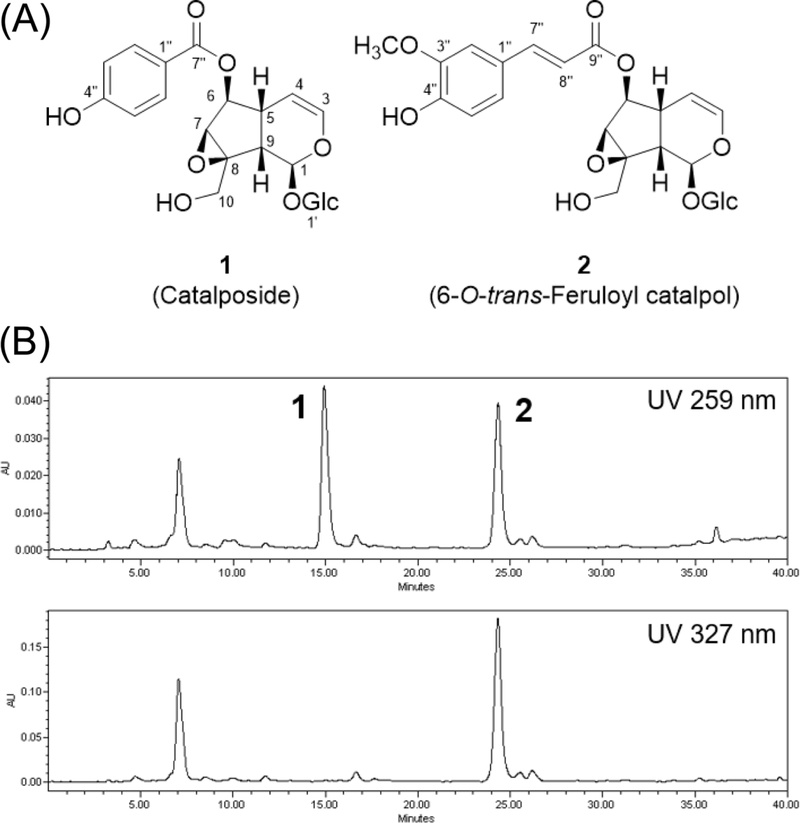
(A) Chemical structures of major iridoid glycosides, catalposide (1) and 6-O-trans-feruloyl catalpol (2). (B) HPLC chromatograms of the 70% EtOH crude extract of the stem bark of C. ovata under detection at UV 259 (top) and 327 nm (bottom).
To determine an optimal HSCCC separation condition for the two major iridoid glycosides, the EtOAc/BuOH/water biphasic solvent system was selected by considering their polarity, and various solvent ratios were evaluated in terms of the partition coefficient (K) and separation factor (α) values (Table 1).15 The K value indicates how the analyte behave in a two-phase solvent and is therefore directly related to the degree of retention and separation in HSCCC. Smaller K values result in earlier elution, whereas larger K values lead to later elution. Accordingly, higher K values are expected to improve resolution, but they may also cause peak broadening and undesirably long retention times. Consequently, a K value in the range of 0.5 to 2 is considered appropriate, with 1 being the central point.6,7 As a result, the EtOAc/BuOH/water (10:1:10, v/v) solvent system gave K values of 0.95 and 1.97 for catalposide (1) and 6-O-trans-feruloyl catalpol (2), respectively. In addition, the separation factor (α) was calculated to be 2.07, indicating effective separation between the two target compounds under the solvent system. An α value higher than 1.5 is generally recommended.6 Collectively, the EtOAc/BuOH/water (10:1:10, v/v) solvent system was selected for the HSCCC isolation.

The partition coefficient (K) and separation factor (α) of catalposide (1) and 6-O-trans-feruloyl catalpol (2) in several solvent systems of EtOAc/BuOH/water.
The crude extract of the stem bark of C. ovata (100 mg) was applied to HSCCC using the optimized biphasic solvent system (EtOAc/BuOH/water, 10:1:10, v/v). The HSCCC operation was monitored by UV detection at 259 and 327 nm, and satisfactory separation was achieved (Fig. 2). For successful separation on HSCCC, it is recommended to retain a sufficient amount of liquid stationary phase in the coiled column, with over 50% of the total column capacity being considered ideal.6 In this study, the retention of the stationary phase in HSCCC operation was 46.2% of the total column capacity, close to the recommended value. The eluents collected in test tubes were combined according to the corresponding resolved peaks and subsequently identified as catalposide (1) and 6-O-trans-feruloyl catalpol (2), respectively, based on comparative analysis of the 1H- and 13C-NMR data with the literature values (Table 2).11,12 The 1H- and 13C-NMR spectra of the two target analytes were found to be highly similar, with characteristic NMR features of a C9-type iridoid skeleton.4 Catalposide (1) showed the diagnostic signals at δH 5.19 (1H, d, J = 8.9 Hz)/δC 95.1 (C-1), 6.38 (1H, dd, J = 6.0, 1.4 Hz)/142.5 (C-3), 5.02 (1H, dd, J = 6.0, 4.2 Hz)/103.0 (C-4), 2.64 (1H, m)/36.8 (C-5), 5.11 (1H, dd, J = 8.0, 1.2 Hz)/81.6 (C-6), 3.74 (1H, d, J = 1.2 Hz)/60.3 (C-7), 2.66 (1H, m)/43.3 (C-9), 3.84 and 4.18 (each 1H, d, J = 13.0 Hz)/61.4 (C-10), and δC 66.9 (C-8). In addition, the typical resonances attributable to the presence of a β-glucopyranosyl group were also observed in both compounds. However, the assignment of the 1H and 13C resonances of the β-glucopyranosyl group in the literature was ambiguous.11,12 Thus, in the present study, further 1H-13C HSQC and 1H-1H COSY NMR data were acquired for 6-O-trans-feruloyl catalpol (2), and unambiguous assignment was achieved by analyzing the 2D correlation data, as well as by comparing the 1H- and 13C-NMR data with those of similar iridoid glycosides.4 While the two target analytes (1 and 2) shared many NMR features, significant differences were observed in the substituent at C-6 of the iridoid skeleton. Catalposide (1) exhibited signals for the p-hydroxybenzoyl group at δH 7.92 (2H, d, J = 9.0 Hz, H-2'' and H-6'') and 6.84 (2H, d, J = 9.0 Hz, H-3'' and H-5'') in the 1H-NMR spectrum.11 The 1H-NMR signals for the trans-feruloyl group were observed in the spectrum of 6-O-trans-feruloyl catalpol (2) instead: δH 7.22 (1H, d, J = 2.0 Hz, H-2''), 6.82 (1H, d, J = 8.4 Hz, H-5''), 7.10 (1H, dd, J = 8.4, 2.0 Hz, H-6''), 7.67 (1H, d, J = 15.8 Hz, H-7''), 6.42 (1H, d, J = 15.8 Hz, H-8''), and 3.90 (3H, s, OCH3-3'').12 The purity of the isolates (1 and 2) was determined by HPLC-ELSD analysis, with 98.1% and 99.2% purity, respectively (Fig. 3).
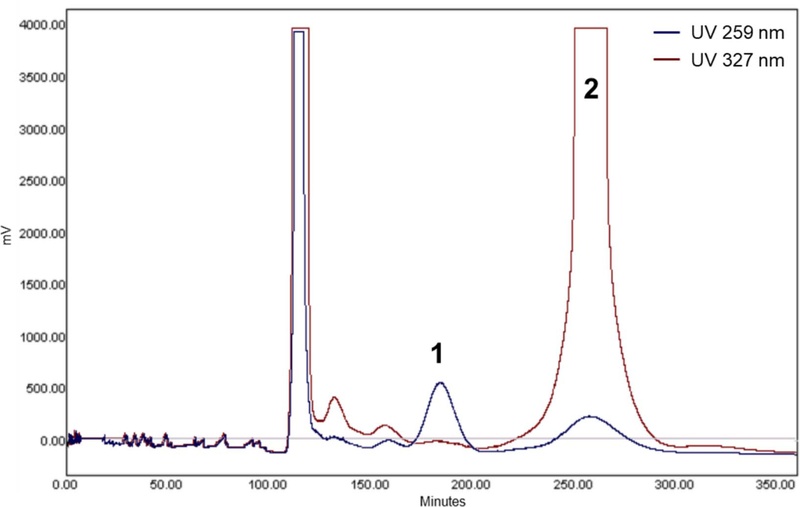
HSCCC chromatogram of the 70% EtOH crude extract of the stem bark of C. ovata. Solvent system: EtOAc/BuOH/water (10:1:10, v/v); flow rate: 1.5 mL/min; revolution rate: 800 rpm; sample size: 100 mg; catalposide (1, tR 185 min) and 6-O-trans-feruloyl catalpol (2, tR 260 min).
1H- and 13C-NMR spectroscopic data of catalposide (1) and 6-O-trans-feruloyl catalpol (2) in comparison with literature values.a
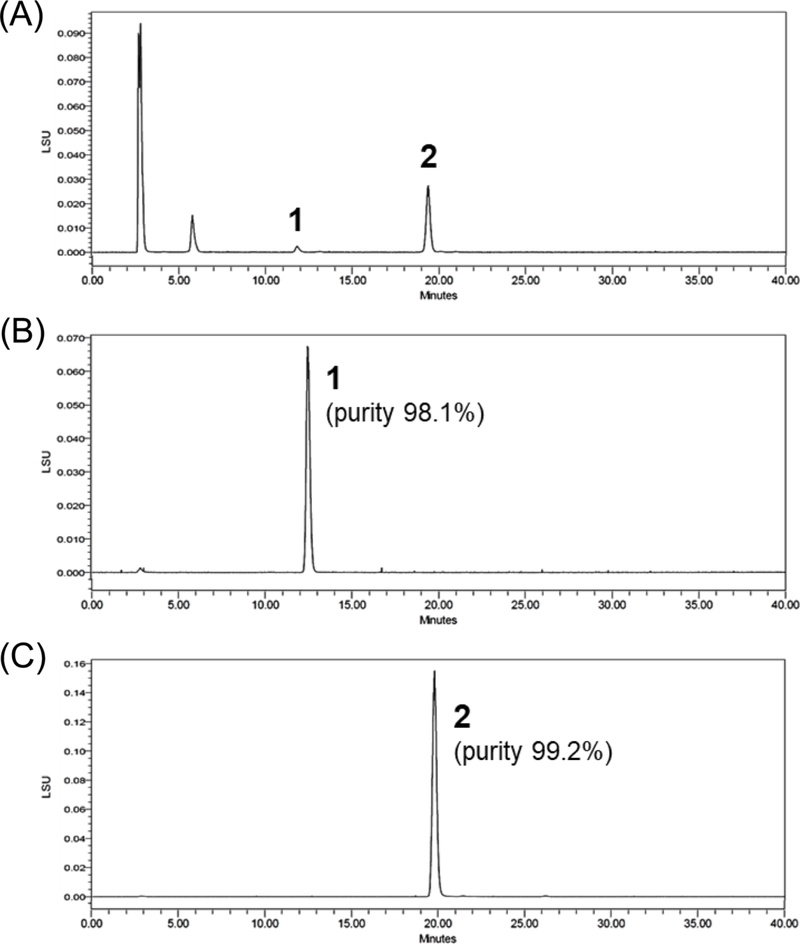
HPLC-ELSD analysis of (A) the 70% EtOH crude extract and HSCCC-purified (B) catalposide (1) and (C) 6-O-trans-feruloyl catalpol (2).
There was a previous study to develop a HSCCC condition (hexane/BuOH/water, 1.5:5:5, v/v) to purify catalposide (1) from the aerial part of Veronica ciliata Fisch., but this was accompanied by solvent partitioning as a pretreatment step (Table 3).16 Other than the study, previous preparation methods involved multi-step processes, including solvent partitioning and conventional column chromatography, which took more preparation time and resulted in lower efficiency. The yields of the target analytes (1 and 2) from the HSCCC separation in the present study were significantly higher than those from the previous methods (1.28% and 4.03%, respectively). It is suggested that the one-step HSCCC separation reduced sample loss that can occur in sequential fractionation steps. The quantities of catalposide (1) and 6-O-trans-feruloyl catalpol (2) were determined to be 1.76% and 21.07%, respectively, by HPLC-ELSD analysis of the 70% EtOH crude extract (Fig. 3A). This indicated that the HSCCC method in this study achieved a high recovery of catalposide (1). The relatively low recovery of 6-O-trans-feruloyl catalpol (2) can be ascribed to the broad peak in the HSCCC separation; however, it still afforded a significantly higher yield than previous methods for the stem bark of C. ovata (0.0300% and 0.0034% yield in references no. 4 and 2, respectively).2,4 Taken together, HSCCC was successfully applied in the present study to develop an efficient preparative method for two major iridoid glycosides from the stem bark of C. ovata. In particular, the optimized HSCCC conditions in the present study can be utilized as an efficient one-step preparative strategy for the bioactive compound 6-O-trans-feruloyl catalpol.
Comparative summary of preparation methods of catalposide (1) and 6-O-trans-feruloyl catalpol (2).
Acknowledgments
This work was supported by the 2024 Inje University research grant.
Conflicts of Interest
The authors declare that they have no conflicts of interest.
References
-
Pae, H. O.; Oh, G. S.; Choi, B. M.; Shin, S.; Chai, K. Y.; Oh, H.; Kim, J. M.; Kim, H. J.; Jang, S. I.; Chung, H. T. J. Ethnopharmacol. 2003, 88, 287–291.
[https://doi.org/10.1016/S0378-8741(03)00228-9]

-
Young, H. S.; Kim, M. S.; Park, H. J.; Chung H. Y.; Choi, J. S. Arch. Pharm. Res. 1992, 15, 322–327.
[https://doi.org/10.1007/BF02974106]
-
Oh, H.; Pae H.‐O.; Oh, G.‐S.; Lee, S. Y.; Chai, K.‐Y.; Song, C. E.; Kwon, T.‐O.; Chung, H.‐T. Planta Med. 2002, 68, 685–689.
[https://doi.org/10.1055/s-2002-33810]
-
Kil, Y.‐S.; Kim, S. M.; Kang, U.; Chung, H. Y.; Seo, E. K. J. Nat. Prod. 2017, 80, 2240–2251.
[https://doi.org/10.1021/acs.jnatprod.7b00139]
-
Park, J.; Kil, Y.‐S.; Yi, H. J.; Seo, E. K.; Woo, H. A. Antioxidants 2025, 14, 1210.
[https://doi.org/10.3390/antiox14101210]
-
Ito, Y. J. Chromatogr. A 2005, 1065, 145–168.
[https://doi.org/10.1016/j.chroma.2004.12.044]
-
Pauli, G. F.; Pro, S. M.; Friesen, J. B. J. Nat. Prod. 2008, 71, 1489–1508.
[https://doi.org/10.1021/np800144q]
-
Tundis, R.; Loizzo, M. R.; Menichini, F.; Statti, G. A.; Menichini, F. Mini Rev. Med. Chem. 2008, 8, 399–420.
[https://doi.org/10.2174/138955708783955926]
-
Ramos‐de‐la‐Peña, A. M.; Leitão, G. G.; Méndez‐Merino, E.; Contreras‐Esquivel, J. C. J. Sep. Sci. 2025, 48, e70305.
[https://doi.org/10.1002/jssc.70305]
-
Kil, Y.‐S.; Nam, J.‐W.; Lee, J.; Seo, E. K. Arch. Pharm. Res. 2015, 38, 1506–1511.
[https://doi.org/10.1007/s12272-014-0530-2]
-
Lee, J. H.; Jun, H.‐j.; Hoang, M.‐H.; Jia, Y.; Han, X. H.; Lee, D.‐H.; Lee, H.‐J.; Hwang, B. Y.; Lee, S.‐J. Biochem. Biophys. Res. Commun. 2012, 422, 568–572.
[https://doi.org/10.1016/j.bbrc.2012.05.025]
-
Stuppner, H.; Wagner, H. Planta Med. 1989, 55, 467–469.
[https://doi.org/10.1055/s-2006-962066]
-
Feng, S.‐X.; Yi, B.; Zhang, M.; Xu, J.; Lin, H.; Xu, W.‐T. Nat. Prod. Res. 2017, 31, 181–189.
[https://doi.org/10.1080/14786419.2016.1224872]
-
Kim, H. M.; Kim, C. Y. Nat. Prod. Sci. 2025, 31, 209–235.
[https://doi.org/10.20307/nps.2025.31.4.209]
-
Friesen, J. B.; Pauli, G. F. J. Chromatogr. A 2007, 1151, 51–59.
[https://doi.org/10.1016/j.chroma.2007.01.126]
-
Lu, Q.; Sun, Y.; Shu, Y.; Tan, S.; Yin, L.; Guo, Y.; Tang L. Molecules 2016, 21, 1234.
[https://doi.org/10.3390/molecules21091234]
-
Park, S.; Shin, H.; Park, Y.; Choi, I.; Park, B.; Lee, K. Y. Bioorg. Chem. 2018, 80, 57–63.
[https://doi.org/10.1016/j.bioorg.2018.05.023]
-
Harput, U. S.; Varel, M.; Nagatsu, A.; Saracoglu, I. Phytochemistry 2004, 65, 2135–2139.
[https://doi.org/10.1016/j.phytochem.2004.05.012]
-
Huang, S.‐X.; Zhou, Y.; Nie, Q.‐J.; Ding, L.‐S.; Peng, S.‐L. J. Asian Nat. Prod. Res. 2006, 8, 259–263.
[https://doi.org/10.1080/10286020500034543]
-
Taskova, R. M.; Kokubun, T.; Garnock‐Jones, P. J.; Jensen, S. R. Phytochemistry 2012, 77, 209–217.
[https://doi.org/10.1016/j.phytochem.2012.02.001]