
Isolation of Pyranone Derivative and Other Secondary Metabolites from Engelhardia spicata Bark and Immunomodulatory Analysis
Abstract
Engelhardia spicata locally known as Mauwa in Nepal, is used as the traditional medicine for treating various ailments. Different classes of biologically active compounds are reported from genus Engelhardia. Despite its biological importance, research on E. spicata remains limited. This study was thus conducted to investigate the bioactive chemical constituents of Engelhardia spicata. The methanolic extract of bark from Engelhardia spicata Lesch. ex Blume, on phytochemical investigation afforded 5-hydroxy-4-(hydroxymethyl)-pyran-2-one (1), gallic acid (2), quercetin-3-O-α-L-rhamnopyranoside (3), astilbin (4), myricitrin (5), quercetin-3-O-β-D-glucopyranoside (6), 3,3′-di-O-methylellagic acid-4-O-β-D-xylopyranoside (7), 3,3′-di-O-methylellagic acid (8) and oleanolic acid (9). Their structures were identified by analyzing the spectroscopic data. Flavonoids, gallic acid, ellagic acid and terpenoids have already been reported from genus Engelhardia. Compound 1, pyranone derivative was reported for the first time from genus Engelhardia. It exhibited weak immunomodulatory activity by 25 μg/mL (176 μM) with oxidative burst inhibition of 27.34 ± 2.1%.
Keywords:
Engelhardia spicata, Immunomodulatory activity, Pyranone, Ellagic acid, FlavonoidIntroduction
Engelhardia spicata Lesch. Ex Blume, locally known as Mauwa in Nepal, is a deciduous tree which is about 20 m tall in height and with a thick, straight and deeply fissured stem. It is mainly found in Nepal, India, China, Indonesia and Philippine. Bark of this plant is consumed as the traditional medicine for treating diarrhea and dysentery and is also used as the fumigant and applied to treat bone fracture. Young shoots of E. spicata are used for fish poison.1,2 Apart from bark, flower of this plant is used to get relief from abdominal pain.3 The leaves of E. chrysolepsis (commonly known as Khoki tea) are sweet in taste and constituents of this tea show activities related to anti-obesity and diabetic complications.4
Various classes of compounds, flavanol glycosides, diarylheptanoids, cyclic diarylheptanoids, napthoquinone, anthraquinone, alkaloid, tetralone, butanolide, sesquiterpenes, tritepenes, polyphenols, benzyl derivatives and long chain fatty acids have been reported as component of genus Engelhardia.5–17 The High-performance counter-current chromatography was used for separation of four pairs of diastereomers from E. roxburghiana.18
The biological study discovered that the flavonoids and polyphenolic compounds isolated from the leaves of Engelhardia species showed various pharmacological properties such as anti-oxidation, anti-allergic, anti-poliferative, anti-inflammatory and anti-cancer activities.7–10,15,16 The compounds like cyclic diarylheptanoids, tetralone and nepthaquinone dimer isolated from E. roxburghiana showed antitubercular activity against Mycobacterium tuberculosis H37Rv.5,13,14 The rat lens aldose reductase enzyme was inhibited by taxifolin and astilbin, reported from the leaves of E. chrysolepis. Taxifolin inhibited the sorbitol accumulation in human blood cells and was effective for preventing osmotic stress in hyperglycemia.20 Plant extracts were well-known for their use in various therapeutic purposes for improving bladder function, treating urinary disturbance and also for treating osteoporosis with less adverse effect.19,20 Compared to astilbin, the leaves of E. roxburghiana presented significantly higher antioxidant and also displayed stronger affinity with α-glucosidase.21 The total flavonoids of E. roxburghiana leaves decrease atherosclerotic plaques size in aorta, and notably reduced the serum lipids, down-regulated NF-κB, TNF-α and VCAM-1, as well as IL-1β expressions in thoracic aorta.22 Further, in vivo and in vitro atherosclerosis progression is alleviated through reducing foam cells formation and inflammatory responses by the total flavonoids of E. roxburghiana. The possible mechanism might be due to the activation of macrophage autophagy by inhibiting AKT and mTOR phosphorylation.23
Despite its biological importance, research on E. spicata remains limited. Therefore, this study was conducted to investigate the bioactive chemical constituents of Plant. From the current phytochemical investigation, the methanolic extract from bark of E. spicata Lesch. ex Blume afforded isolation of nine known compounds. 5-Hydroxy-4-(hydroxyl-methyl)pyran-2-one (1) was isolated from marine-derived fungus Aspergillus flavus identified as possible ligand for GPR12 transfected cells and also from plant, Scadoxus pseudocaulus.24,25 Pyranone derivative was reported for the first time from genus Engelhardia. Compound 1 has exhibited weak immunomodulatory activity by 25 μg/mL (176 μM) with oxidative burst inhibition of 27.34 ± 2.1%.
Experimental
Collection of plant – The plant E. spicata was collected from Gulmi district of Nepal at the altitudes of 1,700 m. It was identified by comparison with herbarium (collection no. 9684146) at National Herbarium Laboratory, Department of Plant Resources, Godawari, Nepal.
Chemicals and instruments – Analytical grade solvents were used for solvent-solvent extraction and column chromatography. Pre-coated silica gel G-25-UV254 plates (E. Merck, Darmstadt, Germany) were used for thin layer chromatography. Silica gel (200-400 mesh, E. Merck, Darmstadt Germany) and polygoprep (100-120) RP-18 reversed phase silica were used for column chromatography. HPLC grade solvents (Merck and Fisher Scientific) were used for HPLC purification. Preparative high-performance liquid chromatography (HPLC) was used for the purification via recycling preparative HPLC (LC-908W-C-60, Japan Analytical Industry Co. Ltd, Tokyo, Japan) with JAIGEL-ODS-L80 (reversed phase 4 µM, 20 × 250 mm2) and JAIGEL-SIL-D-60-10 (normal phase 120 Å, 20 × 250). The flow rate was set at 4 mL/min. The MeOH: water (40:60) solvent systems for reversed phase and ethyl acetate/n-hexane (10:90) solvent system for normal phase were used during HPLC analysis.
The UV spectra were recorded on a Thermo-CN Evolution 300 spectrophotometer and λmax was expressed in nm. The IR spectra were plotted on a FTIR-8900 spectrophotometer using KBr for solid compounds and CHCl3 for gummy compound and expressed in cm-1. 1H-NMR and 13C-NMR spectra were recorded on Bruker AV-300, AV-500 and AV 600 spectrometer. 1H spectra were run at the frequency of 300 MHz and 500 MHz while 13C-NMR spectra were recorded on Bruker AV-500 and AV-600 instrument at 125 MHz and 150 MHz respectively. 1H-NMR and 13C-NMR chemical shifts values were reported in δ (ppm), while coupling constants (J) were calculated in Hz. 2D NMR spectra were measured on Bruker AV 500 and 600 MHz NMR spectrometers. Low resolution electron-impact mass spectra (EI-MS) were recorded at Finnigan MAT-312 and JEOL JMS 600-H instruments. The ion peaks were presented in m/z.
Extraction and separation of compounds – The air dried bark of E. spicata (3.5 kg) was percolated in 90% MeOH/H2O for seven days. The methanol/water extract was concentrated under reduced pressure to obtain the dark gummy extract (310 g). It was diluted in water and the aqueous suspension was then extracted sequentially with n-hexane, dichloromethane, ethyl acetate and n-butanol to obtain n-hexane (12.14 g), dichloromethane (6.63 g), ethyl acetate (20.53 g) and n-butanol (42.48 g) fractions.
The ethyl acetate fraction (20 g) was first fractionated by silica gel column chromatography using n-hexane/ethyl acetate solvent system. Twenty sub-fractions (1–20) were compiled by gradually elution with increasing ethyl acetate in n-hexane and then methanol in ethyl acetate/methanol solvent systems. Sub-fraction 6 (eluted at 30% ethyl acetate in hexane) loaded to silica gel column was eluted with acetone/n-hexane resulting to two major sub-fractions 6a (eluted at 13% acetone in hexane) and 6b (eluted at 25% acetone in hexane). Both sub fractions were subjected to LH20 sephadex column using methanol as mobile phase. 5-hydroxy-4-(hydroxylmethy)-pyranone (1) (157.2 mg) was isolated from sub-fraction 6a and gallic acid (2) (155.3 mg) was isolated from sub-fraction 6b. Sub-fractions 9 (eluted at 60% ethyl acetate in hexane) was run into isocratic reversed phase recycling HPLC (JAIGEL-ODS-L80) eluting with MeOH:water (40:60) to get quercetin-3-O-α-L-rhamnopyranoside (3) (10 mg) at 40 min and astilbin (4) (10 mg) at 52 min. Subfraction 10 (eluted at 80% ethyl acetate in hexane) was also run into isocratic reversed phase recycling HPLC (JAIGEL-ODS-L80) eluting with MeOH:water (40:60) to get quercetin-3-O-β-D-gluco-pyranoside (6) and myricitrin (5) (7 mg) at retention time of 22 min, and 37 min, respectively. 3,3′-di-O-methyl ellagic acid-4-O-β-D-xylopyranoside (7) (78 mg) was obtained as a precipitate from the sub-fraction 13 (eluted at 2% methanol in ethyl acetate) after repeated washing with n-hexane.
The dichloromethane extract (6 g) was eluted with n-hexane/ethyl acetate solvent system in silica gel column to get 1–25 subfractions after analyzing TLC. 3,3′-di-O-methyl ellagic acid (8) (20 mg) was obtained as the precipitate from the sub-fraction 24 (eluted at 10% ethyl acetate in hexane). Oleanolic acid (9) (5 mg) was obtained from the filtrate of same sub-fraction 24 on subjected to normal phase HPLC (JAIGEL-SIL-D-60-10) with solvent system ethyl acetate/n-hexane in ratio 10:90. The structures were identified by comparing their spectroscopic data with the literature.
5-Hydroxy-4-(hydroxylmethyl)-pyran-2-one (1) – Yellow crystalline needles (157.2 mg); M.p.: 260.5oC; UV (CH3COCH3) λmax nm: 272, 239, 217; IR (KBr) νmax cm-1 : 3174 (Ar-H), 1659, 1612 (C=O); EI-MS: m/z 142.0 [M]+ (Calcd. C6H6O4, 142.03); 1H-NMR (300 MHz, MeOD): δ7.94 (1H, s, H-6), 6.48 (1H, s, H-3), 4.39 (2H, s, CH2-7); 13C-NMR (125 MHz, MeOD): δ 176.8 (C-2), 170.4 (C-5), 147.4 (C-4), 141.0 (C-6), 110.7 (C-3), 61.2 (C-7).24
Gallic acid (2) – Crystalline solid (153 mg); M.p.: 253oC; UV (CH3COCH3) λmax nm: 273, 222, 213; IR (KBr) νmax cm-1: 3262 (O-H), 3011 (Ar C-H), 1702 (C=O), 1338, 1252 (C-O); EI-MS: m/z 170.0 [M]+, 153.0 [M+H-H2O]+, (Calcd. C7H6O5, 170.02); 1H-NMR (500 MHz, MeOD): δ7.04 (2H, s, H-7 and H-3); 13C-NMR (125 MHz, MeOD): δ 170.4 (C-1), 146.3 (C-4 and C-6), 139.5 (C-5), 122.1 (C-2), 110.3 (C-3 and C-7).26
Quercetin-3-O-α-L-rhamnopyranoside (3) – Yellow amorphous solid (10 mg); M.p.: 232oC; UV (CH3COCH3), λmax nm: 350, 260, 210; IR (KBr) νmax cm-1: 3250, 3411 (O-H), 1603 (C=O); EI-MS: m/z 302.1 [M+H-C6H11O4]+, (Calcd. C21H20O11, 448.10); 1H-NMR (300 MHz, MeOD): δ 7.32 (H-2′), 7.28 (d, J = 8.4 Hz, H-6′), 6.91 (1H, d, J =8.4 Hz, H-5′), 6.35 (1H, s, H-8), 6.19 (1H, s, H-6), 5.34 (1H, brs, H-1′′), 4.20 (1H, brs, H-2′′), 3.71 (1H, dd, J =9.0 Hz, 2.7 Hz, H-4′′), 3.40 (1H, m, H-5′′), 3.35 (1H, m, H-3′′), 0.94 (3H, d, J = 6.0 Hz, H-6′′); 13C-NMR (150 MHz, MeOD): δ 179.6 (C-4), 166.2 (C-7), 163.2 (C-5), 159.2 (C-2), 158.5 (C-9), 149.8 (C-3′), 146.4 (C-4′), 136.2 (C-3), 122.9 (C-1′), 122.8 (C-6′), 116.9 (C-2′), 116.3 (C-5′), 105.8 (C-10), 103.5 (C-1′′), 94.9 (C-6), 94.7 (C-8), 73.2 (C-3′′), 72.1 (C-2′′), 72.0 (C-4′′), 71.9 (C-5′′), 17.6 (C-6′′).9,27
Astilbin (4) – Yellow amorphous solid (10 mg); M.p.: 179oC; UV (CH3COCH3), λmax nm: 292, 230, 222, 213; IR (KBr) νmax cm-1: 3405, 3268 (Ar-H), 3571 (O-H), 1642, 1601 cm-1 (C=O); EI-MS m/z: 302.1 [M-C6H11O4]+, FAB –ve m/z 449 [M−H]− and FAB +ve m/z 451 [M+H]+, (Calcd. C21H22O11, 450.12); 1H-NMR (300 MHz, MeOD): δ 6.94 (H-2′), 6.84 (H-5′), 6.81 (H-6′), 5.90 (1H, s, H-8), 5.88 (1H, s, H-6), 5.08 (1H, d, J = 10.5 Hz, H-2), 4.58 (1H, d, J = 10.5 Hz, H-3), 4.28 (1H, m, H-2′′), 4.04 (1H, brs, H-1′′), 3.66 (1H, dd, J = 9.3 Hz, 3.0 Hz, H-3′′), 3.53 (1H, s, H-4′′), 3.30 (1H, m, H-5′′), 1.18 (3H, d, J = 6.3 Hz, 6′′-CH3); 13C-NMR (150 MHz, MeOD): δ 195.9 (C-4), 165.4 (C-5), 164.1 (C-9), 147.3 (C-3′), 146.5 (C-4′), 129.2 (C-1′), 120.4 (C-6′), 116.3 (C-2′), 115.4 (C-5′), 102.4 (C-10), 102.1 (C-1′′), 83.9 (C-2), 78.5 (C-3), 97.4 (C-6), 168.8 (C-7), 96.3 (C-8), 73.8 (C-4′′), 72.1 (C-3′′), 71.7 (C-2′′), 70.5 (C-5′′), 17.8 (C-6′′).8
Myricitrin (5) – Pale yellow amorphous solid (7 mg); M.p.: 196oC; (Calcd. C21H20O12, 464.10); 1H-NMR (300 MHz, MeOD): δ 6.93 (2H, s, H-2′ and H-6′), 6.19 (1H, d, J = 2.0 Hz, H-6), 6.35 (1H, d, J = 2.0 Hz,, H-8), 5.30 (1H, brs, H-1′′), 4.20 (1H, brs, H-2′′), 3.75 (1H, dd, J = 9.3 Hz, 3.3 Hz, H-3′′), 3.50 (1H, m, H-4′′), 3.48 (1H, m, H-5′′), 0.96 (3H, d, J = 6 Hz, 6′′-CH3); 13C-NMR (150 MHz, MeOD): δ 179.6 (C-4), 166.1 (C-7), 163.2 (C-5), 159.4 (C-9), 158.5 (C-2), 146.8 (C-3′ and C-5′), 137.9 (C-4′), 136.2 (C-3), 121.8 (C-1′), 109.4 (C-2′ and C-6′), 105.7 (C-10), 103.6 (C-1′′), 99.8 (C-6), 94.7 (C-8), 72.1 (C-2′′), 73.3 (C-3′′), 72.0 (C-4′′), 71.8 (C-5′′), 17.6 (C-6′′).28
Quercetin-3-O-β-D-glucopyranoside (6) – Yellow amorphous solid (8 mg); M.p.: 227 oC; EI-MS: m/z 302.0 [M+H-C6H11O6]+ (Calcd. C21H20O12, 464.10); 1H-NMR (300 MHz, MeOD): δ 7.82 (1H, d, J = 3.0 Hz, H-6′), 7.59 (1H, dd, J = 8.7, 2.1 Hz, H-2′), 6.84 (1H, d, J = 9.0 Hz, H-5′), 6.38 (1H, d, J = 3.0 Hz, H-8), 6.19 (1H, d, J = 3.0 Hz, H-6), 5.13 (1H, d, J = 9.0 Hz, H-1′′), 3.83 (1H, m, H-2′′), 3.81 (1H, m, H-3′′), 3.47 (1H, m, H-4′′), 3.52 (1H, m, H-5′′), 3.55 (2H, d, J = 6.3 Hz H-6′′); 13C-NMR (125 MHz, MeOD): δ 179.5 (C-4), 166.0 (C-7), 163.0 (C-5), 158.7 (C-9), 158.5 (C-2), 149.9 (C-3′), 145.8 (C-4′), 135.7 (C-3), 122.9 (C-1′), 122.8 (C-6′), 117.7 (C-2′), 116.0 (C-5′), 105.6 (C-10), 104.3 (C-1′′), 99.87 (C-6), 94.6 (C-8), 77.2 (C-5′′), 75.7 (C-2′′), 75.0 (C-3′′), 71.8 (C-4′′), 61.93 (C-6′′).29
3,3′-di-O-methyl ellagic acid-4-O-β-D-xylopyranoside (7) – Light Yellow amorphous solid (78 mg); M.p.: 301°C; IR (KBr) νmax cm-1: 1612, 3401 (Ar), 1752 (C=O); EI-MS: m/z 330.0 [M+H-C5H9O5]+, (Calcd. C21H18O12, 462.08); 1H-NMR (300 MHz, DMSO): δ 7.75 (1H, s, H-5′), 7.53 (1H, s, 5-H), 5.48 (1H, m, H-2′′), 5.20 (1H, m, H-1′′), 4.06 (3H, s, 3′-OCH3), 4.04 (3H, s, 3-OCH3), 3.82 (1H, m, H-3′′), 3.80 (1H, m, H-4′′), 2.49 (2H, m, H-5′′); 13C-NMR (125 MHz, DMSO): δ 158.3 (C-7), 158.4 (C-7′), 152.8 (C-4), 151.2 (C-4′), 141.8 (C-2′), 141.6 (C-2), 140.9 (C-3′), 140.1 (C-3), 112.8 (C-6), 114.2 (C-1′), 111.9 (C-6′), 111.8 (C-5′), 111.6 (C-5), 111.1 (C-1), 101.7 (C-1′′), 76.1 (C-3′′), 73.0 (C-2′′), 69.2 (C-4′′), 65.7 (C-5′′), 61.6 (3-OCH3), 61.0 (3′-OCH3).15,30
3,3′-di-O-methyl ellagic acid (8) – Light Yellow amorphous (20 mg); M.p.: 301°C; UV (CH3COCH3), λmax nm: 378, 272, 246; IR (KBr) νmax cm-1: 3272 (Ar-H) and 1725.2 (C=O); EI-MS: m/z 330.0 [M]+, (Calcd. C16H10O8, 330.04); 1H-NMR (500 MHz, DMSO): δ 7.51 (2H, s, H-5 and H-5′), 4.03 (6H, s, 3-OCH3 and 3′-OCH3); 13C-NMR (125 MHz, DMSO): δ 141.2 (C-2 and C-2′), 140.2 (C-3 and C-3′), 152.2 (C-4 and C-4′), 112.1 (C-6 and C-6′), 111.6 (C-5 and C-5′), 111.4 (C-1 and C-1′), 60.9 (3-OCH3 and 3′-OCH3).31
Oleanolic acid (9) – White amorphous (5 mg); M.p.: 306°C; EI-MS: m/z 456.4 [M]+ (Calcd. C30H48O3, 456.36); 1H-NMR (MeOD, 500 MHz) : δ 5.21 (1H, t, J = 3.5 Hz, H-12), 3.15 (1H, m, H-3), 1.11 (3H, s, H-27), 0.96 (3H, s, H-23), 0.97 (3H, s, H-24), 0.95 (3H, s, H-29), 0.86 (3H, s, H-30), 0.84 (3H, s, H-26), 0.77 (3H, s, H-25); 13C-NMR (MeOD, 150 MHz): δ 181.8 (C-28), 139.6 (C-13), 126.8 (C-12), 79.6 (C-3), 54.3 (C-4), 54.3 (C-9), 56.7 (C-5), 43.2 (C-17), 43.2 (C-14), 43.2 (C-19), 40.4 (C-18), 39.9 (C-8), 39.9 (C-1), 34.3 (C-7), 38.1 (C-10), 38.1 (C-21), 31.7 (C-20), 31.7 (C-22), 29.2 (C-15), 28.7 (C-30), 27.8 (C-2), 25.3 (C-11), 24.6 (C-29), 24.3 (C-16), 24.0 (C-27), 19.4 (C-6), 17.8 (C-24), 17.6 (C-23), 16.3 (C-26), 16.0 (C-25).32
Immunomodulatory assay – Immunomodulatory bioassay was performed using whole blood cells of mouse, by oxidative burst assay using chemiluminescence technique.33 Triplicate of each 25 μL of diluted whole blood Hanks Balanced Salt Solution, (HBSS++ containing calcium chloride and magnesium chloride, Sigma, St. Louis, USA) with 25 μL of three different concentrations of isolated compounds (1, 10 and 100 μg/mL) were incubated. The HBSS++ and cells without compounds were used as control. White half area 96 well plates (Costar, NY, USA), were tested for performance. It was incubated at 37 °C for 15 minutes in the thermostat chamber of luminometer (Labsystems, Helsinki, Finland]. After incubation, 25 μL of serum opsonized zymosan (SOZ) (Fluka, Buchs, Switzerland) and 25 μL of intracellular reactive oxygen species detecting probe, Luminol (Research Organics, Cleveland, OH, USA) were added into each well, except blank wells (containing only HBSS++). Luminometer in term of relative light units (RLU) were recorded to determine level of the ROS.
Results and Discussions
Compounds 1–7 (Fig. 1) were isolated from the ethyl acetate fraction and compounds 8 and 9 were isolated from the dichloromethane fraction from E. spicata by repeated column chromatography as discussed in the experimental part. Structurally diverse compounds 1 (pyranone derivative), 2 (phenolic), 3, 4, 5 and 6 (flavonoid derivatives), 7 and 8 (ellagic acid derivatives) and 9 (terpenoid) were characterized on the basis of spectral data of mass, IR, UV, 1H-NMR, 13C-NMR and 2D NMR (Fig. S1–S78). Compounds 2, 4, 7, 8, and 9 have been reported in the literature from different species of genus Engelhardia.8,13,15
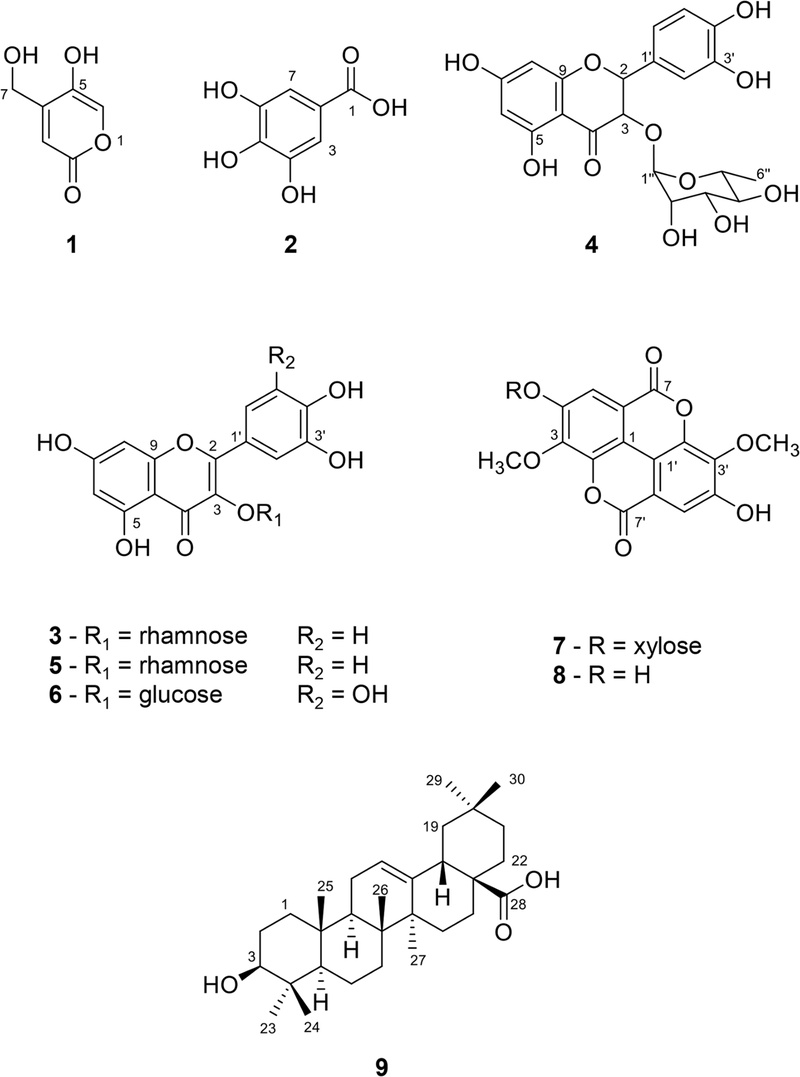
Compounds isolated from E. spicata.
Compound 1 was reported from genus Engelhardia for the first time. The EI-MS showed molecular ion peak at m/z 142 [M]+ and other strong peak at m/z 113 [M-C=O]+. The 13C-NMR spectrum of compound 1 showed six carbon signals. Out of which one methylene, two methine and three quaternary carbons were deduced from analysis of DEPT spectra. The downfield signal at δC 176.8 (C-2) was due to the lactone ring. The enol carbon resonated at δC 170.4 (C-5) and remaining carbons of pyrone ring resonated at δC 110.7 (C-3), 141.0 (C-6) and 147.4 (C-4). The downfield carbon signal at δC 61.9 (C-7) supported the presence of a hydroxyl group. The chemical shift values of NMR data matched with the reported data by Lin et al. 2008.24 The spectral data analysis confirmed the compound 1 as 5-hydroxy-4-(hydroxylmethyl)-pyran-2-one.
Gallic acid (2) showed only one singlet proton at δH 7.04 (H-3, H-7) in the aromatic region due to symmetry. The 13C-NMR broad band spectrum showed total five carbon signals. The downfield carbon resonated at δC 170.4 (C-1) can be assigned to carboxylic carbon and other remaining carbon signals at δC 122.1 (C-2), 110.3 (C-3 and C-7), 146.3 (C-4 and C-6) and 139.5 (C-5) can be assigned to the aromatic carbons.15,26
Compounds 3, 6 and 5 showed similar pattern of 1H-NMR. The 1H-NMR spectra showed the broad singlet signals at δH 6.19 (H-6) and 6.35 to 6.38 (H-8) for the aromatic protons of ring A. The downfield doublets at δH 7.28 to 7.82 (H-6′) and 6.84 to 6.91 (H-5′) and the singlet at 7.32 to 7.59 (H-2′) appeared for the trisubstituted aromatic ring B of compounds 3 and 6.27,29 Further in 2D-NMR, COSY correlation between H-6′ and H-5′ was shown indicating two adjacent protons in the aromatic ring B. The downfield singlets at δH 6.93 (H-2′ and H-6′) instead of doublet H-6′ as in 3 and 6, indicated the tetrasubstituted aromatic ring B of compound 5. The characteristic anomeric protons for 3, 5, 6 were assigned to δH 5.34 (brs), 5.30 (brs) and 5.13 (d, J = 9.0 Hz), respectively. The HMBC correlations of anomeric protons, δH 5.34 (H-1′′) to δC 136.2 (C-3) in 3, δH 5.30 (H-1′′) to δC 136.2 (C-3) in 5 and δH 5.13 (H-1′′) to δC 135.7 (C-3) in 6 confirmed that sugar moiety is linked to C-3. The characteristic hydroxyl substituted methine and methylene signals for rhamnose and glucose moiety appeared at δH 3.35 to 4.28. The upfield methyl signals at δH 0.94 to 0.96 (H-6′′) in 3 and 5 confirms rhamnose sugar. Compound 4 showed the extra doublet signals at δH 5.08 (d, J = 10.5 Hz, H-2) and 4.58 (d, J = 10.5 Hz, H-3) in comparison to compound 3, 5 and 6 which confirmed the saturated C-2 and C-3 bonds.8 The 1H-NMR signals of each proton for respective compounds were assigned in the experimental section.
The 13C-NMR spectra for compounds 3, 4, 5 and 6 were comparatively similar. The downfield carbon resonated at δC 179.5 to 195.9 can be assigned to C-4 carbonyl carbon. Aromatic carbons of ring A with its hydroxy functionalities can be observed between δC 163.0 to165.4 (C-5), 94.9 to 99.8 (C-6), 166.0 to 168.8 (C-7), 94.6 to 96.3 (C-8), 158.5 to 164.1 (C-9) and 102.4 to 105.8 (C-10). The downfield signals at δC 116.3 to 117.7 (C-2′), 147.3 to 149.9 (C-3′), 145.8 to 146.5 (C-4′), 115.4 to 116.3 (C-5′) and 120.4 to 122.8 (C-6′) showed the presence of trisubstituted aromatic ring B in 3, 4 and 6. The different pattern of downfield signals of compound 5 in comparision to 3 and 6 at δC 121.8 (C-1′), 109.4 (C-2′), 146.8 (C-3′), 137.9 (C-4′), 109.4 (C-5′) and 146.8 (C-6′), indicated the tetrasubstituted aromatic ring B.27–29
Compound 7 and 8 also showed similar pattern of 1H-NMR and 13C-NMR. Compounds 7 showed two aromatic singlet protons at δH 7.53 (H-5) and 7.75 (H-5′). Two methyl protons of methoxy group resonated at δH 4.04 (3H, s, 3-OCH3) and 4.06 (3H, s, 3′-OCH3). The two downfield signals at δC 158.4 (C-7′) and 158.3 (C-7) indicated the presence of two lactone rings. The multiplet signals of anomeric proton of xylopyranose appeared at δH 5.20 (1H, m, H-1′′) and showed HMBC correlation with δC 151.2 (C-4′). Compound 8 showed only one aromatic singlet proton in comparison to compound 7 at δH 7.50 (H-5 and H-5′) due to its symmetry. The 13C spectra of compound 7 showed the additional signals for xylopyranose and other remaining signals were almost similar in compound 7 and 8.15,30,31
Compound 9 was UV inactive and showed pink color on spraying ceric sulphate reagent. The EI-MS exhibited molecular ion peak at m/z 456. The 1H-NMR showed sharp singlets for seven methyl at δH 0.96 (H-23), 0.97 (H-24), 0.77 (H-25), 0.84 (H-26), 1.11 (H-27), 0.95 (H-29) and 0.86 (H-30). Olefinic proton resonated at δH 5.51 (1H, t, J = 3.5 Hz, H-12). The multiplet at δH 3.15 (1H, m, H-3) was assigned to the hydroxylated C-3 proton. The downfield signal at δC 181.8 (C-28) was due to presence of a carboxylic group. By comparison of data with the reported compound, it was confirmed as oleanolic acid.32
The oxidative burst assay typically measures the production of reactive oxygen species (ROS) by immune cells (e.g., neutrophils or macrophages) in response to stimuli. This type of assay is frequently used to evaluate immunomodulatory effects related to the oxidative burst and ROS generation, which are key components of the innate immune response. The extracts from Engelhardia were well-known for their use in various therapeutic purposes for inflammation. So, among the compounds isolated, compounds 1 and 7 were studied for immunomodulatory assay along with standard compound ibuprofen. Immunomodulatory assay was performed by Oxidative Burst Assay using Chemiluminescence Technique on a diluted whole blood HBSS++ and cells (whole blood cells of mouse) with different concentration of compound. Compound 1 exhibited weak immunomodulatory activity by 25 μg/mL (176 μM) with oxidative burst inhibition of 27.34 ± 2.1 % whereas compound 7 found to be inactive with inhibition of 9.66 ± 2.7 % by 25 μg/mL (54 μM). The ibuprofen (standard) percent inhibition at 25 μg/mL (121 μM) was 73.2 ± 1.9 %. The level of reactive oxygen species was measured using a ROS detecting probe Luminol.
Previous studies on different species of Engelhardia, like chrysolepis, roxburghiana, serrata and colebrookiana have revealed that different classes of compounds like flavonoids, heptanoids, terpenoids, quinones and tetralones etc were isolated. These compounds had shown biologically potent activities in antitubercular, anticancer, antidiabetic, anti-inflammatory, aldose reductase inhibition, antioxidant, improving bladder function and anti-atherosclerotic etc. However, limited phytochemical investigation of E spicata has been reported. The results of our study from E. spicata confirmed that flavonoid, ellagic acid, terpenoid and gallic acid were the important constituents which had already been reported from genus Engelhardia. Pyranone derivative was reported from genus Engelhardia for the first time. These data suggested that the bark of E. spicata could be an excellent source for developing valuable functional ingredients for utilization in functional beverages, to reduce the risk of the diseases related to various inflammation, tumour and oxidant conditions under physiological conditions. Compositional analysis and characterization of important known constituents further help in the quality standardization of such an important herb, E. spicata. Furthermore, the immudomodulatory activity was evaluated for the first time in Engelhardia species and 5-hydroxy-4-(hydroxylmethyl)-pyran-2-one showed weak immunomodulatory activity. The limitation of this study is that it focused solely on chromatographic and spectroscopic analysis of compounds from the bark of E. spicata. Metabolite profiling by different hyphenated techniques can be further applied to characterize and standardize the active constituents. Future research should investigate other components to discover additional novel compounds with new activities.
Acknowledgments
The World Academy of Sciences for Developing World (TWAS) [grant number 11-010-RG/CHe/AS_G UNeSCO FR: 3240262700] and HEJ Research Institute of Chemistry are highly acknowledged for the financial support.
Conflicts of Interest
The authors declare they have no conflicts of interest.
References
- Ghimire, S. K.; Sapkota, I. B.; Oli, B. R.; Parajuli, R. R. Non-Timber Forest Products of Nepal Himalaya. Kathmandu: WWF Nepal. 2008.
-
Gaire, B. P.; Subedi, L. Am. J. Plant Sci. 2011, 11, 6–17.
[https://doi.org/10.5530/pj.2011.25.2]

- Burlakoti, C.; Kunwar, R. M. Folk Herbal Medicines of Mahakali Watershed Area, Nepal. In Medicinal Plants in Nepal: An Anthology of Contemporary Research. Ecological Society; Kathmandu, Nepal, 2008, pp 187–193.
-
Abidov, M. T.; del Rio, M. J.; Ramazanov, T. Z.; Klimenov, A. L.; Dzhamirze, S.; Kalyuzhin, O. V. Bull. Exp. Biol. Med. 2006, 141, 343–346.
[https://doi.org/10.1007/s10517-006-0167-3]
-
Wu, C.-C.; Peng, C.-F.; Tsai, I.-L.; El-Razek, M. H. A.; Huang, H.-S.; Chen, I.-S. Phytochemistry 2007, 68, 1338–1343.
[https://doi.org/10.1016/j.phytochem.2007.01.018]
-
Kasai, R.; Hirono, S.; Chou, W.-H.; Tanaka, O.; Chen, F.-H. Chem. Pharm. Bull. 1991, 39, 1871–1872.
[https://doi.org/10.1248/cpb.39.1871]
-
Liu, H.; Wang, S.; Cai, B.; Yao, X. Pharm. Biol. 2004, 42, 475–477.
[https://doi.org/10.3109/13880200490889028]
-
Huang, H.; Cheng, Z.; Shi, H.; Xin, W.; Wang, T. T. Y.; Yu, L. L. J. Agric. Food Chem. 2011, 59, 4562–4569.
[https://doi.org/10.1021/jf2002969]
-
Xin, W.; Huang, H.; Yu, L.; Shi, H.; Sheng, Y.; Wang, T. T. Y.; Yu, L. Food Chem. 2012, 132, 788–798.
[https://doi.org/10.1016/j.foodchem.2011.11.038]
-
Haraguchi, H.; Mochida, Y.; Sakai, S.; Masuda, H.; Tamura, Y.; Mizutani, K.; Tanaka, O.; Chou, W. H. Biosci. Biotechnol. Biochem. 1996, 60, 945–948.
[https://doi.org/10.1271/bbb.60.945]
-
Zhou, X.; Xu Q.; Li, J.-X.; Chen, T. Planta Med. 2009, 75, 654–655.
[https://doi.org/10.1055/s-0029-1185360]
-
Uniyal, S. K.; Badoni, V.; Sati, O. P. Int. J. Pharmacogn. 1992, 30, 209–212.
[https://doi.org/10.3109/13880209209053999]
-
Wu, H.-C.; Cheng, M.-J.; Peng, C.-F.; Yang, S.-C.; Chang, H.-S.; Lin, C.-H.; Wang, C.-J.; Chen, I.-S. Phytochemistry 2012, 82, 118–127.
[https://doi.org/10.1016/j.phytochem.2012.06.014]
-
Lin, W.-Y.; Peng, C.-F.; Tsai, I.-L.; Chen, J.-J.; Cheng, M.-J.; Chen, I.-S. Planta Med. 2005, 71, 171–175.
[https://doi.org/10.1055/s-2005-837786]
-
Liu, H.; Qu, G.; Yao, X. Pharm. Biol. 2003, 41, 305–307.
[https://doi.org/10.1076/phbi.41.4.305.15675]
- Mizutani, K.; Kambara, T.; Masuda, H.; Tamura, Y.; Tanaka, O.; Tokuda, H.; Nishino, H.; Kozuka, M. Food Factors for Cancer Prevention. Japan: Hamamatsu 1995, 607–612.
-
Pang, Y.-M.; Shan, Q.; Zhou, F.-J.; Hua, J.; Hou, W.-B. Chin. Herb. Med. 2018, 10, 2–13.
[https://doi.org/10.1016/j.chmed.2018.01.007]
-
Shi, H.; Liu, M.; Wang, R.; Gao, B.; Zhang, Z.; Niu, Y.; Yu, L. L. J. Chromatogr. A 2015, 27, 79–87.
[https://doi.org/10.1016/j.chroma.2015.01.024]
-
Levin, R. M.; Leggett, R. E.; Whitbeck, C.; Murakami, T.; Kambara, T.; Aikawa, K. Neurourol. Urodyn. 2004, 23, 355–360.
[https://doi.org/10.1002/nau.20033]
-
Haraguchi, H.; Ohmi, I.; Fukuda, A.; Tamura, Y.; Mizutani, K.; Tanaka, O.; Chou, W. H. Biosci. Biotechnol. Biochem. 1997, 61, 651–654.
[https://doi.org/10.1271/bbb.61.651]
-
Guo, X.; Zhou, T.; Xing, H.; Zhang, Y.; Fang, J.; Kang, T.; Yao, C.; Yan, J.; Huang, Y.; Yao, Q. Foods 2023, 12, 927.
[https://doi.org/10.3390/foods12050927]
-
Wei, J.; Zhang, Y.; Li, D.; Xie, T.; Li, Y.; Li, J.; Chen, X.; Wei, G. Chem. Biodivers. 2020, 17, e1900629.
[https://doi.org/10.1002/cbdv.201900629]
-
Wei, J.; Huang, L.; Li, D.; He, J.; Li, Y.; He, F.; Fang, W.; Wei, G. Chem. Biodivers. 2021, 18, e2100308.
[https://doi.org/10.1002/cbdv.202100308]
-
Lin, A.; Lu, X.; Fang, Y.; Zhu, T. J.; Gu, Q.; Zhu, W. J. Antibiot. 2008, 61, 245–249.
[https://doi.org/10.1038/ja.2008.36]
-
Pagning, A. L. N.; Tamokou, J.D.; Khan, M. L.; Ali, M. I.; Hameed, A.; Ngnokam, D.; Tapondjou, L. A.; Kuiate, J.R.; Ali, S. M. S. Afr. J. Bot. 2016, 102, 166–174.
[https://doi.org/10.1016/j.sajb.2015.06.009]
- Gangadhar, M.; Bhavana, P.; Sunil, Y.; Datta, S. Int. J. Res. Ayurveda Pharm. 2011, 2, 559–562.
- Nguyen, T. V. T.; Dinh, T. T. H.; Tran, T. M.; Ho, D. C.; Nguyen, X. N.; Pham H. Y.; Phan V. K. Vietnam J. Chem. 2019, 57, 401–405.
-
Mok, S.-Y.; Lee, S. Food Chem. 2013, 136, 969–974.
[https://doi.org/10.1016/j.foodchem.2012.08.091]
- Dudek-Makuch, M.; Matławska, I. Acta Pol. Pharm. 2011, 68, 403–408.
-
Yan, X.-H.; Guo, Y.-W. J. Asian Nat. Prod. Res. 2004, 6, 271–276.
[https://doi.org/10.1080/10286020310001595944]
-
Da Silva, S. L.; Calgarotto, A. K.; Chaar, J. S.; Marangoni, S. Toxicon. 2008, 52, 655–666.
[https://doi.org/10.1016/j.toxicon.2008.07.011]
- Gohari, A. R.; Saeidnia, S.; Hadjiakhoondi, A.; Abdoullahi, M.; Nezafati, M. J. Med. Plants 2009, 8, 65–69.
-
Helfand, S. L.; Werkmeister, J. A.; Roder, J. C. J. Exp. Med. 1982, 156, 492–505.
[https://doi.org/10.1084/jem.156.2.492]