
Antibacterial Activity of Nigella sativa Seed Oil Against Oral Pathogens and Its Inhibitory Effects on Acid Production and Biofilm Formation in Streptococcus mutans
Abstract
This study was conducted to investigate the antibacterial activity of Nigella sativa seed oil (HT_01) against several oral pathogens and the inhibitory effects of HT_01 on acid production and biofilm formation in Streptococcus mutans. The antibacterial activity of HT_01 was tested using the disk diffusion and microdilution methods according to Clinical & Laboratory Standards Institute and Korean Ministry of Food and Drug Safety guidelines. The acid-producing ability test and biofilm formation ability were performed according to Korean Ministry of Food and Drug Safety guidelines. The inhibition zone around the disks containing 50 μL of 10% HT_01 were 42.5 ± 2.5 mm for S. mutans, 41.4 ± 4 mm for Porphyromonas gingivalis, 45 ± 3 mm for Prevotella intermedia, and 28 ± 3 mm for Fusobacterium nucleatum, indicating a strong antibacterial effect. Analysis of acid production showed that the pH of culture broth of S. mutans was 4.23 ± 0.05, whereas culture broth containing of 0.04% and 0.05% HT_01 had neutral pH values of 7.35 ± 0.02 and 7.21 ± 0.04, respectively, confirming the inhibition of acid production. Compared with the control group considered as showing 100% biofilm formation, the rate of biofilm formation was only 32% in the presence of 0.05% HT_01. HT_01 showed potent antibacterial activity against oral pathogens. HT_01 showed potent inhibitory activity against acid production and biofilm formation in S. mutans.
Keywords:
Nigella sativa seed oil, Oral pathogen, Acid production, Biofilm formation, Streptococcus mutansIntroduction
Oral health problems are not life-threatening but are an important public health burden because of their high prevalence. Oral health and quality have social, economic, and psychological impacts1 and are essential components of the overall health and well-being of people.2 The World Health Organization announced a global strategy on oral health in May 2022, defining oral health as “enabling people to perform essential functions, such as eating, breathing, and speaking, with their mouth, teeth, and orofacial area and to carry out social and work life with confidence and well-being, without pain, discomfort, or embarrassment”.3,4 Approximately 3.5 billion people worldwide have oral diseases, with permanent tooth caries accounting for approximately 2 billion cases, followed by severe periodontal disease in approximately 1 billion cases, baby tooth caries in 510 million cases, and edentulosis in 350 million cases. The total estimated number of oral diseases worldwide is greater than that of the five major noncommunicable diseases (cardiovascular disease, diabetes, chronic respiratory disease, and cancer) combined.5 Dental caries (cavities) are diseases that begin when the hard surfaces of teeth are destroyed by acid. This process is initiated by organic acids produced by the breakdown of carbohydrates by oral bacteria. Dental caries is the most common chronic oral disease worldwide. If left untreated or not prevented in the early stages, dental caries can lead to decreased chewing ability, malnutrition, pain, reduced quality of life, severe cases, and tooth loss.6 Periodontal disease is an inflammatory disease that affects the gums and supporting structures of teeth, starting with gingivitis and progressing to periodontitis, and is among the leading causes of tooth loss. The direct cause of periodontal disease is a biofilm known as plaque that continuously forms on teeth. The plaque is sticky and colorless and, if not removed, hardens into tartar. When the gums separate from the teeth because of the presence of tartar, a gap develops, and a periodontal pocket forms between the teeth and gums. As inflammation progresses, the gap between the gums and teeth widens further, the alveolar bone and periodontal ligament are destroyed, and loose teeth eventually require extraction. Periodontal disease begins in childhood and is a chronic disease for which the early treatment window can be missed because of a lack of symptoms or discomfort.7 Additionally, bad breath (halitosis), which affects more than 50% of the population, is not a fatal disease and does not cause pain but can make it difficult to form social relationships and cause psychological withdrawal. Bad breath is mainly caused by volatile sulfur compounds produced by oral bacteria when they break down proteins into amino acids. Proteins that serve as nutrients for bacteria mainly originate from food, saliva, and shed oral mucosal cells.8,9 The bacteria present in dental plaques (biofilms),10 particularly the gram-positive bacterium Streptococcus mutans, cause dental caries through acid production, biofilm formation, and bacterial endocarditis by attaching to and colonizing damaged heart valves using collagen-binding proteins.11 The direct causative agents of periodontal disease include Porphyromonas gingivalis, Treponema denticola, and Tannerella forsythia, which are classified as high-risk red complex groups with the greatest impact on periodontitis progression.12 Although not as dangerous as red complex bacteria, orange complex bacteria such as Fusobacterium nucleatum, Prevotella intermedia, and Campylobacter rectus, which cause the progression of periodontal disease, facilitate colonization of red complex bacteria and worsen periodontal disease.13 To prevent or treat these oral diseases, it is necessary to eradicate pathogenic bacteria from the oral cavity. Although a variety of mouthwashes have been developed for this purpose, concerns have been raised regarding the side effects of chemicals used as ingredients in mouthwashes, such as ethanol, fluoride, and chlorhexidine. Therefore, mouthwashes composed of safe and effective ingredients are necessary.
Nigella sativa, also known as black cumin or black seed and member of the Ranuculaceae family, is an annual plant native to the Middle East and Southeast Asia. It has been used for thousands of years as a spice and food preservative and in traditional medicine for conditions such as asthma, bronchitis, diarrhea, indigestion, menstrual cramps, and amenorrhea.14–17 The main active components of black cumin seed oil are thymoquinone (TQ) and thymol. Studies have also demonstrated the hepatoprotective, anti-inflammatory, anticancer, and antioxidant functions of TQ.18–20 A recent study showed that TQ affects dental caries and periodontal disease. However, the study was conducted using TQ as a single compound; therefore, its potential as a health functional food remains unclear.21 In addition, in studies of black cumin seed extract, the methanol or ethanol used for extraction cannot be used as functional health food materials. Therefore, research is limited on the prevention of oral diseases using black cumin seed oil as a cold-pressed extract that can be used as a functional food.
The black cumin seed oil (ThymoQuin-O’Care or HT_01) used in this study was the first cold-pressed full-spectrum black seed oil (BSO). We investigated the antibacterial effects of standardized BSO on bacteria causing dental caries and periodontal disease and its inhibitory effects on the biofilm and acid production of S. mutans to determine whether standardized BSO can be used as a functional raw material in healthy functional foods, natural medicines, toothpastes, and mouthwashes that are safe and beneficial to oral health.
Experimental
Bacterial strains and culture methods – The oral pathogens used in this study were Streptococcus mutans (S. mutans) KCTC3065, Porphyromonas gingivalis (P. gingivalis) KCTC5352, Fusobacterium nucleatum subsp. nucleatum (F. nucleatum) KCTC2640, and Prevotella intermedia (P. intermedia) KCTC15693, which were purchased from the Korean Collection for Type Cultures (KCTC, Jeongeup, Jeonbuk-do) and stored in our laboratory. S. mutans KCTC3065 were cultured in brain heart infusion medium (BHI; Difco, Detroit, MI, USA) at 37°C in an atmosphere supplemented with 5% CO2. Both P. gingivalis KCTC5352 and P. intermedia KCTC15693 were cultured in BHI medium supplemented with 5% sheep blood (KisanBio, Seoul, Korea) and 0.01% vitamin K-hemin (KisanBio). The F. nucleatum KCTC2640 was cultured in reinforced clostridial medium (Difco). As these three bacterial strains are obligate anaerobes, they were cultured under anaerobic conditions. Lactic acid bacteria (LAB) used in this experiment were isolated, identified, and stored in our laboratory: Lactobacillus paracsei SPM412, L. rhamnosus SPM1012, L. gasseri SPM2021, L. reuteri SPM2023, and Weisiella cibaria SPM402 were cultured in DeMan, Rogosa, and Sharpe (MRS) medium (Difco).
Preparation of HT_01 – Black cumin seed was purchased from TriNutra (Trinutra Ltd., Ramat Gan, Israel). 1 kg of black cumin seeds were dried on a fluidized bed to obtain a weight of approximately 960 g. After removing foreign substances, approximately 950 g of seeds of 4 mm or less were obtained, and oil with a TQ content of 1.5–3.5% and free fatty acid (FFA) content of less than 1.5% was filtered through a 10 μm filter to obtain 280 g of oil. Sunflower lecithin and vitamin E were mixed at room temperature for 0.5–1 h to obtain HT_01 with a TQ content of 1.5–3.5% (v/v) and weight ratio of free FFA to TQ of approximately 2.33 to 0.57:1, which was used in this study. HT_01 was used as a pure solution (100%) and diluted with dimethyl sulfoxide (DMSO) to a concentration of 0.1–10%. The quantitative analysis of thymoquinone (TQ), the main constituent of black cumin seed oil, p-cymene and carvacrol, was commissioned to the Korea Health Functional Food association (KHFFA, Seongnam-si, Gyeonggi-do, Korea).
Antibacterial activity of HT_01 against oral pathogens – Antibacterial activity was tested using disk diffusion and microdilution methods according to Clinical & Laboratory Standards Institute (CLSI) and Korean Ministry of Food and Drug Safety guidelines.22,23 In the disk diffusion method, antibiotic assay disks (ADVANTEC, Tokyo, Japan) with a diameter of 8 mm and thickness of 1.5 mm were used. The disks for the antibacterial test were prepared by adding 50 μL each of 100% HT_01 and 1%-10% HT_01 solution diluted in DMSO, and control disks were prepared by adding 50 μL each of DMSO as a solvent and the original solution of Gum Guard (Dong-A Pharmaceutical Co., Ltd., Seoul, Korea), a commercially available mouthwash. For the basal medium layer, 1.5% Bacto-agar (Difco) was added to the medium corresponding to each strain described in the experimental method above, and 20 mL of this medium was poured into 100 mm diameter Petri dishes. For the intermediate medium layer, 200 μL of each test strain at a concentration of 1 × 10⁹ CFU/mL was mixed with 3 mL of BHI medium containing 0.7% agar, poured onto the basal medium layer, and allowed to solidify. Afterward, each test disk was placed on a plate, and S. mutans was cultured at 37°C, 5% CO2 for 24 h, and the remaining bacteria were cultured anaerobically at 37°C for 48 h. The diameter of the clear zone around the disk was measured and repeated experiments were performed to derive the average value of the results. The minimum inhibitory concentration (MIC) was measured using a microdilution method according to CLSI guidelines in a 48-well plate.22 HT_01 was mixed to the highest concentration of 1%, and then serially diluted in 12 steps; S. mutans was inoculated at 5 × 10⁵ CFU/mL and cultured at 37℃ for 24 h, and anaerobic bacteria were inoculated at a concentration of 1 × 10⁶ CFU/mL and cultured at 37℃ for 48 h. The lowest concentration at which no bacterial growth was observed was determined as the MIC. After confirming the MIC, 10 mL of each culture concentration was inoculated into medium not containing HT_01, and the lowest concentration at which no bacterial growth was observed after culture at 37℃ for 48 h was determined as the minimum bactericidal concentration.
Measurement of antibacterial activity of HT_01 against oral probiotics – Antibacterial activity was measured using the disk diffusion method according to CLSI and Korean Ministry of Food and Drug Safety guidelines.22,23 In the disk diffusion method, a disk for the antibiotic assay (ADVANTEC) with a diameter of 8 mm and thickness of 1.5 mm was used. HT_01 was diluted in DMSO to prepare 10% and 5% solutions. DMSO and Gum Gurad (Dong-A Pharmaceutical Co., Ltd.) were used as controls and prepared so that each disk would contain 50 μL. The basal layer medium was prepared by adding 1.5% Bactoagar (Difco) to the MRS medium described in the experimental method above and then pouring 20 mL into each 90 mm diameter Petri dish. For the intermediate medium layer, 200 μL of each assay bacteria at a 1 × 10⁹ CFU/mL concentration was mixed with 3 mL of MRS medium containing 0.7% agar, poured onto the basal medium layer, and hardened. Each disc was placed on a plate and cultured under anaerobic conditions at 37°C for 48 h. The diameter of the clear zone around the disk was measured, experiment was repeated, and average value was derived from the result.
Inhibitory effect of HT_01 on acid production by S. mutans – The acid-producing ability test was conducted according to Korean Ministry of Food and Drug Safety guidelines.23 HT_01 was added to 10 mL of BHI broth containing 1% sucrose to obtain final HT_01 concentrations of 0.01%, 0.02%, 0.03%, 0.04%, and 0.05%. Gum Guard and DMSO were added to 10 mL of BHI broth containing 1% sucrose to obtain final concentrations of 0.05%, which were equivalent to the highest concentration of HT_01, and used as controls. The concentration of S. mutans was adjusted to 1 × 10⁵ CFU/mL, and 100 μL of this suspension was inoculated into each test group. After culturing for 48 h under conditions of 37°C and 5% CO2 supply, the pH of the medium was measured.
Inhibitory effect of HT_01 on biofilm formation by S. mutans – Biofilm formation was assessed according to Korean Ministry of Food and Drug Safety guidelines.23 HT_01 was added to 10 mL of BHI liquid medium containing 1% sucrose to obtain final HT_01 concentrations of 0.01%, 0.02%, 0.03%, 0.04%, and 0.05%. Gum Guard, DMSO and xylitol [10% (g/v), dissolved in DW] were added to 10 mL of BHI broth containing 1% sucrose to obtain final concentrations of 0.05%, which were equivalent to the highest concentration of HT_01, and used as controls. After adjusting the bacterial count of S. mutans to 1 × 10⁵ CFU/mL, 100 μL of this suspension was inoculated into the corresponding medium, and the test tube was tilted at 30° and cultured for 24 h at 37°C under conditions of 5% CO2 supply. After incubation, 5 mL of 0.5 M NaOH solution was added to suspend the cells attached to the wall, 3 mL of the suspension was collected, and absorbance was measured at 550 nm using spectrophotometer (S-3100, SCINCO, Seoul, Korea) to confirm biofilm formation.
Statistical analysis – The results were expressed as the mean ± standard deviation. After one-way analysis of variance (ANOVA), statistical processing was performed using GraphPad Prism® software (GraphPad, Inc., La Jolla, CA, USA). Post-hoc testing was performed using Bonferroni’s multiple comparison test. As shown in Fig. 3, the xylitol and HT_01 groups and the Listerine and HT_01 groups were tested separately using one-way ANOVA, followed by post-hoc test using Bonferroni's multiple comparison test.
Results and Discussion
According to the HPLC analysis, the blank solution was analyzed to confirm that there was no interference between the standard TQ solution and the test solution, and the retention times of the standard TQ solution and the test solution were consistent (Fig. 1). The quantitative analysis of HT_01 to confirm the active constituents, GC analysis was performed. Concentration of three of active constituents thymoquinone, p-cymene and Carvecrol were 31.63 ± 0.48 mg/g, 12.85 ± 0.63 mg/g and 0.52 ± 0.09 mg/g, respectively (Table 1).
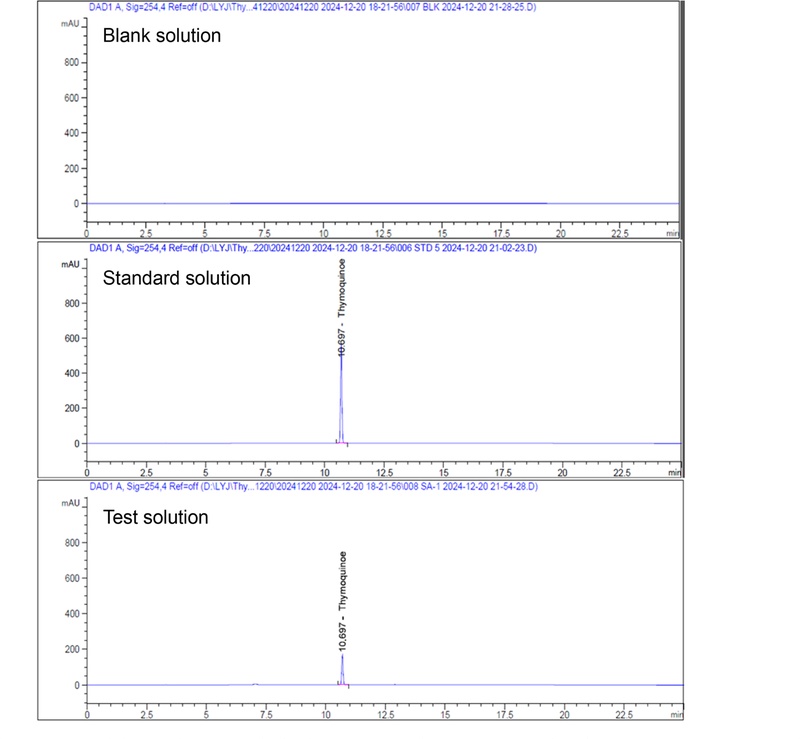
HPLC chromatogram of thymoquinone. Standard solution contains thymoquinone purchased from Sigma (Sigma Co.) and test solution contains prepared HT_01.

Quantitative analysis of main constituents of HT_01
Antibacterial activity against oral pathogens was measured using the disk diffusion method according to Korean Ministry of Food and Drug Safety and CLSI guidelines. The inhibition zone around the disks containing 50 μL of 10% HT_01 were 42.5 ± 2.5 mm for S. mutans, 41.4 ± 4 mm for P. gingivalis, 45 ± 3 mm for P. intermedia, and 28 ± 3 mm for F. nucleatum, indicating a strong concentration-dependent antibacterial effect. Because no inhibition zone was formed around DMSO, the solvent used to dilute HT_01, the antibacterial activity of HT_01 observed at various concentrations reflected the antibacterial activity of HT_01. Even in disks containing 50 μL of 1% HT_01, the lowest concentration of HT_01 used in the experiment, the antibacterial effect was similar to or slightly superior to that of the Gum Guard undiluted solution, confirming that the effect was superior to that of existing oral cleansers. As HT_01 is an oil, the highest concentration did not exceed 1%, and the MIC measurement results showed that the MIC of S. mutans was 0.06%, that of P. intermedia and P. nucleatum was 0.25%, and that of P. gingivalis was 1% (Table 2 and Fig. 2). Standardized HT_01 (ThymoQuin-O’Care) exhibited excellent antibacterial activity against major oral pathogens, including S. mutans, P. gingivalis, P. intermedia, and F. nucleatum.
Antibacterial activity of HT_01 against several oral pathogens
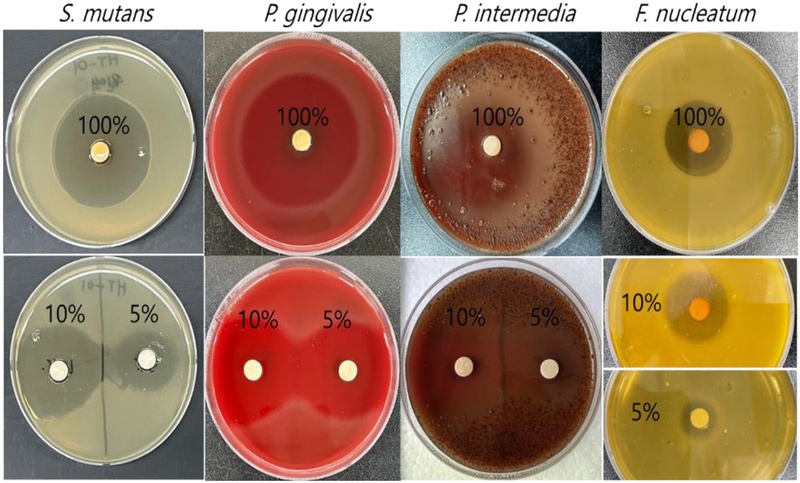
Zones of inhibition at different concentrations of Nigella sativa seed oil (HT_01) against oral pathogens.
Antibacterial activity against LAB was measured using the disk diffusion method according to Korean Ministry of Food and Drug Safety and CLSI guidelines. The experimental results showed that all five types of LAB were cultured under anaerobic conditions and grew without inhibition around the HT_01, DMSO, and Gum Guard disks (Table 3). Thus, these substances showed no anti-bacterial effects against beneficial LAB.
Antibacterial activity of HT_01 against oral probiotics
Acid production performance was measured according to the guidelines of the Korean Ministry of Food and Drug Safety. The pH of the culture supernatant of normal BHI medium, used as the control group, was 4.23 ± 0.05, confirming that S. mutans produced acid. In the DMSO 0.05% control group and GumGuard 0.05% group, normal acid production was confirmed at pH 4.32 ± 0.03 and 4.47 ± 0.02, respectively, indicating that acid production was not inhibited. HT_01 inhibited acid production in a concentration-dependent manner. At concentrations of 0.04% and 0.05%, the pH was 7.35 ± 0.02 and 7.21 ± 0.04, respectively, showing a neutral pH, confirming that acid production was completely inhibited (Fig. 3).
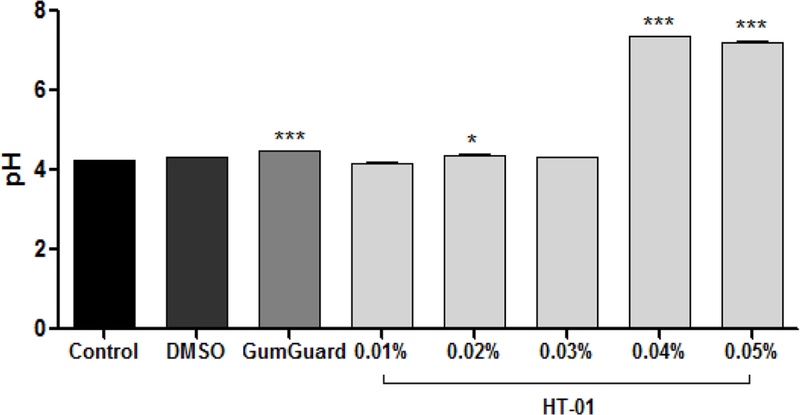
Inhibitory effect of Nigella sativa seed oil (HT_01) on the production of acid in Streptococcus mutans. All data were performed in triplicate and expressed as mean ± SD. *p < 0.05, **p < 0.01, ***p < 0.001 compared with control.
The S. mutans were cultured in BHI liquid medium containing 1% sucrose. The biofilm formed on the walls of the test tube was suspended in NaOH, and the absorbance was measured to compare the formed biofilms. The results confirmed that the absorbance decreased in a concentration-dependent manner in the presence of HT_01 and the turbidity of the culture medium decreased. This effect was attributed to the inhibition of biofilm formation by HT_01. In the case of the control group, the absorbance value was 1.22 ± 0.032, confirming that S. mutans formed a biofilm. Following DMSO treatment, the absorbance value was 0.783 ± 0.034, indicating that biofilm formation was approximately 64.2% of that in the control group. In the presence of 0.05% xylitol, the absorbance value was 0.909 ± 0.019, indicating that biofilm formation was approximately 74.5% of that in the control group. The absorbance value was 0.791 ± 0.068 in the 0.05% Gum Guard group, which was 64.8% of that in the control group. In the HT_01 0.01% group, biofilm formation was 73.9% compared to that in the control group, whereas this value in the HT_01 0.02% group was 68.7%. By contrast, biofilm formation was significantly inhibited in the 0.05% HT_01 group, even when the effect of DMSO was excluded (biofilm formation was 32.3 % compared to that of control) (Fig. 4).
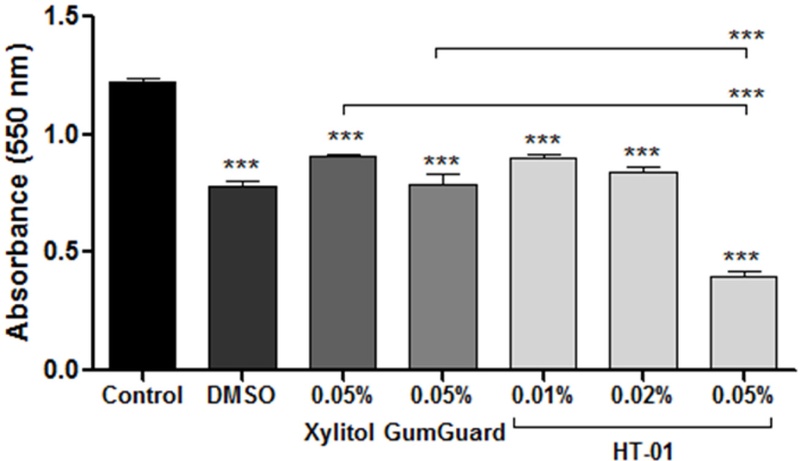
Inhibitory effect of Nigella sativa seed oil (HT_01) on the formation of biofilm in Streptococcus mutans. All data were performed in triplicate and expressed as mean ± SD. *p < 0.05, **p < 0.01, ***p < 0.001 compared with control.
Dental caries results from the breakdown of hydroxyapatite, a component of the hard tissue on the surface of teeth, by organic acids produced by carbohydrate metabolism of oral microorganisms, causing minerals such as calcium and phosphorus to escape and corrode the tooth surface to cause tooth damage.24 The representative pathogen that causes dental caries is S. mutans, a gram-positive facultative anaerobic bacterium that produces insoluble glucans and forms a hard biofilm. A biofilm formed on teeth, commonly called dental plaque, is a sticky, colorless thin film formed when bacteria adhere tightly to the tooth surface. Extracellular polymeric substances, as polymer complexes composed of DNA, proteins, and polysaccharides derived from bacteria, are involved in biofilm formation and are the main components of dental plaque.25 Additionally, once a biofilm forms, the bacteria forming the colony become resistant to antibiotics or attack by immune cells, making their removal difficult. Normal oral acidity is maintained at around pH 7.0–7.5 by saliva; however, following food consumption, carbohydrates are fermented by bacteria to produce acid, which causes the oral pH to decrease to below 7.0 and become acidic. In the case of S. mutans, it contributes not only to biofilm formation but also to acid production, resulting in deterioration of dental health. Particularly, when the pH in the mouth falls to below 5.5, hydroxyapatite crystals in the enamel break down or demineralize, causing dental caries.26 Therefore, controlling the production of organic acids and dental calculus, a type of biofilm that causes dental caries and gingivitis (the initial stage of periodontal disease), at an early stage is important for maintaining and improving oral health. Antibiotics, mouthwashes, and scaling are used to physically remove tartar and suppress pathogenic bacteria from the mouth. However, antibiotics can cause systemic side effects and lead to the emergence of resistant bacteria and superinfection in the oral cavity. Antibacterial agents such as ethanol, fluoride, chlorhexidine (cetylpyridium chloride), and methyl salicylate are used in mouthwashes but cannot be used long-term because of toxicity to the human body, emergence of resistant bacteria, and carcinogenicity. Scaling is a method of physically removing the tartar by a professional and is not an oral care method that can be performed during daily life. Therefore, agents that can be used for safe and continuous oral hygiene management and oral health promotion without adverse side effects on the teeth or gums are needed. To overcome these issues, recent studies have been conducted to confirm the antibacterial properties of plant-derived essential oils, such as thymol, eucalyptus oil, and menthol, against oral pathogenic bacteria.27 There is antibacterial data of BSO against S. aureus, E. coli and L. monocytogens, but there is no antibacterial data against oral pathogenic bacteria.28–29 In addition, HT_01, the material of this study, was obtained by cold pressing rather than organic solvent extraction method, completely eliminating the influence of solvent. In this study, we examined whether the BSO HT_01, which has long been used as a traditional medicine and mouthwash ingredient, can overcome the limitations of antibiotics and mouthwashes. Therefore, standardized HT_01, a BSO that has long been used as a natural product in traditional medicine to treat various diseases, may be suitable as an oral hygiene ingredient because of its strong antibacterial activity against common oral pathogens and its ability to inhibit acid production and biofilm formation by S. mutans.
Acknowledgments
This work was supported by the Technology development Program (RS-2024-00467570) funded by the Ministry of SMEs and Startups (MSS, Korea).
Conflicts of Interest
The authors declare that they have no conflict of interest.
References
-
Spanemberg, J. C.; Cardoso, J. A.; Slob, E. M. G. B.; López-López, J. J. Stomatol. Oral Maxillofac. Surg. 2019, 120, 234–239.
[https://doi.org/10.1016/j.jormas.2019.02.004]

-
Bhargava, N.; Jadhav, A.; Kumar, P.; Kapoor, A.; Mudrakola, D. P.; Singh, S. J. Pharm. Bioallied. Sci. 2021, 13, S387–S390.
[https://doi.org/10.4103/jpbs.JPBS_588_20]
- World Health Organization. Global oral health status report; Towards universal health coverage for oral health by 2030; WHO, 2020, pp 16–18.
-
Baiju, R. M.; Peter, E.; Varghese, N. O.; Sivaram, R. J. Clin. Diagn. Res. 2017, 11, ZE21–ZE26.
[https://doi.org/10.4103/jisp.jisp_144_17]
-
Wolf, T. G.; Cagetti, M. G.; Fisher, J. M.; Seeberger, G. K.; Campus, G. Front. Oral Health 2021, 2, 725460.
[https://doi.org/10.3389/froh.2021.725460]
-
Nicolas, G. G.; Lavoie, M. C. Can. J. Microbiol. 2011, 57, 1–20.
[https://doi.org/10.1139/W10-095]
- Noh, H.-J.; Park, S. Y. J. Health Info. Stat. 2002, 27, 50–65.
-
Kwon, J.-H.; Chang, M.-T.; Ryu, S.-H.; Kim, H.-S. J. Periodontal Implant Sci. 2000, 30, 203–211.
[https://doi.org/10.5051/jkape.2000.30.1.203]
-
Rosenberg, M.; Kulkarni, G. V.; Bosy, A.; McCulloch, C. A. J. Dent. Res. 1991, 70, 1436–1440.
[https://doi.org/10.1177/00220345910700110801]
-
Marsh, P. D. Microb. Ecol. Health Dis. 2000, 12, 130–137.
[https://doi.org/10.1080/089106000750051800]
-
Otsugu, M.; Nomura, R.; Matayoshi, S.; Teramoto, N.; Nakano, K. Infect. Immun. 2017, 85, e00401–e00417.
[https://doi.org/10.1128/IAI.00401-17]
-
Mohanty, R.; Asopa, S. J.; Joseph, M. D.; Singh, B.; Rajguru, J. P.; Saidath, K.; Sharma, U. J. Family Med. Prim. Care. 2019, 8, 3480–3486.
[https://doi.org/10.4103/jfmpc.jfmpc_759_19]
-
de Andrade, K. Q.; Almeida-da-Silva, C. L. C.; Coutinho-Silva, R. Mediators Inflamm. 2019, 24, 7241312.
[https://doi.org/10.1155/2019/7241312]
-
Ahmad, A.; Husain, A.; Mujeeb, M.; Khan, S. A.; Najmi, A. K.; Siddique, N. A.; Damanhouri, Z. A.; Anwar, F. Asian Pac. J. Trop. Biomed. 2013, 3, 337–352.
[https://doi.org/10.1016/S2221-1691(13)60075-1]
-
Kooti, W.; Hasanzadeh-Noohi, Z.; Sharafi-Ahvazi, N.; Asadi-Samani, M.; Ashtary-Larky, D. Chin. J. Nat. Med. 2016, 14, 732–745.
[https://doi.org/10.1016/S1875-5364(16)30088-7]
-
Chern, C. W.; Alan P. K.; Gautam S.; Tan, K. H. B. Biochem. Pharmacol. 2012, 83, 443–451.
[https://doi.org/10.1016/j.bcp.2011.09.029]
-
Chatterjee, G.; Saha, A. K.; Khurshid, S.; Saha, A. J. Med. Food. 2025, 325–339.
[https://doi.org/10.1089/jmf.2024.k.0149]
-
Noorbakhsh, M. F.; Hayati, F.; Samarghandian, S.; Shaterzadeh-Yazdi, H.; Farkhondeh, T. Recent Pat. Food Nutr. Agric. 2018, 9, 14–22.
[https://doi.org/10.2174/2212798410666180221105503]
-
Ebuehi, O. A. T.; Olowojaiye, A. A.; Erukainure, O. L.; Ajagun-Ogunleye, O. M. J. Food Biochem. 2020, 44, e13108.
[https://doi.org/10.1111/jfbc.13108]
- Çınar, İ.; Gıdık, B.; Dirican, E. Mol. Biol. Rep. 2024, 51, 491.
-
Tantivitayakul, P.; Kaypetch, R.; Muadchiengka, T. Arch. Oral Biol. 2020, 115, 104744.
[https://doi.org/10.1016/j.archoralbio.2020.104744]
- Clinical and Laboratory Standards Institute (CLSI). Performance standards for antimicrobial susceptibility testing, 30th ed., Informational Supplement. Document M100, CLSI, Wayne, PA, USA, 2020, pp 190–193.
- Korean Food & Drug Administration, Health functional food functional evaluation guide (civil petitioner's guide)-may help dental health; Ministry of Food and Drug administration. Republic of Korea, 2017, pp 20–23.
-
Meyer, F.; Wiesche, E. S. Z.; Amaechi, B. T.; Limeback, H.; Enax, J. Eur. J. Dent. 2024, 18, 766–776.
[https://doi.org/10.1055/s-0043-1777051]
-
Jakubovics, N. S.; Goodman, S. D.; Mashburn-Warren, L.; Stafford, G. P.; Cieplik, F. Periodontol. 2000 2021, 86, 32–56.
[https://doi.org/10.1111/prd.12361]
-
Moynihan, P.; Petersen, P. E.; Public Health Nutr. 2004, 7, 201–226.
[https://doi.org/10.1079/PHN2003589]
-
Wang, T.-H.; Hsia, S.-M.; Wu, C.-H.; Ko, S.-Y.; Chen, M. Y.; Shih, Y.-H.; Shieh, T.-M.; Chuang, L.-C.; Wu, C.-Y. PLoS One 2016, 11, e0163147.
[https://doi.org/10.1371/journal.pone.0163147]
-
Zouirech, O.; Alyousef, A. A.; El Barnossi, A.; El Moussaoui, A.; Bourhia, M.; Salamatullah, A. M.; Ouahmane, L.; Giesy, J. P.; Aboul-Soud, M. A. M.; Lyoussi, B.; Derwich, E. Biomed Res. Int. 2022, 2022, 5218950.
[https://doi.org/10.1155/2022/5218950]
-
Abo-Neima, S. E.; El-Sheekh, M. M.; Al-Zaban, M. I.; El-Sayed, A. I. M. BMC Microbiol. 2023, 23, 274.
[https://doi.org/10.1186/s12866-023-03018-1]