
3′-Oxo-dihydrophaseic Alcohol and Norisoprenoids from Combretum quadrangulare with Cytotoxicity against Human Liver Cancer Cells
Abstract
A new 3ʹ-oxo-dihydrophaseic alcohol (1), along with three known norisoprenoids (2–4), was isolated from the 70% ethanol extract of the aerial parts of Combretum quadrangulare through repeated column chromatography. The structure of the new compound was elucidated using extensive spectroscopic methods, including 1D and 2D NMR techniques. The isolated compounds (1–4) displayed cytotoxic activity against the HepG2 liver cancer cell line, with IC50 values in the range of 18.8–32.5 μM. The results provide insights into the structure–activity relationships of norisoprenoids and their potential as anticancer agents.
Keywords:
Combretum quadrangulare, Combretaceae, 3ʹ-Oxo-dihydrophaseic alcohol, Norisoprenoid, HepG2Introduction
The medicinal plant Combretum quadrangulare Kurz (Combretaceae) has long held a place in Southeast Asian ethnomedicine, traditionally used to address various conditions such as febrile illnesses, gastrointestinal infections, and liver dysfunction. Indigenous communities across countries including Vietnam, Myanmar, and Thailand have employed extracts from this species in herbal formulations for generations.1,2 Based on such traditional uses, ongoing research has been exploring the phytochemical composition and biological properties of C. quadrangulare from a modern pharmacological perspective. The genus Combretum comprises several hundred species that are known to produce a wide array of structurally diverse secondary metabolites. Among them, flavonoids, lignans, and terpenoids have been particularly well studied for their broad biological activities, including antimicrobial, anti-inflammatory, and cytotoxic effects.2,3 As part of our ongoing search for bioactive constituents from medicinal plants, we investigated the aerial parts of C. quadrangulare, which led to the isolation of a previously undescribed compound, 3ʹ-oxo-dihydrophaseic alcohol (1), along with three known norisoprenoids (2–4). Their structures were elucidated by comprehensive spectroscopic methods, including 1D and 2D NMR. In addition, considering the traditional use of C. quadrangulare for liver-related disorders,2 the cytotoxicity of the isolated compounds was evaluated against the human hepatocellular carcinoma cell line HepG2 to assess their potential anticancer effects. The results provide preliminary insights into the structure-activity relationships of the isolated compounds.
Experimental
General experimental procedures – TLC was conducted on both silica gel 60 F254 and RP-C18 plates (Merck, Darmstadt, Germany), and spots were visualized by spraying with 10% sulfuric acid solution. Milli-Q grade water (Waters Corporation, Milford, MA, USA) was used throughout the experiments. Silica gel (40–60 μm, 230–400 mesh; Merck, Darmstadt, Germany) was used for column chromatography. MPLC was performed using a Biotage Isolera One system (Biotage, Uppsala, Sweden), equipped with reversed-phase C18 silica gel (Cosmosil, Kyoto, Japan). Preparative HPLC was carried out using a Gilson 321 pump combined with a Gilson 172 diode array detector (Gilson, Madison, WI, USA), employing a Luna C18 column (250 × 10 mm, 5 μm; Phenomenex, CA, USA). HR-MS data were acquired using a Waters Xevo G2 Q-TOF instrument (Waters, Medford, MA, USA). NMR spectra were recorded using multiple spectrometers: JEOL JNM-ECA AVANCE 400 and 600 MHz (JEOL Ltd., Tokyo, Japan), and Bruker AVANCE 500 MHz (Bruker, Karlsruhe, Germany). UV spectra were measured using a Chirascan-Plus ECD spectrometer (Applied Photophysics Ltd., Tokyo, Japan), and optical rotation was determined using a JASCO P-2000 polarimeter (JASCO, Tokyo, Japan). FT-IR spectra were obtained with a JASCO FT/IR-4700 spectrometer.
Plant materials – Aerial parts of C. quadrangulare were collected from Ninh Son District, Ninh Thuan Province, Vietnam (11°38′18.3″N, 108°52′53.7″E) on March 13, 2016. The plant material was taxonomically identified by Dr. Luong Van Dung of the Center for Biodiversity and Climate Change Research, Dalat University (Dalat, Vietnam), based on morphological characteristics. A voucher specimen (accession no. NIBRVP0000821147) has been deposited in the herbarium of the National Institute of Biological Resources (Incheon, Korea).
Extraction and isolation – The dried leaves and twigs of C. quadrangulare (1.0 kg) were extracted three times with 70% ethanol (3 h each). The combined extracts were concentrated in vacuo at 40℃ to yield a crude extract (310.8 g). The extract (310.8 g) was suspended in 1.2 L of distilled water and successively partitioned three times each with CHCl3 (1.2 L) and n-butanol (1.2 L), resulting in CHCl3-, n-butanol-, and water-soluble fractions. The butanol-soluble extract (30.3 g, CQB) was chromatographed on silica gel column chromatography with gradient mixtures of hexane-EtOAc (5:1 to 1:1) and then CHCl3-MeOH (10:1 to 1:1), to afford 6 sub-fractions (CQB-1 to CQB-6). The fraction CQB-3 (256.3 mg) was chromatographed on silica gel column chromatography with gradient mixtures of hexane-EtOAc (10:1 to 1:1) and then CHCl3-MeOH (5:1 to 1:1), to afford 7 sub-fractions (CQB-3A to 3G). The fraction CQB-3D (43.1 mg) was purified by HPLC [MeCN-H2O (15:85) for 50 min, then 100% MeCN for 5 min, isocratic elution, 3.0 mL/min] to afford compound 1 (tR 46.83 min, 1.2 mg).
The CHCl3-soluble fraction (5.7 g, designated CQC) was subjected to silica gel column chromatography using a gradient of hexane–EtOAc (20:1 to 1:1), followed by CHCl3–MeOH (10:1 to 3:1), to afford eight subfractions (CQC-1 to CQC-8). Fraction CQC-5 (685.0 mg) was further separated by MPLC on RP-C18 silica gel using a gradient of MeOH–H2O (5:95 to 80:20), yielding 14 subfractions (CQC-5A to CQC-5N). Subfraction CQC-5C (26.5 mg) was purified by HPLC [MeCN-H2O (20:80) for 25 min, followed by 100% MeCN for 5 min, isocratic, 3.0 mL/min] to afford compound 2 (tR = 23.15 min, 1.5 mg). Fraction CQC-7 (2,451.3 mg) was also subjected to MPLC on RP-C18 silica gel using a MeOH-H2O gradient (0:100 to 60:40), yielding 11 subfractions (CQC-7A to CQC-7K). Fraction CQC-7A (312.6 mg) was chromatographed on a Sephadex LH-20 column using MeOH, giving three subfractions (CQC-7A1 to CQC-7A3). Subfraction CQC-7A1 (102.3 mg) was purified by HPLC [MeCN-H2O (15:85) for 45 min, followed by 100% MeCN for 5 min, isocratic, 3.0 mL/min] to yield compound 3 (tR = 44.75 min, 1.9 mg). Similarly, CQC-7C (147.4 mg) was subjected to HPLC [MeCN-H2O (25:75) for 15 min, followed by 100% MeCN for 5 min, isocratic, 3.0 mL/min], affording compound 4 (tR = 15.81 min, 0.9 mg).
(1E, 3E, 1ʹR, 5ʹR, 8ʹS)-3′-oxo-dihydrophaseic alcohol (1) – White amorphous powder; +17.2 (c 0.10, MeOH); UV (MeOH) λmax (log ε) 265 (4.2) nm; ECD (MeOH) λmax (Δε) 234 (−5.97), 270 (4.35) nm; IR (ATR) νmax 3451, 2973, 2945, 2872, 2837, 1712, 1639, 1603, 1517, 1452, 1381, 1339, 1243, 1166, 1055, 1026, 1012 cm-1; 1H- and 13C-NMR (MeOD), see Table 1; HR-ESI-MS m/z 251.1282 [M−H]− (calcd. for C14H19O4, 251.1283)

1H- and 13C-NMR data of compound 1 in MeOH-d4, recorded at 400 MHz (δH and δC in ppm)
Computational ECD methodology – Preliminary geometries of compound 1 were generated using Chem3D software and subjected to conformational searches in Spartan 16 program. The searches were carried out employing the MMFF94 molecular force-field. Conformers with a predicted population above 95% were selected for further analysis. These conformers were subsequently optimized, and their vibrational frequencies were calculated using density functional theory (DFT) at the mPW1PW91/6-31+G (d, p) basis set with the CPCM model (methanol) in Gaussian 16 software (Gaussian Inc., Wallingford, CT, USA). The ECD spectra of the optimized conformers were calculated using time-dependent DFT (TDDFT) under the same conditions as the geometry optimization, considering the 10 excitations. The resulting spectra were combined according to Boltzmann-weighted contributions based on Gibbs free energies. The combined ECD curves were then adjusted for sigma/gamma values and UV correction using SpecDis 1.70.1 software [shifting = 30 nm, sigma/gamma value = 0.30 eV for compound 1]. The calculated ECD spectra were finally compared with the experimental spectra for configuration assignment.
Cell culture – The HepG2 human liver cancer cell line (ATCC, USA) was cultured in MEM supplemented with EBSS, 10% FBS, and 100 U/mL penicillin/streptomycin at 37℃ in a humidified 5% CO₂ atmosphere. All procedures followed the same conditions as our previous study.4,5 MEM/EBSS, FBS, and antibiotics were obtained from Hyclone (Logan, USA).
Cytotoxicity assay – Cell viability was assessed in HepG2 cells using the WST-8 assay kit (GenDEPOT, USA) according to the manufacturer’s instructions. The assay procedure followed our previous study,4,5 except that compound treatment was extended to 72 hours instead of 24 hours. Doxorubicin was included as a positive control.
Statistical analysis – Statistical comparisons among multiple groups were conducted using one-way ANOVAs, followed by Dunnett’s test as the post-hoc test. Differences between groups were deemed significance at p < 0.05 (*p < 0.05, **p < 0.01, ***p < 0.001), and all values are presented as mean ± S.E.M. (standard error of the mean). Data obtained from studies performed in cell lines are representative of three independent experiments.
Results and Discussion
Compound 1 was obtained as a white amorphous powder. The molecular formula was determined to be C14H20O4 from the molecular ion peak [M−H]− at m/z 251.1282 (calcd. for C14H19O4, 251.1283) in the negativeion HRESIMS. The IR spectrum showed absorptions characteristic of hydroxy (3451 cm-1) and ketone groups (1712 cm-1). The 1H NMR spectrum displayed signals corresponding to three methyl groups at δH 2.06 (3H, s), 1.21 (3H, s) and 1.01 (3H, s), two oxymethylene protons at δH 3.94 (1H, d, J = 7.6 Hz) and 3.66 (1H, d, J = 7.6 Hz), four methylene protons at δH 2.81 (1H, d, J = 17.9 Hz), 2.71 (1H, dd, J = 18.0, 2.5 Hz), 2.46 (1H, dd, J = 17.9, 2.5 Hz) and 2.38 (1H, dd, J = 18.0, 2.5 Hz), and three olefinic protons at δH 8.08 (1H, d, J = 15.9 Hz), 6.44 (1H, d, J = 15.9 Hz), and 5.80 (1H, s). In the 13C NMR spectrum revealed, 13 carbon resonances, three methyl carbons at δC 21.2, 19.5 and 15.9, two methylene carbons at δC 54.1 and 53.3, one oxygenated methylene carbon at δC 78.7, three olefinic carbons at δC 133.3, 133.1 and 120.6, and four quaternary carbons at δC 211.1, 150.5, 87.9 and 83.1. These spectral data suggested that 1 was to be a dihydrophaseic acid derivative.6 Key HMBC correlations (Fig. 2) were detected from Me-10′ to C-1ʹ, C-2′, and C-8′; from Me-9′ to C-4′, C-5′, C-7′, and C-8′; and from H2-2′/H2-4′ to C-3. Together with correlations from H-7′ to C-1′, C-4′, C-8′, and C-9′, these data established an oxygenated methylene-bridged cyclohexane moiety. Additionally, the 1H-1H COSY correlation between H-3 and H-4 (Fig. 2), along with HMBC correlations from H-4 to Me-5 and C-8ʹ, from Me-5 to C-2, and from H-3 to C-1 confirmed the structure of the side chain in compound 1.
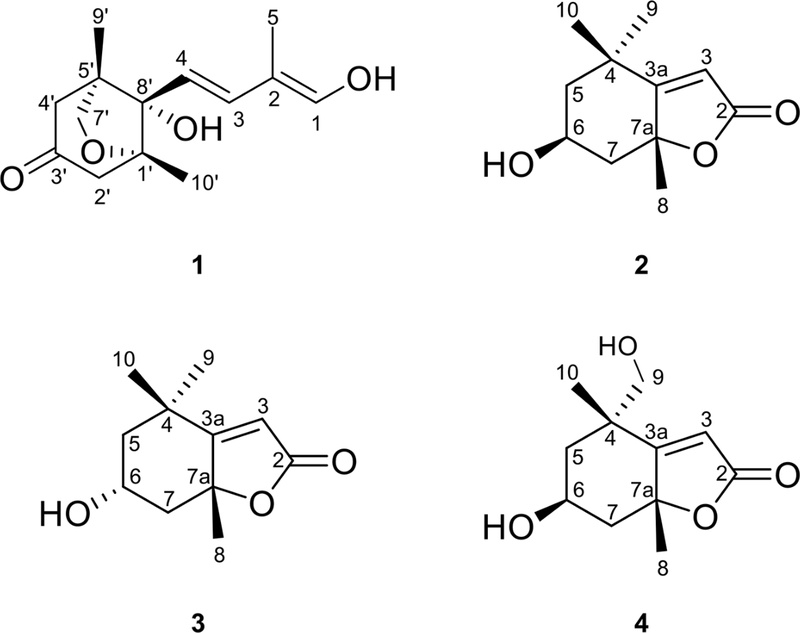
The structures of 1–4 isolated from C. quadrangulare.
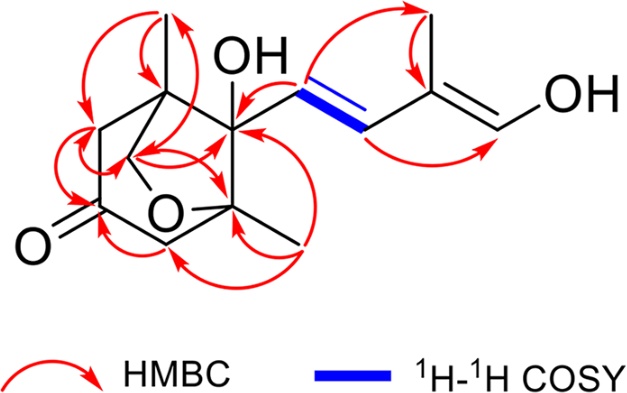
Key COSY and HMBC correlations of 1.
The relative configuration of compound 1 was determined by analysis of NOESY spectra (Fig. 3). NOESY correlations between H-2ʹax, H-4ʹax, and H-8ʹ indicated that these protons are oriented in the same direction (β-position). In contrast, the oxymethylene protons of H-7ʹendo showed correlations with H-2ʹeq and H-4ʹeq, indicating that they are positioned on the opposite face (α-position) of the bridged cyclohexane ring. Furthermore, for the attached methylpenta-1,3-dien-1-ol moiety, the large coupling constant (15.9 Hz) of the olefinic protons indicated that the double bond between C-3 and C-4 adopts a trans configuration.
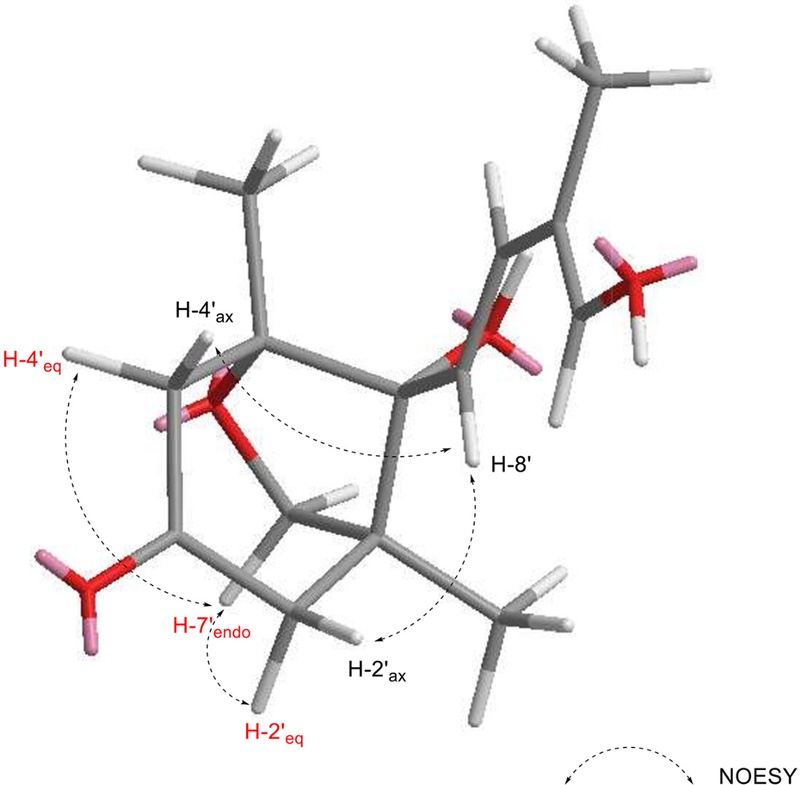
Key NOESY correlations of 1.
The final absolute configuration of compound 1 was determined by comparing its experimental ECD spectrum with the calculated spectra. Based on the relative configuration obtained from NOESY data, two possible stereoisomers were considered: 1a (1E, 3E, 1ʹR, 5ʹR, 8ʹS) and 1b (1E, 3E, 1ʹS, 5ʹS, 8ʹR). ECD calculations were performed for all atoms of both candidates using time-dependent density functional theory (TD-DFT). The calculated ECD spectrum of isomer 1a closely matched the experimental data, showing a negative Cotton effect at 234 nm and a positive Cotton effect at 270 nm (Fig. 4). This strong agreement confirmed that compound 1 possesses the 1E, 3E, 1ʹR, 5ʹR, 8ʹS configuration, and it was thus designated as (1E, 3E, 1ʹR, 5ʹR, 8ʹS)-3ʹ-oxo-dihydrophaseic alcohol.
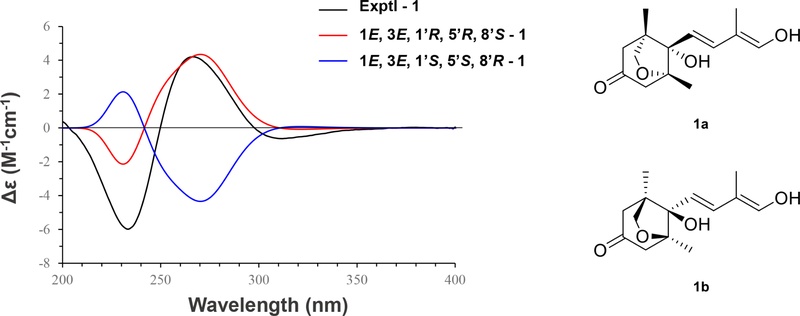
(A) Experimental and calculated ECD spectra of compound 1 and (B) the structures of 1a and 1b.
Three known compounds—loliolide (2), epi-loliolide (3), and (−)-10-hydroxydihydroactinidiolide (4)—were identified (Table 2) by comparison of their spectroscopic data with literature values (Fig. 1).7,8 To the best of our knowledge, this is the first report of these compounds from the genus Combretum.
1H and 13C NMR data of compounds 2–4 in CDCl3 (δH and δC in ppm)
The cytotoxic activities of compounds 1–4 were evaluated, and their IC50 values were determined to be 18.8, 23.6, 24.3, and 32.5 μM, respectively (Table 3). Compound 1, 3ʹ-oxo-dihydrophaseic alcohol, showed the strongest activity. The presence of the oxygenated methylene-bridged cyclohexane moiety (C-1′–C-7′) together with the conjugated dienol side chain (C-3/C-4) may account for its enhanced potency compared to the loliolide-type lactones.
Cytotoxic activities of compounds 1–4 against HepG2 cells determined by WST assay. Data are expressed as IC₅₀ values (μM, mean ± SD, n = 3 independent replicates)
Within the loliolide-type compounds, 2 and 3 displayed comparable activity despite their different stereochemistry around the lactone moiety, suggesting that variation at these stereocenters has little influence. In contrast, compound 4, bearing an additional hydroxyl group at C-9, appears to be associated with the reduced activity observed.
Overall, compound 1 represents the most potent scaffold, while compounds 2 and 3 exhibited comparable activity regardless of stereochemistry. In contrast, the additional hydroxyl group at C-9 in compound 4 was associated with reduced activity. These findings provide valuable insights into the structure–activity relationships of the isolated compounds from C. quadrangulare.
Acknowledgments
This research was supported by grants from the National Institute of Biological Resources (NIBR), funded by the Ministry of Environment (MOE) of the Republic of Korea (NIBR202207102 and NIBR202506102) and National Research Foundation of Korea (NRF), funded by the Korean government (MSIT) (RS-2024-00410675).
Conflicts of Interest
The authors declare that they have no conflicts of interest.
References
-
de Morais Lima, G. R.; de Sales, I. R. P.; Caldas Filho, M. R. D.; de Jesus, N. Z. T.; de Sousa Falcão, H.; Barbosa-Filho, J. M.; Cabral, A. G. S.; Souto, A. L.; Tavares, J. F.; Batista, L. M. Molecules 2012, 17, 9142–9206.
[https://doi.org/10.3390/molecules17089142]

-
Banskota, A. H.; Tezuka, Y.; Tran, Q. L.; Kadota, S. Curr. Top. Med. Chem. 2003, 3, 227–248.
[https://doi.org/10.2174/1568026033392516]
-
Toume, K.; Nakazawa, T.; Ohtsuki, T.; Arai, M. A.; Koyano, T.; Kowithayakorn, T.; Ishibashi, M. J. Nat. Prod. 2011, 74, 249–255.
[https://doi.org/10.1021/np100784t]
-
An, C.-Y.; Son, M.-G.; Chin, Y.-W. ACS Omega 2023, 8, 32804–32816.
[https://doi.org/10.1021/acsomega.3c03873]
-
An, C.-Y.; Pel, P.; Bae, M.; Park, C.-W.; Kwon, H.; Lee, H. S.; Dung, L. V.; Kim, C.; Lee, D.; Choi, Y. H.; Chin, Y.-W. Phytochemistry 2025, 230, 114330.
[https://doi.org/10.1016/j.phytochem.2024.114330]
- Yang, H.; Gan, C.; Guo, Y.; Qu, L.; Ma, S.; Ren, Y.; Wang, X.; Wang, L.; Huang, J.; Wang, J. Nat. Prod. Res. 2022, 36, 3389–3395.
-
Morais, A. M. M. B.; Kumla, D.; Martins, V. F. R.; Alves, A.; Gales, L.; Silva, A. M. D.; Costa, P. M.; Mistry, S.; Kijjoa, A.; Morais, R. M. S. C. Molecules 2024, 29, 5175.
[https://doi.org/10.3390/molecules29215175]
-
Huang, X.; Xu, N.; Liu, Z.; Li, H.; Lu, H.; Li, J. Chem. Biodivers. 2024, 21, e202400946.
[https://doi.org/10.1002/cbdv.202400946]